In Beyond the Limits, the twenty-year sequel to The Limits to Growth, the researchers make a distinction between development and growth, and write:
In the rich world, economic growth is believed to be necessary for employment, social mobility, and technical advance. In the poor world, economic growth seems to be the only way out of poverty. And a poor family sees that many children can be a source not only of joy, but also of hope for economic security. Until other solutions are found for the legitimate pproblems of the world, people will cling to the idea that growth is the key to a better future, and they will do all they can to produce more growth.
We should recognize that there's a certain amount of hurry-up involved too.
Showing posts with label Limits to Growth. Show all posts
Showing posts with label Limits to Growth. Show all posts
Sunday, November 13, 2011


Tuesday, November 1, 2011
George Papandreou And The Limits To Growth
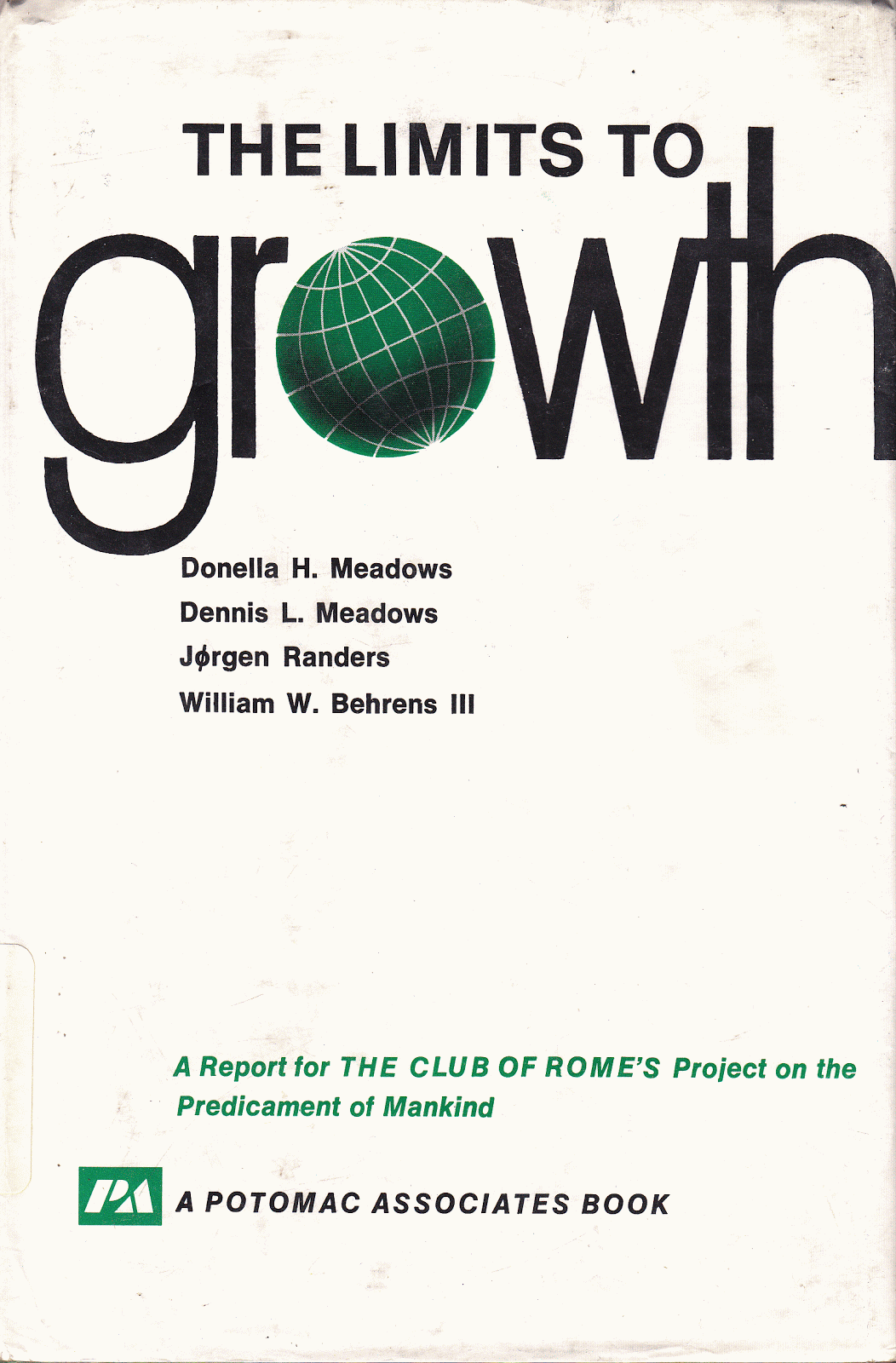

LTG was the popular summary of an MIT study that modeled the interactions between population, food production, industrialization, pollution, and non-renewable resources in the world economy. There were about a hundred variables, and the researchers were looking to see what would make the system grow, collapse, or oscillate.
St. Paul native, and Greek Prime Minister, George Papandreou has called for a referendum on his country's proposed European bailout. The trade is austerity for 110 billion Euros. Service contributes 78.8% of GDP, and the public sector accounts for 40% of jobs. Oops.
If anything can save us, it probably won't come from public policy, but maybe a country with a severely straitened economy could afford to tell the industrial economy to "Take a hike. We're going to see how many of us can keep eating."
Wednesday, December 9, 2009
Pictures Of Winter In Minneapolis


On the other hand, a piece in the magazine Ode (for rich people with compact fluorescent lamps) got my Irish up, and an answer came immediately to mind. Brian O’Neill, of Spiked, a British Internet magazine, wrote five hundred or so words under the headline “Who’s Afraid of Billions of People.” He says, “No limits should be set on population growth. I hope in my lifetime the human population on Earth will reach the tens of billions, and it won’t be a problem if it rises to hundreds of billions.” (An Irishman wants more children. Swate sooferin’ Jaysuss! I don't think I can eat that many babies.)
Here’s his case: Efforts to limit reflect a lack of faith in human ingenuity. If you believe in civilization you shouldn’t worry about carrying capacity, because we can figure out how to feed ourselves. More people equal more brains. The population control and reduction lobby has been around since Malthus, and keeps changing its rationale. Malthus said that food supply increases arithmetically, while population increases geometrically. O’Neill says that Malthus didn’t count on the technological innovations of the last two hundred years. Population lobbyists of the early twentieth century were racists and eugenecists, and current anti-birthers want to protect Mother Earth, but whatever our stated reasons, we really don’t have faith in ourselves. We are disingenuous because we say that the planet has a fixed carrying capacity. He points to uranium, which was known to ancients as a mere tint for glass. He says we inhabit only a tiny fraction of the planet’s surface. He finishes by saying, “Anyone who thinks people are a good thing rather than a menace, and believes we can find solutions to our problems, should reject the population control argument and make the case for full freedom of choice on reproductive matters.”
Thank you, Mr. Rand.
Around 1963, Buckminster Fuller said that all of the world’s population, about half what it is now, could be inside, in New York City, doing the Twist. I don’t know how he figured all of that city’s floor space, but okay... I wondered about now. I did the Twist in my kitchen, and measured the area required, sixteen square feet. I multiplied sixteen by 6.8 billion, divided by the number of square feet in a square mile, and got Iceland. Imagine, every wonderful ingenious (and ingenuous) human soul dancing to the music of Chubby Checker, under the midnight sun. The volcanoes would probably erupt.
Look, I understand that you can’t prove a negative, and I don’t want to be like those nineteenth century scientists that didn’t think we could survive speeds of sixty miles an hour, or build flying machines, but here’s the deal. We need various resources, metals, soil for growing food, etc. We took the easy stuff first. We started out getting iron from hematite, now we’re down to taconite. It takes more energy to use the resources we’ve left ourselves with, and we’re running out of high-quality fuels.
Maybe we can jump off cliffs and sprout wings, but I don’t think so. Maybe we can make energy from water and sand, but you need electricity to get hydrogen from water, and the energy return on investment for photovoltaics is about eight percent.
The Green Revolution did increase crop production per acre, but at the cost of reducing it per calorie, and production per acre has stalled, as energy has become dear. We might increase land under production, but once again, we started with the best land. O’Neill says that forty-six percent of British land is used for agriculture, and eleven or twelve is wooded. His context here implies that there are still plenty of places to stack Brits, but this raises the issue of opening new land (the other forty-two or forty-three percent) to agriculture production. I’m all for eliminating lawns, but is that what O’Neill is calling for?
His comment about people’s, thousands of years ago, thinking of uranium merely as an interesting rock, makes me wonder if O’Neill thinks ingenuity equals nuclear power. I’m not as excitable about ticking Geiger counters as a lot of people, but I have to insist that there are problems with nukes that I haven’t heard solved, and there’s not a whole lot of precedent among the other species for playing with radiation. Nuclear power’s energy return on investment is about three percent.
I believe in human ingenuity, too, but I’ve driven enough miles in city traffic, and watched enough people ignore exercise etiquette at the gym, to take it for granted. And don’t forget the US’s 108th Congress. I believe in human ingenuity. I yearn for it. But when it comes, there’s only so much it can do.
(Thanks to Marissa for the Jonathan Swiftie!)
Subscribe to:
Posts (Atom)