I'm a space cowboy, which ain't a fer real cowboy, but it's pretty real. Yeah, it's real. Man.
Gotta credit Steve Miller for the phrase, maybe a better word for hippie, and it ain't that bad of a song:
All you back room schemers and small trip dreamers
Better find something new to say
Cause you're the same old story
It's the same old crime
And you got some heavy dues to pay.
What it's really about was in 1957, I'm sitting in my pajamas, Mattel Fanner Fifty strapped to my thigh, half pint ten gallon hat on my head, and I'm watching Have Gun Will Travel on Saturday night. Fast forward a dozen years, and Neil Armstrong is conquering the moon, I'm dropping acid like popcorn, in protest of the Vietnam War.
I'm sure you know where it's at.
Thursday, November 29, 2012


Wednesday, November 28, 2012
Quotes From "Angels"
A couple of quotes from VIII Metalogue: "Secrets" in Angels Fear, by Gregory and Mary Catherine Bateson. The Metalogues were dialogues between "Father" and "Daughter." Most of them were written by Gregory ("Father"), but this one is by Mary Catherine ("Daughter"), written after Gregory's death. Neither quote is the main point of the Metalogue, or even complete thoughts, just kind of interesting.
"We have so largely lost track of the sacred that we are becoming incapable of committing sacrilege."
"The story is about the need to limit or control knowledge or communication across species lines and across gender lines -- the basic discontinuities of natural history."
Mary Catherine put both quotes in Gregory's mouth.
"We have so largely lost track of the sacred that we are becoming incapable of committing sacrilege."
"The story is about the need to limit or control knowledge or communication across species lines and across gender lines -- the basic discontinuities of natural history."
Mary Catherine put both quotes in Gregory's mouth.
Tuesday, November 27, 2012
Human Progress Real!
Sometimes I wonder if there really is progress, or if we just keep rearranging the furniture. I mean, finally there's going to be entropy, but you can arrange it so that some subsystem of the universe prospers by increasing entropy in the rest of the big system.
Life miraculously does this. According to Newton, you and I are not really supposed to be here. But from the human point of view, can we learn as a species and find a way to live with each other and the rest of nature?
Somebody, maybe Derek Jensen or Jared Diamond, suggested that agriculture was humanity's biggest mistake. With ag, we got hierarchies, private property, women and children as chattel, war, slavery, depleted soil, the beginnings of all the heartaches that we wonder and anguish over in the 21st century.
As agriculture outpaced forager depletion of the environment, industry has outpaced agriculture. The best, most nearly complete model of the world economy predicted economic collapse in this century, absent certain changes. There may be cameras on Mars and a Worldwide Web, but things like that happen at a cost.
I'm working on some projects that I think demonstrate human progress.
I'm working to bring Nora Bateson's cinematic portrait of her father Gregory, An Ecology of Mind, to the Twin Cities. Bateson thought that an epistemology that was neither superstitious nor materialistic could bring us into a relationship with our planet that could last and make us happy. The trick will be to get a speaker to answer questions. Bateson was a very -- um -- knowledgeable fellow and can be hard to follow.
I'm helping neighbors to build relationships in south Minneapolis that we hope will allow a smooth transition from an oil economy to one that will let us thrive on down the corridors of time.
My current Face of Wisdom for Zenith City Weekly is Dimitri Mendeleev. Mendeleev took the handful of elements isolated by the 1860s, and arranged them as we know them in the Periodic Table, leaving spaces for elements remaining to be discovered. In other words, Dimitri took the dribs and drabs that had been discovered, and teased out their relationships. He gave us the beginning of a theory of matter!
List other global understandings of existence: genetics from Mendel to the Human Genome Project, quantum mechanics, cybernetics, chaos theory, natural selection, ecology. These indicate progress in that our noodling around and trying to understand every single thing by itself has given us a comprehensive and accurate understanding of our place in the universe.
Life miraculously does this. According to Newton, you and I are not really supposed to be here. But from the human point of view, can we learn as a species and find a way to live with each other and the rest of nature?
Somebody, maybe Derek Jensen or Jared Diamond, suggested that agriculture was humanity's biggest mistake. With ag, we got hierarchies, private property, women and children as chattel, war, slavery, depleted soil, the beginnings of all the heartaches that we wonder and anguish over in the 21st century.
As agriculture outpaced forager depletion of the environment, industry has outpaced agriculture. The best, most nearly complete model of the world economy predicted economic collapse in this century, absent certain changes. There may be cameras on Mars and a Worldwide Web, but things like that happen at a cost.
I'm working on some projects that I think demonstrate human progress.
I'm working to bring Nora Bateson's cinematic portrait of her father Gregory, An Ecology of Mind, to the Twin Cities. Bateson thought that an epistemology that was neither superstitious nor materialistic could bring us into a relationship with our planet that could last and make us happy. The trick will be to get a speaker to answer questions. Bateson was a very -- um -- knowledgeable fellow and can be hard to follow.
I'm helping neighbors to build relationships in south Minneapolis that we hope will allow a smooth transition from an oil economy to one that will let us thrive on down the corridors of time.
My current Face of Wisdom for Zenith City Weekly is Dimitri Mendeleev. Mendeleev took the handful of elements isolated by the 1860s, and arranged them as we know them in the Periodic Table, leaving spaces for elements remaining to be discovered. In other words, Dimitri took the dribs and drabs that had been discovered, and teased out their relationships. He gave us the beginning of a theory of matter!
List other global understandings of existence: genetics from Mendel to the Human Genome Project, quantum mechanics, cybernetics, chaos theory, natural selection, ecology. These indicate progress in that our noodling around and trying to understand every single thing by itself has given us a comprehensive and accurate understanding of our place in the universe.
Monday, November 26, 2012
Growing The American Economy
In the recent presidential election, one side said that the way to grow the stalled economy was to relieve employers of the burdens of taxation and regulation, while the other said that getting new money into the budgets of middle class families would do the same thing by increasing markets for the employers to sell to.
"How do we grow our stalled economy?" is the wrong question.
A better one is, "How do we assure 300 million Americans of livelihoods, now that the economy has grown as far as it will?"
"How do we grow our stalled economy?" is the wrong question.
A better one is, "How do we assure 300 million Americans of livelihoods, now that the economy has grown as far as it will?"
Sunday, November 25, 2012
Deliverance And Integrity
Spent Thanksgiving with my family in Macomb, Illinois.
We celebrated at a rented lodge, four buildings in the woods built by a demented millionaire during the 1920s. It belongs to the university today, and a previous guest left a copy of James Dickey's Deliverance.
Dickey's great; everything in the story is imagined accurately and in scrupulous detail.
Ed Gentry -- the Jon Voigt character in the movie -- tells the tale. He is a partner in a pre-computer graphic design firm, and comfortably trapped.
Ed's friend Lewis -- the Burt Reynolds character -- manages inherited rental properties. Explaining to Drew, another suburban businessman, why Drew should prefer to share a canoe with Lewis, Ed tells him, "Fine. But you probably ought to know that he can handle a canoe pretty well, and I can't. He's strong as the Devil, too, and he's in shape. I'm not." Drew says, "I'm a-goin' with you, and not Mr. Lewis Medlock. I done seen how he drove these roads he don't know nothing about."
Ed introduces himself in the book's first section. "Before," and early in the second section, "September 14." Several of September 14's pages are a conversation that introduces Lewis. It's Friday morning and Ed and Lewis are in one of two cars, headed into the mountains to canoe a wild river that will soon be dammed for development.
" 'I had an air-raid shelter built,' he said. 'I'll take you down there sometime.' " Deliverance was published in 1970, when bomb shelters were already an anachronism, but Dickey may have been working on the novel for several years, and the shelter doesn't make another appearance. " 'I decided that survival was not in the rivets and the metal, and not in the double-sealed doors, and not in the marbles of Chinese Checkers. It was in me. It came down to the man, and what he could do. The body is the one thing you can't fake; it's just got to be there.' "
They drive on and Lewis tells Ed that he would move to the mountains, hunt and farm, if there were a nuclear war.
" 'Oh, I don't know,' I said. 'If you wanted to, you could go up in the hills and live right now. You could have all those same conditions. You could hunt. You could farm. You could suffer just as much as if they dropped the H-bomb. You could even start a colony, How do you think Carolyn would like that life?'
" 'It's not the same.' Lewis said. 'Don't you see? It would just be eccentric. Survival depends -- well, it depends on having to survive. The kind of life I'm talking about depends on it's being the last chance. The very last of all.'
" 'I hope you don't get it,' I said. 'It's too big a price to pay.'
" 'No price is too big,' Lewis said, and I knew that part of the conversation was over."
There's a piece of foreshadowing later in this conversation. They are talking about the integrity of fitting into your own fantasy. Both men have hunting bows.
" 'There're lots of other kinds of people to be than what you are,' I said.
" 'Sure there are, But this is my kind. It feels right, like when you turn loose the arrow, and you know when you let go that you've done everything right. You know where the arrow is going. There's not any other place that it can go.' "
Two days later, Lewis is lying on a beach at the bottom of the river gorge, with a compound fracture, and Ed has to scale a cliff, stalk a woodsman who has sodomized one canoeist and killed another. He must save his own life, Lewis' and the rape victim's by killing the man with bow and arrow.
At the critical moment, the man realizes he is in Ed's sights, and faces him. Ed's concentration evaporates, and he lets the arrow fly. It hits the man, but Ed falls from the tree he's used as a blind, breaking his bow and putting an arrow through his own side.
The man shoots at him, and Ed hides behind a rock. He watches his victim's agony, wishing death would end it. Ed passes out, and wakes to find the man gone. He follows the trail of blood to the woodsman's corpse, and can't be sure that he's killed the right man.
" '...you know when you let go that you've done everything right. You know where the arrow is going. There's not any other place that it can go.' "
We celebrated at a rented lodge, four buildings in the woods built by a demented millionaire during the 1920s. It belongs to the university today, and a previous guest left a copy of James Dickey's Deliverance.
Dickey's great; everything in the story is imagined accurately and in scrupulous detail.
Ed Gentry -- the Jon Voigt character in the movie -- tells the tale. He is a partner in a pre-computer graphic design firm, and comfortably trapped.
Ed's friend Lewis -- the Burt Reynolds character -- manages inherited rental properties. Explaining to Drew, another suburban businessman, why Drew should prefer to share a canoe with Lewis, Ed tells him, "Fine. But you probably ought to know that he can handle a canoe pretty well, and I can't. He's strong as the Devil, too, and he's in shape. I'm not." Drew says, "I'm a-goin' with you, and not Mr. Lewis Medlock. I done seen how he drove these roads he don't know nothing about."
Ed introduces himself in the book's first section. "Before," and early in the second section, "September 14." Several of September 14's pages are a conversation that introduces Lewis. It's Friday morning and Ed and Lewis are in one of two cars, headed into the mountains to canoe a wild river that will soon be dammed for development.
" 'I had an air-raid shelter built,' he said. 'I'll take you down there sometime.' " Deliverance was published in 1970, when bomb shelters were already an anachronism, but Dickey may have been working on the novel for several years, and the shelter doesn't make another appearance. " 'I decided that survival was not in the rivets and the metal, and not in the double-sealed doors, and not in the marbles of Chinese Checkers. It was in me. It came down to the man, and what he could do. The body is the one thing you can't fake; it's just got to be there.' "
They drive on and Lewis tells Ed that he would move to the mountains, hunt and farm, if there were a nuclear war.
" 'Oh, I don't know,' I said. 'If you wanted to, you could go up in the hills and live right now. You could have all those same conditions. You could hunt. You could farm. You could suffer just as much as if they dropped the H-bomb. You could even start a colony, How do you think Carolyn would like that life?'
" 'It's not the same.' Lewis said. 'Don't you see? It would just be eccentric. Survival depends -- well, it depends on having to survive. The kind of life I'm talking about depends on it's being the last chance. The very last of all.'
" 'I hope you don't get it,' I said. 'It's too big a price to pay.'
" 'No price is too big,' Lewis said, and I knew that part of the conversation was over."
There's a piece of foreshadowing later in this conversation. They are talking about the integrity of fitting into your own fantasy. Both men have hunting bows.
" 'There're lots of other kinds of people to be than what you are,' I said.
" 'Sure there are, But this is my kind. It feels right, like when you turn loose the arrow, and you know when you let go that you've done everything right. You know where the arrow is going. There's not any other place that it can go.' "
Two days later, Lewis is lying on a beach at the bottom of the river gorge, with a compound fracture, and Ed has to scale a cliff, stalk a woodsman who has sodomized one canoeist and killed another. He must save his own life, Lewis' and the rape victim's by killing the man with bow and arrow.
At the critical moment, the man realizes he is in Ed's sights, and faces him. Ed's concentration evaporates, and he lets the arrow fly. It hits the man, but Ed falls from the tree he's used as a blind, breaking his bow and putting an arrow through his own side.
The man shoots at him, and Ed hides behind a rock. He watches his victim's agony, wishing death would end it. Ed passes out, and wakes to find the man gone. He follows the trail of blood to the woodsman's corpse, and can't be sure that he's killed the right man.
" '...you know when you let go that you've done everything right. You know where the arrow is going. There's not any other place that it can go.' "
Tuesday, November 20, 2012
The Conundrum of Our Time
It's clear to me from yesterday's blog that some occupations that are a drag on the economy. Armed Robber. Pimp. Corporate CEO.
If you accept Schumacher's claim that natural resources are capital and not income, and then -- thought experiment -- eliminate oil, everybody's broke.
Simplistic it is. Yeah, yeah, yeah, if we're gonna dig our way out of this hole, we're gonna need a shovel and tetanus shots, etc. Somebody's gotta pump the oil, dig the taconite, and inactivate the tetanospasmin.
Buckminster Fuller suggested pensioning everybody off. (Quotes are from page 266 of Critical Path.) "Obviously the first step is to pay people the handsome fellowships to stay at home and say to themselves, 'What was I thinking about before I was first told, convincingly, that I had to "earn a living" by doing what someone else said I had to do?' " "With complete freedom of choice, much of humanity will begin to discover that it loves to work at tasks of its own choosing -- that it loves to discipline itself to demonstrate its competence to others -- that it will compete with the many to demonstrate its competence to serve on one of the multitude of production teams."
Aint' gonna happen.
But consider this: It's the hard-working middle class, whatever they do, that has the heaviest ecological footprint. There are too few rich to make much of a difference, and the poor don't consume enough. Corollary to "the poor don't consume enough," it's absurd to say subsistence is too much.
I have a schizophrenic friend who lives on less than a thousand dollars a month -- SSI, I do believe. He fouls the nest much less than I do, because he's so fucking poor, and he keeps trying to make a difference, persuading people to an environmentalist point of view.
If you accept Schumacher's claim that natural resources are capital and not income, and then -- thought experiment -- eliminate oil, everybody's broke.
Simplistic it is. Yeah, yeah, yeah, if we're gonna dig our way out of this hole, we're gonna need a shovel and tetanus shots, etc. Somebody's gotta pump the oil, dig the taconite, and inactivate the tetanospasmin.
Buckminster Fuller suggested pensioning everybody off. (Quotes are from page 266 of Critical Path.) "Obviously the first step is to pay people the handsome fellowships to stay at home and say to themselves, 'What was I thinking about before I was first told, convincingly, that I had to "earn a living" by doing what someone else said I had to do?' " "With complete freedom of choice, much of humanity will begin to discover that it loves to work at tasks of its own choosing -- that it loves to discipline itself to demonstrate its competence to others -- that it will compete with the many to demonstrate its competence to serve on one of the multitude of production teams."
Aint' gonna happen.
But consider this: It's the hard-working middle class, whatever they do, that has the heaviest ecological footprint. There are too few rich to make much of a difference, and the poor don't consume enough. Corollary to "the poor don't consume enough," it's absurd to say subsistence is too much.
I have a schizophrenic friend who lives on less than a thousand dollars a month -- SSI, I do believe. He fouls the nest much less than I do, because he's so fucking poor, and he keeps trying to make a difference, persuading people to an environmentalist point of view.
Monday, November 19, 2012
Social Media and The Limits to Growth
I've been writing a column for Duluth's Zenith City (semi-) Weekly, profiles with portraits, of the kind of people I've covered on this blog. That's taken me away from here for a while.
I came back with the idea of short, frequent comments, and found that the software had changed, gone beyond what my decade-old iMac could do, beyond what I could upgrade to.
The IMAC is a great old workhorse. Congratulations to Apple for making something that's easy to use and that lasts!
One of the suggestions that The Limits to Growth made for limiting industrial investment to depreciation, and avoiding worldwide economic collapse, was producing long-lasting things that are easily repaired. Think of the old Volkswagen Beetle, or the chest freezer in my basement that's probably as old as I am.
Changes in Blogger (and other social media site) software doubtless fit Google's (and other companies') business plan and contribute to their bottom line, but they force us to scrap perfectly good tools, or opt out of the civic conversation. Do wrong or be disenfranchised. This depletes society's actual wealth, even though it employs and enriches some. It's an example of how individuals' interests can be contrary to society's, of how the short term preempts the long.
I came back with the idea of short, frequent comments, and found that the software had changed, gone beyond what my decade-old iMac could do, beyond what I could upgrade to.
The IMAC is a great old workhorse. Congratulations to Apple for making something that's easy to use and that lasts!
One of the suggestions that The Limits to Growth made for limiting industrial investment to depreciation, and avoiding worldwide economic collapse, was producing long-lasting things that are easily repaired. Think of the old Volkswagen Beetle, or the chest freezer in my basement that's probably as old as I am.
Changes in Blogger (and other social media site) software doubtless fit Google's (and other companies') business plan and contribute to their bottom line, but they force us to scrap perfectly good tools, or opt out of the civic conversation. Do wrong or be disenfranchised. This depletes society's actual wealth, even though it employs and enriches some. It's an example of how individuals' interests can be contrary to society's, of how the short term preempts the long.
Wednesday, November 14, 2012
Jeremiad on the Economy
Did anthrogenic climate change cause Hurricane Sandy, the current midwestern drought, and the rain that started right after you washed your car? The standard answer is "You can't say." What you can say is that higher levels of "greenhouse gases" in the atmosphere will cause weird weather in general, but there are too many steps between letting energy into the system and not letting it our, and any one event. And not much point in lingering over the argument.
You can also say that it's valid and legitimate to discuss the composition of the atmosphere when something unusual and unpleasant has happened.
But that's not what I want to talk about. I'd throttle back my energy use, and so should you, if I'd never heard of "global warming." I want to use climate change as an analogy for something else.
I've mentioned The Limits to Growth before. Limits was a 1972 report on a computer study that predicted global economic collapse in the 21st century unless the world limited births to deaths and industrial investment to depreciation. Australian Graham Turner surveyed the trends that Limits modeled: population, industrial production, agricultural production, services, and pollution. 1972 to 2000, those trends were as predicted.
Can we blame Greek and other European economic problems on Limits' predicted economic collapse? How about post-Sandy gas lines? 8% unemployment? Lockout at the Minneapolis Symphony Orchestra, St. Paul Chamber Orchestra, and the NHL?
Sure. Take them as warnings.
You can also say that it's valid and legitimate to discuss the composition of the atmosphere when something unusual and unpleasant has happened.
But that's not what I want to talk about. I'd throttle back my energy use, and so should you, if I'd never heard of "global warming." I want to use climate change as an analogy for something else.
I've mentioned The Limits to Growth before. Limits was a 1972 report on a computer study that predicted global economic collapse in the 21st century unless the world limited births to deaths and industrial investment to depreciation. Australian Graham Turner surveyed the trends that Limits modeled: population, industrial production, agricultural production, services, and pollution. 1972 to 2000, those trends were as predicted.
Can we blame Greek and other European economic problems on Limits' predicted economic collapse? How about post-Sandy gas lines? 8% unemployment? Lockout at the Minneapolis Symphony Orchestra, St. Paul Chamber Orchestra, and the NHL?
Sure. Take them as warnings.
Wednesday, May 16, 2012
Drawing Group last night, and I got some promising studies.
The last two weeks have been busy writing about synthetic marijuana, a new Minnesota drug statute, and a September raid on a Duluth head shop that raises questions about official respect for the Fourth and Sixth Amendment. (The Fourth is the one about being secure in our persons houses and effects, and the Sixth says we're entitled to a speedy and public trial.)
At drawing group we talked about the new Vikings stadium that the state and city are going to subsidize. Sue had mentioned last week that a sports stadium anchors a lot of downtown businesses. I mentioned that professional sports provide a venue for deal makers to network. This week Sue said that the stadium is important to the future of the Twin Cities economy. I said that that is the reason I opposed the stadium. I mentioned The Limits to Growth, and Australian Graham Turner's confirmation that the LTG 1972 predictions for significant curves (Non-renewables, per-capita services, per-capita industrial production, per capita agricultural production, population, and pollution) were on track as of 2002. I said that the modelers had been able to avoid mid-century collapse only by limiting births to deaths and industrial investment to depreciation. Kathy had read about LTG recently, including the 2030 prediction for collapse, which comes from some other sources than the study. The modelers refused to be that precise, and the curves drop sharply in different parts of the century for different scenarios.
I said that I recognized that mine was a minority opinion, and that people need jobs.
One specific action that LTG suggested was stewarding capital by building things that last and that are easily repaired. Appropos of that, I'm writing this on a borrowed computer. Google has changed the format for Blogspot, and my browser doesn't support it. My perfectly good computer won't handle the update. This is something I've already experienced with YouTube, and -- I believe -- Facebook. Hell of a use of capital.
The last two weeks have been busy writing about synthetic marijuana, a new Minnesota drug statute, and a September raid on a Duluth head shop that raises questions about official respect for the Fourth and Sixth Amendment. (The Fourth is the one about being secure in our persons houses and effects, and the Sixth says we're entitled to a speedy and public trial.)
At drawing group we talked about the new Vikings stadium that the state and city are going to subsidize. Sue had mentioned last week that a sports stadium anchors a lot of downtown businesses. I mentioned that professional sports provide a venue for deal makers to network. This week Sue said that the stadium is important to the future of the Twin Cities economy. I said that that is the reason I opposed the stadium. I mentioned The Limits to Growth, and Australian Graham Turner's confirmation that the LTG 1972 predictions for significant curves (Non-renewables, per-capita services, per-capita industrial production, per capita agricultural production, population, and pollution) were on track as of 2002. I said that the modelers had been able to avoid mid-century collapse only by limiting births to deaths and industrial investment to depreciation. Kathy had read about LTG recently, including the 2030 prediction for collapse, which comes from some other sources than the study. The modelers refused to be that precise, and the curves drop sharply in different parts of the century for different scenarios.
I said that I recognized that mine was a minority opinion, and that people need jobs.
One specific action that LTG suggested was stewarding capital by building things that last and that are easily repaired. Appropos of that, I'm writing this on a borrowed computer. Google has changed the format for Blogspot, and my browser doesn't support it. My perfectly good computer won't handle the update. This is something I've already experienced with YouTube, and -- I believe -- Facebook. Hell of a use of capital.
Saturday, March 31, 2012
A Role Model From The Hunger Games
Busy week. The big chore was a profile and drawing, both of mega-structure architect Paolo Soleri, for Zenith City Weekly. When I started this series, I thought I could pull the profiles out of my skull. They all take research.
Last weekend, Sam and Marissa took us to the opening of The Hunger Games. Directed by Gary Ross (Pleasantville, Sea Biscuit), based on the novel by Suzanne Collins, HG is set in a dystopian future US, in which the dominant Capital exact tribute from its twelve provinces in the form of twenty-four teenagers who battle to the death of all but one on television. Jennifer Lawrence carries the show as the identity figure, with Josh Hutcherson as co-fighter and love interest. Elizabeth Banks, Stanley Tucci, Donald Sutherland, and, especially, Woody Harrelson lead a strong chorus.
The Capital is all flamboyant manners, contrasted with a Dorothea Lange grittiness in the provinces.
Two reactions.
Dystopia seems appropriate now, a reaction to our current peril, but I couldn't detect a justifying glimmer of the society I know in this film (or in the book). Nor could I trace a path from now to the world of HG. I see two opposing points of view as possible foundations for an honest dystopia.
One is currently dominant, growing out of the 2008 recession and weak recovery, and Tea Party populism. In this view, taxation and regulation limit the engines of progress, that is capitalism, industry and technology. This imnpoverishes society and threatens a becoming human existence. Probably it threatens civilization.
In the other view, materialism mistakes capital for income, sees 20th century ingenuity at consuming capital as technological triumph over scarcity, and demands more in the face of overshot limits.
Maybe that's a little too deep. HG is a bagatelle, and taking a position on the economic controversy of our time might limit its greatest virtue. There were three little girls in front of us, two sisters and a friend, escorted by the sisters' father. The younger sister was probably eight, the friend and the older sister may have been eleven. They had all read the book, in fact they had read the entire trilogy, and were excited to see the film. Jennifer Lawrence's character is steadfast, strong, self-sacrificing, competent, kind, moral, and (begrudgingly) flexible. She's a real heroine.
The closest comparable action hero Barbara and I could think of was Ripley in the Alien movies, which weren't made for girls of tender years. The girls in front of us and their generation have an advantage none of their older sisters did.
Last weekend, Sam and Marissa took us to the opening of The Hunger Games. Directed by Gary Ross (Pleasantville, Sea Biscuit), based on the novel by Suzanne Collins, HG is set in a dystopian future US, in which the dominant Capital exact tribute from its twelve provinces in the form of twenty-four teenagers who battle to the death of all but one on television. Jennifer Lawrence carries the show as the identity figure, with Josh Hutcherson as co-fighter and love interest. Elizabeth Banks, Stanley Tucci, Donald Sutherland, and, especially, Woody Harrelson lead a strong chorus.
The Capital is all flamboyant manners, contrasted with a Dorothea Lange grittiness in the provinces.
Two reactions.
Dystopia seems appropriate now, a reaction to our current peril, but I couldn't detect a justifying glimmer of the society I know in this film (or in the book). Nor could I trace a path from now to the world of HG. I see two opposing points of view as possible foundations for an honest dystopia.
One is currently dominant, growing out of the 2008 recession and weak recovery, and Tea Party populism. In this view, taxation and regulation limit the engines of progress, that is capitalism, industry and technology. This imnpoverishes society and threatens a becoming human existence. Probably it threatens civilization.
In the other view, materialism mistakes capital for income, sees 20th century ingenuity at consuming capital as technological triumph over scarcity, and demands more in the face of overshot limits.
Maybe that's a little too deep. HG is a bagatelle, and taking a position on the economic controversy of our time might limit its greatest virtue. There were three little girls in front of us, two sisters and a friend, escorted by the sisters' father. The younger sister was probably eight, the friend and the older sister may have been eleven. They had all read the book, in fact they had read the entire trilogy, and were excited to see the film. Jennifer Lawrence's character is steadfast, strong, self-sacrificing, competent, kind, moral, and (begrudgingly) flexible. She's a real heroine.
The closest comparable action hero Barbara and I could think of was Ripley in the Alien movies, which weren't made for girls of tender years. The girls in front of us and their generation have an advantage none of their older sisters did.
Wednesday, March 7, 2012
Alley Oop & Graphing Peak Oil

A graph like the one above would be more effective. If I were a citizen of the Jurassic Period, trying to plan an economy dependent upon the size of the dinosaur herd, this would give me a better intuitive understanding than the same information displayed as bell curves.
Me and all the other Alley Oops have our caveman enterprises in the dinosaur economy. I want to try something new and stegosaur-dependent in the late Jurassic. If I want to count on enough stegosaurs, I'll have to count on several business failures among the other stego-businesses.
Tuesday, February 7, 2012
Factoids About Food And Farming
Researching food production for an eco-village operating manual, I came across these factoids, mostly in a book by John Jeavons, called How to Grow More Vegetables than You Ever Thought Possible:
The world has about one human lifetime of soil left, assuming industrial farming practices;
The world has about nine thousand square feet of arable land per person;
Nineteenth century Chinese practices allowed production for one person on four thousand square feet;
Jeavons and his colleagues at Ecology Action in Willits, California, can grow one person’s entire diet on five thousand square feet, with a six month growing season, and winters that allow them to grow grain over the winter;
Jeavons’ practices build soil rather than deplete it;
These practices require fifteen minutes (or less) per day, per one hundred square feet, translating to ten hours (or less) per day, per person, assuming the Chinese level of production.
The world has about one human lifetime of soil left, assuming industrial farming practices;
The world has about nine thousand square feet of arable land per person;
Nineteenth century Chinese practices allowed production for one person on four thousand square feet;
Jeavons and his colleagues at Ecology Action in Willits, California, can grow one person’s entire diet on five thousand square feet, with a six month growing season, and winters that allow them to grow grain over the winter;
Jeavons’ practices build soil rather than deplete it;
These practices require fifteen minutes (or less) per day, per one hundred square feet, translating to ten hours (or less) per day, per person, assuming the Chinese level of production.
Monday, February 6, 2012
Reading Environment, Power, and Society

Odum's goal for the book is to communicate a "macroscopic" -- as opposed to reductionist -- view of the world. He discusses the flows of power in ecosystems -- of which human economy is an example -- and suggests that human survival depends upon understanding the energetics of systems. He writes, "Since decisions on such matters in the arena of public affairs are ultimately made according to the beliefs of the citizens, it is the citizens who must somehow include the energetics of systems in their education."
I'll bite. I'm happy to be able to run my eyes over Odum's discussions of the power flows in various ecosystems. I'm grateful to him for providing a vocabulary of symbols used in network diagrams, such as the one above, which illustrates the flows of carbon in a microcosm. P=gross photosynthesis. R=respiration. Hexagons are self reproducing systems, either organisms or populations. The bulge on the left indicates plants as labeled. The things with roof are supposed to look like tanks, and stand for storage.
Sunday, November 13, 2011
Growth, Development, And The Urgent Need For a Better Way
In Beyond the Limits, the twenty-year sequel to The Limits to Growth, the researchers make a distinction between development and growth, and write:
In the rich world, economic growth is believed to be necessary for employment, social mobility, and technical advance. In the poor world, economic growth seems to be the only way out of poverty. And a poor family sees that many children can be a source not only of joy, but also of hope for economic security. Until other solutions are found for the legitimate pproblems of the world, people will cling to the idea that growth is the key to a better future, and they will do all they can to produce more growth.
We should recognize that there's a certain amount of hurry-up involved too.
In the rich world, economic growth is believed to be necessary for employment, social mobility, and technical advance. In the poor world, economic growth seems to be the only way out of poverty. And a poor family sees that many children can be a source not only of joy, but also of hope for economic security. Until other solutions are found for the legitimate pproblems of the world, people will cling to the idea that growth is the key to a better future, and they will do all they can to produce more growth.
We should recognize that there's a certain amount of hurry-up involved too.
Thursday, November 10, 2011
Beginning Beyond The Limits
In 1972's The Limits to Growth, the authors made a case that, if trends in resource use, population, pollution, industrial and agricultural production continued, the world would reach its limits to growth within a century. They also showed that it would be possible to avoid this catastrophe, and that doing so would be easier the earlier the world began.
Here's a paragraph from the 1992 sequel, Beyond the Limits:
But until we started updating The Limits to Growth we had not let our minds fully absorb the message. The human world is beyond its limits. The present way of doing things is unsustainable. The future, to be viable at all, must be one of drawing back, easing down, healing. Poverty cannot be ended by indefinite material growth; it will have to be addressed while the material human economy contracts. Like everyone else, we didn't really want to come to these conclusions.
Here's a paragraph from the 1992 sequel, Beyond the Limits:
But until we started updating The Limits to Growth we had not let our minds fully absorb the message. The human world is beyond its limits. The present way of doing things is unsustainable. The future, to be viable at all, must be one of drawing back, easing down, healing. Poverty cannot be ended by indefinite material growth; it will have to be addressed while the material human economy contracts. Like everyone else, we didn't really want to come to these conclusions.
Wednesday, November 2, 2011
Eco-Village, Neologism, And Artifact Ecology
Steve, my chief partner in writing the eco-village operating manual may have found a location.
I went to look at photovoltaic setups with neighbor, Joe Hesla, who asked me if I were planning on moving to the eco-village. I said that our neighborhood was my eco-village.
Steve likes to make up words and phrases. I believe English teachers call made-up vocabulary "neologisms." They are often Latin compounds. Steve usually makes his from scratch. His often seem to duplicate existing words, although Steve might feel that they remove some distasteful accidental meaning or emphasize something that isn't in the conventional word. "Woma" is a case in point. It really means the same thing as "woman," a mature female member of our species. The emphasis for Steve is sexual maturity, although I don't know why removing the en shows that. Inadvertently, or otherwise, it also removes the implication that a woman is a man with a womb.
One phrase of Steve's that everybody ought to adopt is artifact ecology. In artifact ecology, we consider the various materials and processes we use in providing ourselves with some means of survival or culture. Resource use, pollution, effect on community, benefit are all considered for -- say -- a person web logging.
I went to look at photovoltaic setups with neighbor, Joe Hesla, who asked me if I were planning on moving to the eco-village. I said that our neighborhood was my eco-village.
Steve likes to make up words and phrases. I believe English teachers call made-up vocabulary "neologisms." They are often Latin compounds. Steve usually makes his from scratch. His often seem to duplicate existing words, although Steve might feel that they remove some distasteful accidental meaning or emphasize something that isn't in the conventional word. "Woma" is a case in point. It really means the same thing as "woman," a mature female member of our species. The emphasis for Steve is sexual maturity, although I don't know why removing the en shows that. Inadvertently, or otherwise, it also removes the implication that a woman is a man with a womb.
One phrase of Steve's that everybody ought to adopt is artifact ecology. In artifact ecology, we consider the various materials and processes we use in providing ourselves with some means of survival or culture. Resource use, pollution, effect on community, benefit are all considered for -- say -- a person web logging.
Tuesday, November 1, 2011
George Papandreou And The Limits To Growth
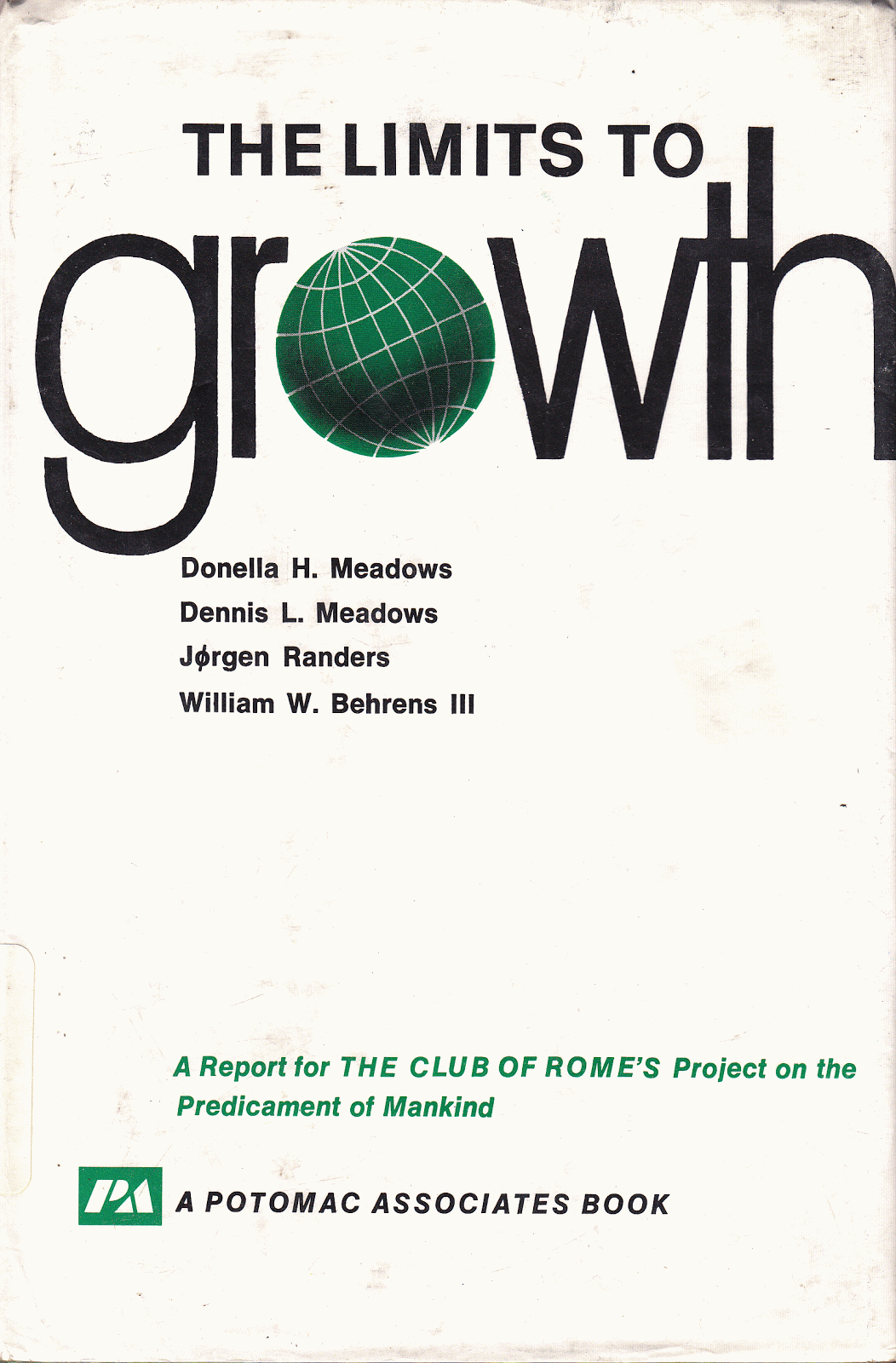

LTG was the popular summary of an MIT study that modeled the interactions between population, food production, industrialization, pollution, and non-renewable resources in the world economy. There were about a hundred variables, and the researchers were looking to see what would make the system grow, collapse, or oscillate.
St. Paul native, and Greek Prime Minister, George Papandreou has called for a referendum on his country's proposed European bailout. The trade is austerity for 110 billion Euros. Service contributes 78.8% of GDP, and the public sector accounts for 40% of jobs. Oops.
If anything can save us, it probably won't come from public policy, but maybe a country with a severely straitened economy could afford to tell the industrial economy to "Take a hike. We're going to see how many of us can keep eating."
Saturday, October 29, 2011
Caged Hazel

Phone Conversation With Steve
Nice phone conversation with Steve last night about eco-village project, and general premises. Good communication. Sent him a copy of the current version of the Intro and outline for the Operating Manual.
Left voice mail message for Noel about TC Daily Planet story.
Left voice mail message for Noel about TC Daily Planet story.
Winterizing The Rabella

Friday, October 28, 2011
Winterizing My Apple Trees


The top photo shows the trunks wrapped with "Tree Wrap," two inch-wide paper, to protect the bark from winter cold and temperature changes. In the bottom photo, they're caged with hardware cloth to keep snow-tunneling mice from gnawing them to death.
I will do something similar with my hazel bushes, whose predecessors were victims of predator bunnies, and an espaliered Rabella apple, as well as several more established, but still young fruit trees.
Wednesday, October 26, 2011
Landmark Forum, Breakdown-To-Breakthrough, Eco-Village Breakdown
Tuesday night was the last night of the Landmark Forum. Most of us brought guests. I didn't. Barbara was specifically not interested, and I didn't invite Sam, having made an executive decision that he should save his five hundred bucks.
Not a whole lot new. For the most part the affair was a sales presentation for the guests. It was an accurate presentation, and the guests received useful information, gratis. The value I got from the evening was a refresher of something I'd missed:
Landmark calls times when you're frustrated "breakdowns," and talks about how to turn them into "breakthroughs."
The way you do this is to work from the commitment the frustration highlights. The commitment's the important thing, and you need to act in some new way to further your commitment.
On the eco-village front, I've had a breakdown communicating with my colleagues. They are way under-capitalized (read "real broke"), and one way this manifests is e-mail accounts but no computers, pager accounts and balky voice mail, but no phones.
Breakthrough will come from initiative, persistence and creativity on my part. Use of the USPS? Regular, expected, calls to the voice mail? Regular, scheduled, meetings?
Maybe finding phones, computers and internet connections will be the ultimate answer. This will require funding, and I'm not that flush myself. A benefactor will want to believe we're capable of something beyond what little we've done so far. The Daily Planet story will help, as will production of the manual I've begun and that we will write. I've encouraged Steve to get together with the community garden in his neighborhood, so as to establish a track record.
Not a whole lot new. For the most part the affair was a sales presentation for the guests. It was an accurate presentation, and the guests received useful information, gratis. The value I got from the evening was a refresher of something I'd missed:
Landmark calls times when you're frustrated "breakdowns," and talks about how to turn them into "breakthroughs."
The way you do this is to work from the commitment the frustration highlights. The commitment's the important thing, and you need to act in some new way to further your commitment.
On the eco-village front, I've had a breakdown communicating with my colleagues. They are way under-capitalized (read "real broke"), and one way this manifests is e-mail accounts but no computers, pager accounts and balky voice mail, but no phones.
Breakthrough will come from initiative, persistence and creativity on my part. Use of the USPS? Regular, expected, calls to the voice mail? Regular, scheduled, meetings?
Maybe finding phones, computers and internet connections will be the ultimate answer. This will require funding, and I'm not that flush myself. A benefactor will want to believe we're capable of something beyond what little we've done so far. The Daily Planet story will help, as will production of the manual I've begun and that we will write. I've encouraged Steve to get together with the community garden in his neighborhood, so as to establish a track record.
Tuesday, October 25, 2011
Eco-Village.
I've known a guy, Steve, for about fifteen years. He's passionate about peak oil. He's also a client of the mental health system, and lives on a disability stipend. Something brilliant about him is his idea that an eco-village would be a good home for marginalized people like himself.
I have been helping him and two of his friends. We got together to prep for an interview that Steve had landed with a public affairs program on KFAI, the local community radio station. We're also working on a story we plan to submit to Twin Cities Daily Planet.
I'm working on an operating manual for the eco-village. My winter project. The technologies and lifestyle I'll describe in it are ones that I want to promote, but as a retired bus driver, I really don't have standing to be heard. The beautiful, ironic thing about Steve and his friends is that these marginal guys have standing. These confused social dependents want to live ecologically. Creating and building this way of life would demand a level of initiative and self reliance from outcasts that few normal folk show.
I have been helping him and two of his friends. We got together to prep for an interview that Steve had landed with a public affairs program on KFAI, the local community radio station. We're also working on a story we plan to submit to Twin Cities Daily Planet.
I'm working on an operating manual for the eco-village. My winter project. The technologies and lifestyle I'll describe in it are ones that I want to promote, but as a retired bus driver, I really don't have standing to be heard. The beautiful, ironic thing about Steve and his friends is that these marginal guys have standing. These confused social dependents want to live ecologically. Creating and building this way of life would demand a level of initiative and self reliance from outcasts that few normal folk show.
Landmark Forum
I complete the Landmark forum tonight. It's a seminar to help me be more effective. The thing that it's left me with is a better self-bullshit detector. Part of my bullshit -- they call it "rackets" -- is being unenergetic about the things that I want to pursue.
Friday, September 30, 2011
Planting Daffodils
We planted a hundred daffodil bulbs Wednesday. Daffodils are the first fairly large flower of the spring, and it felt as though we were making an offering to the gods of pollination.
Wednesday, September 7, 2011
Bateson Metalogue Impinges on Life
So “Father” convinced “Daughter” that things get in a muddle because there are many more ways of being muddled than of being tidy.
Flip a coin ten times, and there are 1,024 combinations of heads and tails, but in only two of them are there no heads following heads or tails following tails.
I dispatched buses. Let’s say a company drives twenty thousand miles a day, and has a breakdown or accident every hundred thousand miles. It would be preposterous to expect the problems to come every fifth day (“Hey, brother, watch your back, today’s the twenty-fifth”), so the dispatcher goes through periods of multiple crisis and periods of calm. Things don’t happen in threes, but they do bunch up.
Flip a coin ten times, and there are 1,024 combinations of heads and tails, but in only two of them are there no heads following heads or tails following tails.
I dispatched buses. Let’s say a company drives twenty thousand miles a day, and has a breakdown or accident every hundred thousand miles. It would be preposterous to expect the problems to come every fifth day (“Hey, brother, watch your back, today’s the twenty-fifth”), so the dispatcher goes through periods of multiple crisis and periods of calm. Things don’t happen in threes, but they do bunch up.
Thursday, September 1, 2011
Bateson's "Metalogues"
Steps to an Ecology of Mind's first chapter is a series of "Metalogues," ostensible conversations between "Father," the author, and "Daughter," Mary Catherine Bateson. The earliest Metalogue is from 1948, when "Daughter" would have been ten, and ending in 1969.
The conversations cover several of Bateson's interests:
The reason why things inevitably get muddled,
Non-verbal communication,
Games, play, seriousness,
Measuring knowledge,
Why things have outlines,
Metaphor/sacrament/performance/pretend,
and Instinct, explanatory principles, hypotheses.
Bateson wrote that the conversations "should be such that not only do the participants discuss the problem, but the structure of the conversation as a whole is relevant to the subject."
Late in his life, Bateson's nine-year old daughter, Nora, asked him if she would understand Steps. He said that she might be able to read the Metalogues. The last two must have been tough for her. "Daughter's" voice matures over the years, even though the conversations are compositions. She asks tougher questions, and gets more complex or ambiguous answers. All of the Metalogues are full of good things to ponder.
Several more Metalogues appear in Angels Fear, Gregory's posthumously published collaboration with Mary Catherine, most composed by a middle-aged "Daughter."
From "Why Do Things Get in a Muddle?"
D: Daddy, you didn't finish. Why do my things get the way I say isn't tidy?
F: But I have finished -- it's just because there are more ways which you call "untidy" than there are which you call "tidy."
D: But that isn't a reason why --
F: But yes it is. And it is the real, and only, and very important reason.
The conversations cover several of Bateson's interests:
The reason why things inevitably get muddled,
Non-verbal communication,
Games, play, seriousness,
Measuring knowledge,
Why things have outlines,
Metaphor/sacrament/performance/pretend,
and Instinct, explanatory principles, hypotheses.
Bateson wrote that the conversations "should be such that not only do the participants discuss the problem, but the structure of the conversation as a whole is relevant to the subject."
Late in his life, Bateson's nine-year old daughter, Nora, asked him if she would understand Steps. He said that she might be able to read the Metalogues. The last two must have been tough for her. "Daughter's" voice matures over the years, even though the conversations are compositions. She asks tougher questions, and gets more complex or ambiguous answers. All of the Metalogues are full of good things to ponder.
Several more Metalogues appear in Angels Fear, Gregory's posthumously published collaboration with Mary Catherine, most composed by a middle-aged "Daughter."
From "Why Do Things Get in a Muddle?"
D: Daddy, you didn't finish. Why do my things get the way I say isn't tidy?
F: But I have finished -- it's just because there are more ways which you call "untidy" than there are which you call "tidy."
D: But that isn't a reason why --
F: But yes it is. And it is the real, and only, and very important reason.
Wednesday, August 31, 2011
Bateson: Creatura and Pleroma
Where Basteson (1904-1980) wound up was dividing the world into pleroma and creatura, ideas he got from Jung. You see pleroma in the photograph of the badlands. Beautiful forms but it’s all uplift and erosion, physics and chemistry. Creatura is life: people, redwood forests, Congress, “mind.” Mind is made of interacting parts or circuits, requires collateral energy, is triggered by difference, and requires circular or more complex interaction. He divided existence this way to avoid the mind-matter Cartesian split that he felt had corrupted enlightenment epistemology. Cogito ergo sum, but I am thinking: something material is doing something mental. Mind isn’t separate, and is fair game for investigation.
For Bateson this was “religious” in so many words, but not mechanical or superstitious. He took a while to get there, though, and there’s a lot of it that leaves me thinking, “Huh?” or “Why does that follow?” Lipset’s biography helps, but I still fall off here and there. I’m reading Steps to an Ecology of Mind studying the building blocks slowly and painstakingly, hoping I’ll be able to make the tough connections.
For Bateson this was “religious” in so many words, but not mechanical or superstitious. He took a while to get there, though, and there’s a lot of it that leaves me thinking, “Huh?” or “Why does that follow?” Lipset’s biography helps, but I still fall off here and there. I’m reading Steps to an Ecology of Mind studying the building blocks slowly and painstakingly, hoping I’ll be able to make the tough connections.
Saturday, August 27, 2011
More Bateson
I wrote a note to an old acidhead buddy to the effect that Bateson either makes me go "wish I'd said that," "wow, I never thought of that," or "huh?" I wrote a very telegraphic five hundred or a thousand words, and only got him out of his teens. I'm less than fluent with things like the relation between logical types/contextual paradox and double-bind theory. To say nothing of the relation between all that and phylogenetic homology. Still going "huh?". So now I've begun "Steps to an Ecology of Mind," the anthology of major Bateson academic papers, and the one among his three popular books I haven't read. Hoping for sort of reverse reductionism, or something like that.
Friday, August 26, 2011
Gregory Bateson
Brushing up on my Gregory Bateson for a profile in Duluth's Zenith City Weekly. Reading David Lipset's Gregory Bateson: Legacy of a Scientist.
It's nice to have a guide. It's also interesting looking forward to explaining Gregory Bateson in under a thousand words. The great systems thinker, he's all of one piece; every idea depends on all the rest.
It's nice to have a guide. It's also interesting looking forward to explaining Gregory Bateson in under a thousand words. The great systems thinker, he's all of one piece; every idea depends on all the rest.
Subscribe to:
Posts (Atom)