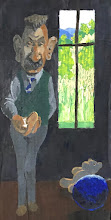
I gave this drawing
 to Barbara’s business partner, Jason, who had admired it. I drew it about a year ago for a group show of art based on the human figure. The characters of the
Minotaur and Sculptor came from a Picasso etching of a
Bacchanal done in 1933. I find the Picasso picture appalling, and to my chagrin, arousing.
I’m not a great draftsman, but a lot of the virtue in my drawing I owe to Picasso. If you think that Picasso was taking shortcuts to avoid the hard work of getting a likeness, disabuse yourself of that notion (Ken). The failings of Pablo Diego Jose Francisco de Paula Juan Nepomuceno Maria de los Cipriano Santisima Trinidad Ruiz y Picasso lay in other directions. There are abundant examples of Picasso’s stunning conventional representation, and anecdotes about his faking other artists’ styles to put critics. who preferred their art, in their places. For me, it was seeing Georges Cluzot’s
The Mystery of Picasso that made me realize how skilled my man Pablito was. So free, so expressive. I kept saying, “I didn’t know you could do that.”
Cluzot directed
Mystery in the summer of 1954, with Claude Renoir -- son of the painter, Pierre-Auguste -- operating the camera. In the film, Picasso draws with inks that bleed through paper stretched on a special easel. This allows us to see the drawings appear as if by magic (later in the film, editing allows us essentially the same experience, as paintings appear on canvas). Toreros, bulls, models, artists, clowns, and acrobats assemble in scene after meaningful scene. One critic commented that the film was a gift, “generous,” and I certainly was glad to watch the master at work.
Exchanges between the artist and director, a certain mimed tension on Cluzot’s part, and the incongruity of a little subplot about running out of film, in a picture that couldn’t have happened without an editing suite, tip the film makers’ hands that this is a bit of modernist hagiography. The septuagenarian hero creating in his underpants, his comments that he doesn’t mind being tired, and that he wants to “go deeper,” Picasso’s discarding a large painting of a Mediterranean resort, after countless revisions, only to replace it with another revision on a second canvas, all play to the image Mr. P. and his sycophants wanted to leave behind.
The Bacchanal has the Minotaur and Sculptor toasting each other, apparently after having worn out two sprawled and nude models. Picasso was a libertine and a sadist, though not a sadist in the consensual, top-bottom sense of modern fantasy play. There really are no minotaurs, so both male characters are alter egos for the artist himself, and the models’ names are Dora and Marie-Therese. Both were Picasso’s mistresses, and their tenures overlapped. Marie-Therese was the earlier of the two, a very young woman when Picasso approached her on the street, an athlete, and not, reportedly, profound. She was the mother to Picasso’s daughter Maya. Dora was an artist, photographer, and poet, muse to the surrealists. She documented the production of the anti-war, anti-fascist mural
Guernica, and was rumored to have produced some of the studies for it. Picasso may have discovered the pleasure of dominating others earlier, but it grew with the much younger and submissive Marie-Therese, and came to full flower with the chance to practice on Dora, the stronger ego. The game was to charm the mistress, convincing her that it was she alone whom he loved, and then arrange for her to catch him with the other and to snub her. There were two other women on the scene at the time, estranged wife Olga, who was too much of a nudge to be any fun, and Francoise, who came close to losing her soul, but survived. Picasso once put a cigarette out on Francoise’s cheek.
If ever a painter needed a loving kick in the shorts, it was Picasso.
Picasso died at great age, leaving behind a shamble of confused exes and offspring. Marie-Therese, second wife Jacqueline, and grandson Pablito committed suicide. Son by Olga, Paulo, died at 54 of cirrhosis of the liver.
Picasso, with Georges Braque, was co-inventor of Cubism, which means modern art. Cubism began in 1907, and lasted until after the First World War. In Cubism, the subject of a painting is represented from multiple points of view, and the resulting picture is a shallow, flickering pattern, usually in limited value and color. Before Cubism, there was a half-century of experimentation with representation, beginning with the Realists and Impressionists, and erupting with the Post-Impressionists, at the turn of the century. Cubism liberated artists from narrative and anecdote, but wasn’t inane: paintings continued to be about something. The problem was that what a painter could say about reality wasn’t nice -- was incomplete. This probably seemed apt for a century in which humanity seemed to have slipped its religious moorings, and upon which was visited such abundant pain.
In her biography of the great man,
Picasso Creator and Destroyer, Arianna Huffington wrote, “With prodigious skill, complete mastery of the language of painting, inexhaustible versatility and monumental virtuosity, ingenuity and imagination, Picasso showed us the mud in our frog pond, and the night over it.”
In my drawing, the Sculptor rebukes the now sheepish Minotaur, too late for Picasso but not for the Picasso in each of us.