I've been reading Howard Odum's Environment Power and Society. I don't read technical stuff well. Odum says that it's a work for popular consumption. I see how it could be more difficult, but a lot of new concepts come at you on each page.
Odum's goal for the book is to communicate a "macroscopic" -- as opposed to reductionist -- view of the world. He discusses the flows of power in ecosystems -- of which human economy is an example -- and suggests that human survival depends upon understanding the energetics of systems. He writes, "Since decisions on such matters in the arena of public affairs are ultimately made according to the beliefs of the citizens, it is the citizens who must somehow include the energetics of systems in their education."
I'll bite. I'm happy to be able to run my eyes over Odum's discussions of the power flows in various ecosystems. I'm grateful to him for providing a vocabulary of symbols used in network diagrams, such as the one above, which illustrates the flows of carbon in a microcosm. P=gross photosynthesis. R=respiration. Hexagons are self reproducing systems, either organisms or populations. The bulge on the left indicates plants as labeled. The things with roof are supposed to look like tanks, and stand for storage.
Monday, February 6, 2012
Sunday, November 13, 2011
Growth, Development, And The Urgent Need For a Better Way
In Beyond the Limits, the twenty-year sequel to The Limits to Growth, the researchers make a distinction between development and growth, and write:
In the rich world, economic growth is believed to be necessary for employment, social mobility, and technical advance. In the poor world, economic growth seems to be the only way out of poverty. And a poor family sees that many children can be a source not only of joy, but also of hope for economic security. Until other solutions are found for the legitimate pproblems of the world, people will cling to the idea that growth is the key to a better future, and they will do all they can to produce more growth.
We should recognize that there's a certain amount of hurry-up involved too.
Thursday, November 10, 2011
Beginning Beyond The Limits
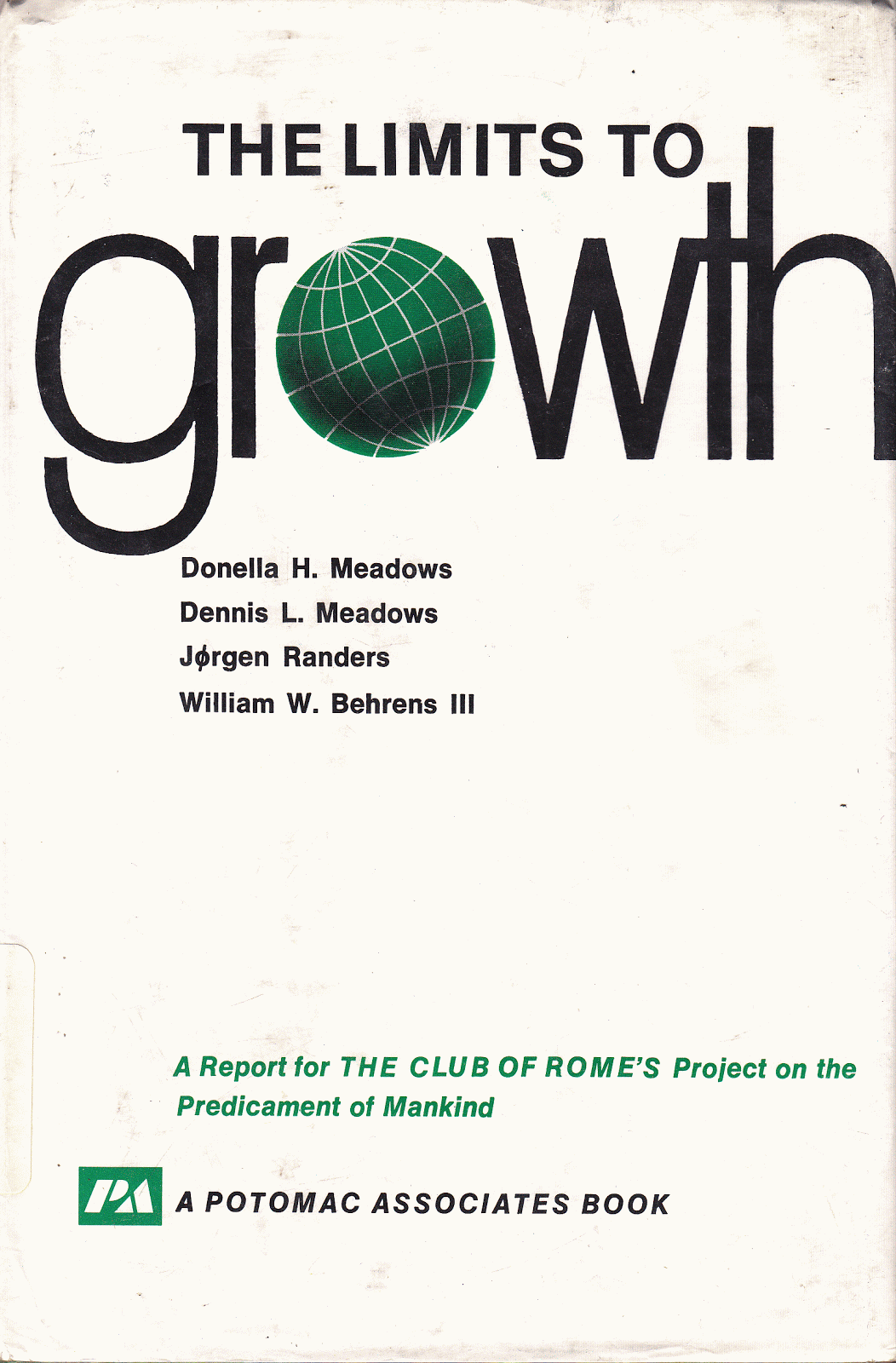
In 1972's The Limits to Growth, the authors made a case that, if trends in resource use, population, pollution, industrial and agricultural production continued, the world would reach its limits to growth within a century. They also showed that it would be possible to avoid this catastrophe, and that doing so would be easier the earlier the world began.
Here's a paragraph from the 1992 sequel, Beyond the Limits:
But until we started updating The Limits to Growth we had not let our minds fully absorb the message. The human world is beyond its limits. The present way of doing things is unsustainable. The future, to be viable at all, must be one of drawing back, easing down, healing. Poverty cannot be ended by indefinite material growth; it will have to be addressed while the material human economy contracts. Like everyone else, we didn't really want to come to these conclusions.
Wednesday, November 2, 2011
Eco-Village, Neologism, And Artifact Ecology
Steve, my chief partner in writing the eco-village operating manual may have found a location.
I went to look at photovoltaic setups with neighbor, Joe Hesla, who asked me if I were planning on moving to the eco-village. I said that our neighborhood was my eco-village.
Steve likes to make up words and phrases. I believe English teachers call made-up vocabulary "neologisms." They are often Latin compounds. Steve usually makes his from scratch. His often seem to duplicate existing words, although Steve might feel that they remove some distasteful accidental meaning or emphasize something that isn't in the conventional word. "Woma" is a case in point. It really means the same thing as "woman," a mature female member of our species. The emphasis for Steve is sexual maturity, although I don't know why removing the en shows that. Inadvertently, or otherwise, it also removes the implication that a woman is a man with a womb.
One phrase of Steve's that everybody ought to adopt is artifact ecology. In artifact ecology, we consider the various materials and processes we use in providing ourselves with some means of survival or culture. Resource use, pollution, effect on community, benefit are all considered for -- say -- a person web logging.
Tuesday, November 1, 2011
George Papandreou And The Limits To Growth
Here's a 2500 year old Greek bronze discovered in the sea the same year, 1972, that The Limits to Growth was published.
LTG was the popular summary of an MIT study that modeled the interactions between population, food production, industrialization, pollution, and non-renewable resources in the world economy. There were about a hundred variables, and the researchers were looking to see what would make the system grow, collapse, or oscillate.
St. Paul native, and Greek Prime Minister, George Papandreou has called for a referendum on his country's proposed European bailout. The trade is austerity for 110 billion Euros. Service contributes 78.8% of GDP, and the public sector accounts for 40% of jobs. Oops.
If anything can save us, it probably won't come from public policy, but maybe a country with a severely straitened economy could afford to tell the industrial economy to "Take a hike. We're going to see how many of us can keep eating."
Saturday, October 29, 2011
Caged Hazel
Two year-old hazel, caged for winter. I lost half of my ten hazels last winter, and all ten of their predecessors. I don't understand, because deer are supposed to think they taste awful. I'm not taking any chances with the rabbits and mice this year. Notice the lid. The bit of silver immediately above is the caged Rabella.
Phone Conversation With Steve
Nice phone conversation with Steve last night about eco-village project, and general premises. Good communication. Sent him a copy of the current version of the Intro and outline for the Operating Manual.
Left voice mail message for Noel about TC Daily Planet story.
Winterizing The Rabella
Mellow late-October afternoon, first-season espaliered Rabella apple on dwarfing rootstock. Two three by three-and-a-half foot sheets of half-inch hardware cloth, spread with a piece of light lumber and stitched together with baling wire. Tried to anchor the cage with staples made from wire clothes hangers, but couldn't get a good grip on the ground. Scraped a groove with a garden trowel, and buried the bottom with dirt from a harvested potato tower to exclude mice.
Friday, October 28, 2011
Winterizing My Apple Trees
Two apple trees, planted about a yard apart. "Freedom" on the left and "Liberty" on the right, purchased from St. Lawrence Nursery in Pottsdam, NY. The names claim freedom and liberty from disease. A couple of big, permaculture orchards I know have had good luck with them. They are not on dwarfing rootstock, and I'm expecting to have to prune them to keep them at a scale that's reasonable for their site. I plan to graft branches between them, Freedom to Liberty, to form a ladder, and train other branches to a single goblet shape.
The top photo shows the trunks wrapped with "Tree Wrap," two inch-wide paper, to protect the bark from winter cold and temperature changes. In the bottom photo, they're caged with hardware cloth to keep snow-tunneling mice from gnawing them to death.
I will do something similar with my hazel bushes, whose predecessors were victims of predator bunnies, and an espaliered Rabella apple, as well as several more established, but still young fruit trees.
Wednesday, October 26, 2011
Landmark Forum, Breakdown-To-Breakthrough, Eco-Village Breakdown
Tuesday night was the last night of the Landmark Forum. Most of us brought guests. I didn't. Barbara was specifically not interested, and I didn't invite Sam, having made an executive decision that he should save his five hundred bucks.
Not a whole lot new. For the most part the affair was a sales presentation for the guests. It was an accurate presentation, and the guests received useful information, gratis. The value I got from the evening was a refresher of something I'd missed:
Landmark calls times when you're frustrated "breakdowns," and talks about how to turn them into "breakthroughs."
The way you do this is to work from the commitment the frustration highlights. The commitment's the important thing, and you need to act in some new way to further your commitment.
On the eco-village front, I've had a breakdown communicating with my colleagues. They are way under-capitalized (read "real broke"), and one way this manifests is e-mail accounts but no computers, pager accounts and balky voice mail, but no phones.
Breakthrough will come from initiative, persistence and creativity on my part. Use of the USPS? Regular, expected, calls to the voice mail? Regular, scheduled, meetings?
Maybe finding phones, computers and internet connections will be the ultimate answer. This will require funding, and I'm not that flush myself. A benefactor will want to believe we're capable of something beyond what little we've done so far. The Daily Planet story will help, as will production of the manual I've begun and that we will write. I've encouraged Steve to get together with the community garden in his neighborhood, so as to establish a track record.
Tuesday, October 25, 2011
Eco-Village.
I've known a guy, Steve, for about fifteen years. He's passionate about peak oil. He's also a client of the mental health system, and lives on a disability stipend. Something brilliant about him is his idea that an eco-village would be a good home for marginalized people like himself.
I have been helping him and two of his friends. We got together to prep for an interview that Steve had landed with a public affairs program on KFAI, the local community radio station. We're also working on a story we plan to submit to Twin Cities Daily Planet.
I'm working on an operating manual for the eco-village. My winter project. The technologies and lifestyle I'll describe in it are ones that I want to promote, but as a retired bus driver, I really don't have standing to be heard. The beautiful, ironic thing about Steve and his friends is that these marginal guys have standing. These confused social dependents want to live ecologically. Creating and building this way of life would demand a level of initiative and self reliance from outcasts that few normal folk show.
Landmark Forum
I complete the Landmark forum tonight. It's a seminar to help me be more effective. The thing that it's left me with is a better self-bullshit detector. Part of my bullshit -- they call it "rackets" -- is being unenergetic about the things that I want to pursue.
Friday, September 30, 2011
Planting Daffodils
We planted a hundred daffodil bulbs Wednesday. Daffodils are the first fairly large flower of the spring, and it felt as though we were making an offering to the gods of pollination.
Wednesday, September 7, 2011
Bateson Metalogue Impinges on Life
So “Father” convinced “Daughter” that things get in a muddle because there are many more ways of being muddled than of being tidy.
Flip a coin ten times, and there are 1,024 combinations of heads and tails, but in only two of them are there no heads following heads or tails following tails.
I dispatched buses. Let’s say a company drives twenty thousand miles a day, and has a breakdown or accident every hundred thousand miles. It would be preposterous to expect the problems to come every fifth day (“Hey, brother, watch your back, today’s the twenty-fifth”), so the dispatcher goes through periods of multiple crisis and periods of calm. Things don’t happen in threes, but they do bunch up.
Thursday, September 1, 2011
Bateson's "Metalogues"
Steps to an Ecology of Mind's first chapter is a series of "Metalogues," ostensible conversations between "Father," the author, and "Daughter," Mary Catherine Bateson. The earliest Metalogue is from 1948, when "Daughter" would have been ten, and ending in 1969.
The conversations cover several of Bateson's interests:
The reason why things inevitably get muddled,
Non-verbal communication,
Games, play, seriousness,
Measuring knowledge,
Why things have outlines,
Metaphor/sacrament/performance/pretend,
and Instinct, explanatory principles, hypotheses.
Bateson wrote that the conversations "should be such that not only do the participants discuss the problem, but the structure of the conversation as a whole is relevant to the subject."
Late in his life, Bateson's nine-year old daughter, Nora, asked him if she would understand Steps. He said that she might be able to read the Metalogues. The last two must have been tough for her. "Daughter's" voice matures over the years, even though the conversations are compositions. She asks tougher questions, and gets more complex or ambiguous answers. All of the Metalogues are full of good things to ponder.
Several more Metalogues appear in Angels Fear, Gregory's posthumously published collaboration with Mary Catherine, most composed by a middle-aged "Daughter."
From "Why Do Things Get in a Muddle?"
D: Daddy, you didn't finish. Why do my things get the way I say isn't tidy?
F: But I have finished -- it's just because there are more ways which you call "untidy" than there are which you call "tidy."
D: But that isn't a reason why --
F: But yes it is. And it is the real, and only, and very important reason.
Wednesday, August 31, 2011
Bateson: Creatura and Pleroma
Where Basteson (1904-1980) wound up was dividing the world into pleroma and creatura, ideas he got from Jung. You see pleroma in the photograph of the badlands. Beautiful forms but it’s all uplift and erosion, physics and chemistry. Creatura is life: people, redwood forests, Congress, “mind.” Mind is made of interacting parts or circuits, requires collateral energy, is triggered by difference, and requires circular or more complex interaction. He divided existence this way to avoid the mind-matter Cartesian split that he felt had corrupted enlightenment epistemology. Cogito ergo sum, but I am thinking: something material is doing something mental. Mind isn’t separate, and is fair game for investigation.
For Bateson this was “religious” in so many words, but not mechanical or superstitious. He took a while to get there, though, and there’s a lot of it that leaves me thinking, “Huh?” or “Why does that follow?” Lipset’s biography helps, but I still fall off here and there. I’m reading Steps to an Ecology of Mind studying the building blocks slowly and painstakingly, hoping I’ll be able to make the tough connections.
Saturday, August 27, 2011
More Bateson
I wrote a note to an old acidhead buddy to the effect that Bateson either makes me go "wish I'd said that," "wow, I never thought of that," or "huh?" I wrote a very telegraphic five hundred or a thousand words, and only got him out of his teens. I'm less than fluent with things like the relation between logical types/contextual paradox and double-bind theory. To say nothing of the relation between all that and phylogenetic homology. Still going "huh?". So now I've begun "Steps to an Ecology of Mind," the anthology of major Bateson academic papers, and the one among his three popular books I haven't read. Hoping for sort of reverse reductionism, or something like that.
Friday, August 26, 2011
Gregory Bateson
Brushing up on my Gregory Bateson for a profile in Duluth's Zenith City Weekly. Reading David Lipset's Gregory Bateson: Legacy of a Scientist.
It's nice to have a guide. It's also interesting looking forward to explaining Gregory Bateson in under a thousand words. The great systems thinker, he's all of one piece; every idea depends on all the rest.
Monday, June 20, 2011
Trolley Tracks, Jon Freise, & Peak Oil
It would seem like a literary device, if it weren't something you can see half a dozen blocks from here, at the corner of Cedar Avenue and 35th Street: One of Minneapolis' many potholes, this one revealing the original brick paving and a rail from the 60 year-defunct trolley system.
A week ago I interviewed neighbor Jon Freise for the neighborhood newspaper, Corcoran News. I had heard Jon present an explanation of peak oil at the Corcoran Park building in February, and was eager to include him in my series of portraits of interesting neighbors. (Jon told me about the pothole; it's by his house.)
During our conversation, I quoted Wes Jackson to Jon as having said that those of us who conserve are making it easier for the profligate by not bidding against them in the de facto energy auction. Jon thought about this for a while, and responded that it's an accurate observation, but the rich bastards are not the only ones who need cheap oil. Operations that feed the elderly and the sick, people who have to get to work where there's no public transportation, and energy-intensive services upon which even the most conservative among us rely are examples of functions that we would not want to bid against.
Saturday, June 4, 2011
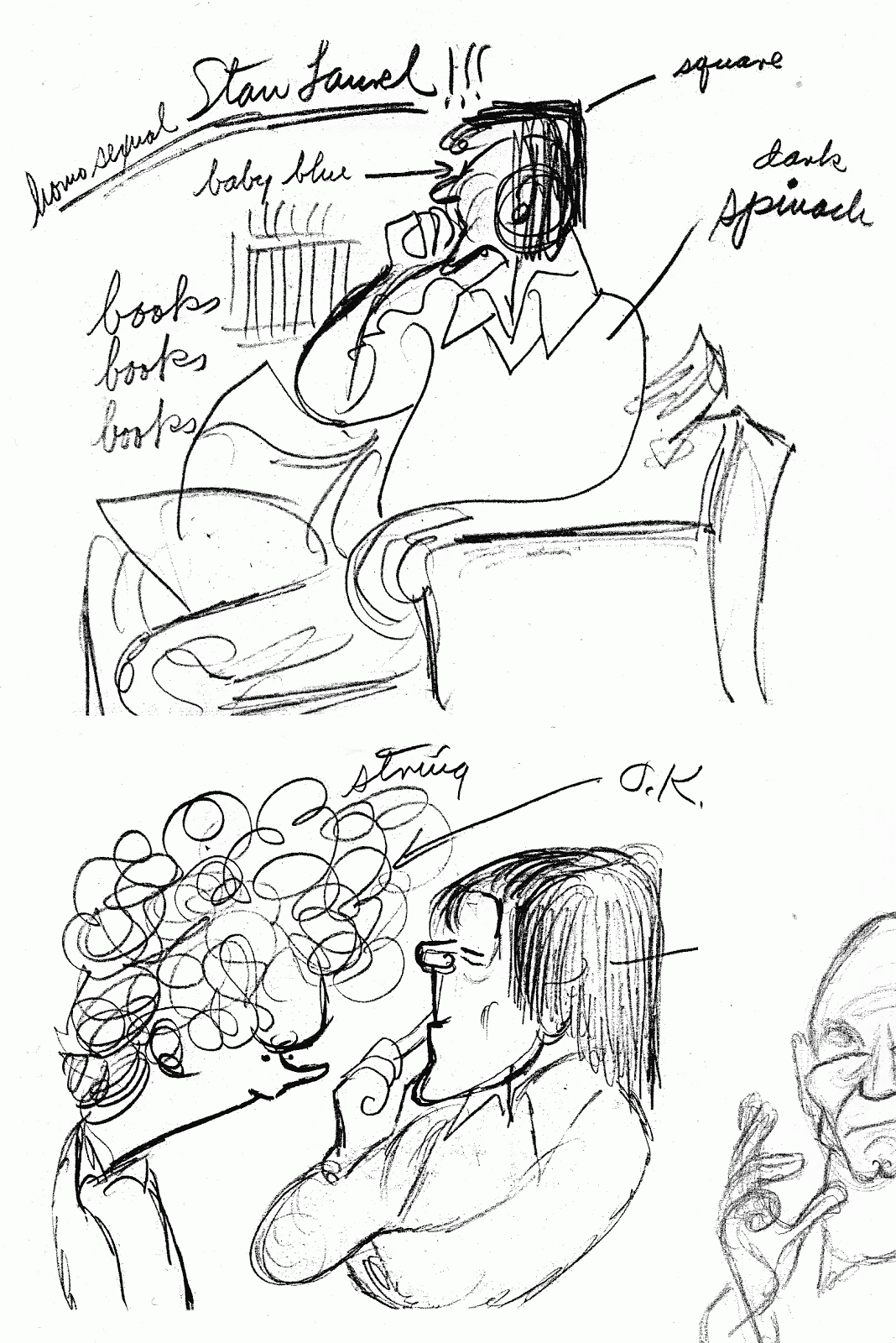
Trying to Draw Like Al Hirschfeld
CD cover for my friend Lisa, designed by Dawn Yema, drawings by me. I'd been sketching Lisa while she performed for a few years, and turned a decent likeness into a caricature under the influendce of Al Hirschfeld. The drawings of the other artists are mostly from photos. The exception is Linda Tennyson, the bassist behind Lisa's elbow.
Hirschfeld, born in 1903, was the NY Times Drama Caricaturist. He died, still drawing, five months shy of his hundredth birthday. Of course the fellow with the white whiskers and the eyebrows is the artist in self portrait. The sketchier stuff is Hirschfeld, studying Tom Courtenay. Hirschfeld would attend opening night, sit on the aisle, and take notes or draw in a personal shorthand in his pocket. I've seen a video of the ninety-nine year old Hirschfeld working on a finished drawing of Paul Newman as the Narrator/Stage Manager in Our Town. The Tom Courtenay studies are instructive, but I'd give a lot to see some of the pocket drawings.
Friday, May 13, 2011
Lou Gottlieb
The Folksinger Who Hosted a Commune
The idea of communes "working," flourishing, succeeding is always brought up, but this is beside the point in the case of the communes now existing in America. What is essential is to expose ourselves to a life of voluntary poverty, or life for minimal cost, and a life of sharing...because this is what it is, alone, that makes the commune endeavor an important thing in America.
Elia Katz, quoted by Lou Gottlieb
It's a lucky child that has a chance to be reared in an intentional community
Lou Gottlieb
Lou Gottlieb was born to immigrant parents in 1923, Jewish name, Catholic upbringing. (During his second LSD experience, he huddled in a closet and chanted Luke 1:31, "Fear not, Mary," mantra-like in Latin.) He played piano, oboe, and bass fiddle, and started college at 16. During the War, the Army Band, stationed at the Army War College, was shipped overseas. The College still wanted a band, and Gottlieb played bass in the replacement band. After the War, Gottlieb finished his education, played in jazz bands and a folk group, the Gateway Singers. He received a PhD in musicology in 1958, transposing fifteenth century masses into modern notation for his dissertation.
Post-doc, Lou continued to gig, and made a serious attempt at stand-up comedy, becoming friends with Lenny Bruce and Don Adams. He arranged tunes for the Kingston Trio, and enlisted vocalists Alex Hasselev and Glenn Yarbrough to help record a demo of his arrangements. Gottlieb, Hasselev, and Yarbrough began to tour as the Limeliters, and formed the nucleus of the ABC television folk hour, Hootenanny, with Lou arranging, playing bass, and wisecracking with the audience.
In 1962, the Limeliters took a break after walking away from a plane crash. Lou bought thirty-two acres of meadow orchard and redwoods, a former chicken ranch just north of the San Francisco Bay, with the idea of subdividing it. At the same time he was investigating yoga, Indian religion, and psychedelics. Lou and friends, Ramon Sender and Stewart Brand would visit the property to horse around. Lou moved his piano into a converted chicken shed, meaning to commit a program of classical music to memory.
In 1966 the San Francisco Diggers, accepting the responsibility for feeding the tide of young visitors to Haight Street, asked Lou if they could tend the orchard and start a garden. Somebody put up a sign inviting hippies to visit the "Digger Farm," and Lou Gottlieb's Morningstar Ranch became ground zero for the hippie commune movement. Between then and 1972, something like fifteen hundred people passed through Morningstar, some for a day, some years. Lou attended seven hippie births, and thought he had been an obstetrician or midwife in a former life.
Lou came to see "open land" as a necessity and way of ameliorating the human condition. Social wealth and automation were making some people "technologically unemployable," and some people were simply "impossibles," people whose need for leisure is more demanding than their fear of starvation. There need to be places where anybody may go, outlaw places where the impossibles are free to take their chances being impossible. Late in life, Lou said -- only half facetiously -- that this is the idea for which he should receive a Nobel Prize.
Culture shock and, we must surmise, a certain hippie fecklessness alienated Morningstar's neighbors. Over the commune's half-dozen years, petitioners and Sonoma County officials angled to evict visitors. At one point, Lou deeded the property to God. He paid $15, 000 in fines and did fifteen days in jail for contempt. Finally the county bulldozed the hippie shacks, the Morningstar adventure having cost Lou something like seven hundred thousand 2011 dollars.
The Limeliters re-formed, and Lou continued to make periodic attempts at working up a classical performance. He also continued to propose that society set aside remote sites where anybody could squat.
Lou died in 1996, diabetes having masked a malignancy until two or three weeks before the end. He faced imminent death with grace and humor.
Thursday, April 14, 2011
Wes Jackson
The Kansas Farm Boy Who's Breeding an Edible Prairie
Extractive economy simply means an economy based on depletion, deficit spending of the Earth's ecological capital.
Wes Jackson
Wes Jackson was born in 1936 on a farm near Topeka, Kansas. He would have been learning long division and joining the 4H while WWII was rushing to its bloody close, receiving his BS in Biology while cars still had tail fins, his MS in Botany at the Cold War's suspenseful height, and a PhD in Genetics when American citizens were beginning to realize foreign policy could be mistaken. Jackson chaired one of America's first Environmental Studies programs, at California State University in Sacramento, then returned to Kansas to found the Land Institute.
Some plants, annuals, live for one season, others, perennials, for several. In nature perennials, in mixtures, dominate. Agriculture has reversed this, and we grow acres of nothing but one or another annual (chiefly just four, rice, wheat, corn, and soy), sprawling beyond the horizon. The Land Institute is trying to get back to nature by breeding perennial versions of corn, sorghum, sunflower, and wheat, and growing them together. They are also domesticating food-producing wild perennials. This strategy saves soil and energy, because plants growing deep roots over many seasons won't require tilling, and will have greater access to minerals and water, and because mixtures of plants will be less vulnerable to diseases and pests.
Jackson describes himself not as optimistic, but hopeful.
Thursday, April 7, 2011
The-Bigger-The-Belt-Buckle Department
One of Barbara's and my favorite novels is Booth Tarkington's The Magnificent Ambersons, published in 1918. It's a midwestern story to the bone, the story of an Indiana city, the story of a family of magnificent privilege, the story of the nineteenth century's yielding to the twentieth, the automobile, and the beginnings of urban sprawl. The identity figure for all this change is Georgie Minafer -- the least sympathetic identity figure in western literature -- the grandson of the Amberson who made the family fortune, and one volcanically self absorbed fool and petty tyrant.
George's rudeness and presumption have been so outrageous from the cradle -- and have reflected his elders' own secret attitudes -- that the family fondly indulges them. In the end, Georgie finds grace, love, and forgiveness, but not before ending his widowed mother Isabel's chances for reunion with the great love of her life, Eugene Morgan, an automobile manufacturer.
In a dinner table conversation George embarrasses himself and his family by loudly telling Eugene that "Automobiles are a useless nuisance" that should never have been invented. His grandfather corrects him, but George persists and speaks facetiously.
Then Eugene began to laugh cheerfully.
"I'm not sure he's wrong about automobiles," he said. "With all their speed forward, they may be a step backwards in civilization. -- that is in spiritual civilization. It may be that they will not add to the beauty of the world, nor to the life of men's souls. I am not sure. But automobiles have come, and they bring a greater change in our life than I think most of us suspect. They are here, and almost all outward things are going to be different because of what they bring."
Written in 1918! The irony is that the automobile maker can articulate this, while Georgie is just bristling at vaguely perceived threats to unearned privilege -- and trying to injure his mother's suitor.
There have been three films of The Magnificent Ambersons: a 1925 silent adaptation of a book that has a lot of speeches, the 1942 Orson Welles classic which was as faithful to the original as a movie can be to a novel, but was severely edited by the RKO brass, the deleted scenes destroyed, and a 2002 A&E version directed by Alfonso Arau, using Welles' script. The Arau Ambersons looks and sounds the more midwestern to my Illinois-bred eyes and ears, despite Arau's Mexican birth, and despite his shooting it in Ireland. Its one false note plays over and over in a series of sensuous caresses and lingering kisses between Georgie and Isabel. Tarkington couldn't have failed to know about Freud, but probably had very little patience with the idea of Oedipus complexes. George Minafer would have objected to losing centrality in any of his family's lives, and been squeamish at Isabel's sexuality.
Safe driving tip of the day: Minnesota DMV wants you to keep three seconds between yourself and the car ahead of you. You can do this by counting the seconds between the time when the other car's rear bumper passes a landmark, and when your front bumper reaches it.
But how do you help somebody you pass keep his distance from you? To help a slower driver maintain his or her interval, if the other car is going sixty, count thirty-six seconds from when your rear bumper is even with the other car's front bumper before you pull back into the right lane. To pass somebody going seventy, count forty-two seconds. This assumes you're going 5 MPH faster than the other driver.
Scary when you compare that to what we really do.
Wednesday, April 6, 2011
World War Robot
A day of battle is a day of profit.
Darwin Rothschild
I found Ashley Wood's and T. P. Louise's World War Robot (www.idwpublishing.com) at Minneapolis' East Lake Library. It is the story of the war between expat atheists living on Mars and believers who stayed on Earth. It's told sparingly in a series of letters, reports, and diary entries, and especially in about seventy very juicy paintings. The pictures were what grabbed me.
The James Cameron Terminator movies, The Terminator and Judgment Day, are food for thought. Out-of-control robots from the future can stand for lots of human creations which have become dangerous to us. Think DDT, think the private automobile, but think especially about Earth's new dominant life form, the corporation.
Corporations were originally chartered with the idea of human or national progress. Since they are legally obliged to return a profit and little else, when faced with a choice between making a dime and sparing the commons, they won't know it was loaded.
In the story of the war between Earth and Mars, the corporate face of the enemy is more apparent than in the Terminator films. I could never decide whether WWR's authors were on the side of the believers or the non-believers (or which side was in which paintings), but supplying both armies with robots from the Moon is a guy named Darwin Rothschild.
In itty-bitty letters under the bar code, it says that WWR is "suggested for mature audiences." I'll go along with that; the book is pretty grim, but the warning is probably there because of a glimpse in one painting of a military brothel, and of pubic hair. Sordid, but not exactly titillating.
Thursday, March 31, 2011
Buckminster Fuller
It was never my intention to design the geodesic dome. I wanted to discover the principles at work in our universe. I could have ended up with a pair of flying slippers.
Buckminster Fuller
Richrd Buckminster Fuller remains the most fascinating member of the World War I generation. A business failure and grieving father at 32, he prepared to drown himself. It came to him that he was the product of the things he learned from everyone he knew, and from a chain of people going back to humanity's beginning, so his life was not his own to throw away. Since he had been planning to die, Fuller -- or "Bucky" as he liked to be called -- decided to comit "egocide" instead, and live dedicated to the desires of the universe and the betterment of all people.
For Bucky, humanity was going through its final exam, pass-or-fail, utopia or oblivion. He decided that it would be easier to reform the environment than people, who -- mistakenly -- believe that the world holds too few resources to let us all survive peacefully. His career was one of invention, and he died holding twenty-eight patents for devices to house and serve us better than ever, using less material and energy. He also published over thirty books. Fuller's inventions include a new geometry, a high-mileage-for-its-time car which could turn 360 degrees inside its own radius, and the geodesic dome, a structure which can cover unlimited area without any internal columns or load-bearing walls.
Toward the end of a long, productive life, Buckminster Fuller called us "four billion billionaires who are entirely unaware of their good fortune."
Wednesday, March 23, 2011
Steven Leblanc
If we do not strive to understand what we have done in the past and why, it will only make it harder to get it right in the future.
Steven LeBlanc
Archeologist Steven LeBlanc was born in 1943, the same year as Jim Morrison, romance and mystery novelist Janet Evanovich, and Newt Gingrich. He is the director of collections at the Peabody Museum of Archeology and Ethnology at Harvard University, and an expert on the Mimbres Culture of southwestern New Mexico.
In 2003's Constant Battles, LeBlanc and his wife and co-author Katherine Register make the case that ecological imbalance causes human warfare. People deforest or overgraze the places where we live, or breed beyond our environments' carrying capacities, then try to expand our territories by invasion. There has never been an Edenic time in which we were at peace with our environment or each other. LeBlanc's case for this includes the way ancient people sited their villages, ancient skeletons damaged by violence, anecdotes related to early European settlers by native Americans, and the behavior of other primates and remaining "stone age" farmers.
Monday, March 14, 2011
Tsunami
I saw pictures of the devastation on Japan's east coast, and thought we don't need global warming to make us do the right things. The earth or the sea or the wind can well up in no time, and break our necks. Or our hearts. That could be my house or shop that the flood uprooted and dragged down the street. Planning for sure, but most important are humility and kindness.
I painted the copy of Katshushika Hokusai's Great Wave, with a diagram of four tetrahedrons arrayed to form one larger tetrahedron and enclose an octahedron, twenty-five or thirty years ago. I was into Buckminster Fuller and Hokusai both then.
Sunday, March 13, 2011
Betty Edwards
The left hemisphere has no patience with this detailed perception, and says, in effect, "It's a chair, I tell you. That's enough to know. In fact, don't bother to look at it, because I've got a ready-made symbol for you. Here it is; add a few details if you want, but don't bother me with this looking business."
Betty Edwards
Art educator, Betty Edwards was born in 1926, roughly contemporary with Pop artists like Andy Warhol, not to mention cartoonist and Mad Magazine founder Harvey Kurtzman. She graduated from UCLA in 1947, and would have crossed paths there with the first vets returning to college from Europe and the Pacific on the GI Bill.
Edwards is the author of the standard drawing instruction book, Drawing on the Right Side of the Brain. Drawing's thesis is that, while language and analysis are functions of our brains' left hemispheres, good drawing is done by the right hemisphere. Our untrained impulse is to use symbols -- circles for eyes, upside-down sevens for noses -- to represent things, but to represent them well, we need to draw what we see, not what we "know" is there. Edwards provides exercises to train us to do just that.
All very interesting, and useful if drawing's your thing, but of no wider consequence. Except...in our moment of history we're encountering entirely novel challenges, with stakes never higher. And we're digging in to meet them, believing we already know all the answers. We get to make mistakes (I drew Edward's mouth more widely open than it is in the photograph, and with a fuller lower lip), but we have to try to draw what we see, not what we know is there.
Monday, March 7, 2011
Frances Moore Lappe
My whole mission in life is to help us find the power we lack to create the world we want.
Frances Moore Lappe
Frances Moore Lappe was born early in 1944, when the Allies were beginning to organize the Normandy Invasion, and Allied troops were still bogged down at Anzio. She came to prominence in 1971 with the publication of her best selling book, Diet for a Small Planet, in which she made the case that livestock require many times the protein, in the form of legumes and grains, than they yield, and that it would be more economical for the world to consume the corn and beans directly. (Lappe included nutritional information to assure that readers who changed their diets would get enough protein, and recipes for the unfamiliar new ingredients.)
With co-author Joseph Collins, Lappe followed Diet with World Hunger (Ten Myths), then expanded Ten Myths into Food First, in which she and Collins posed and answered fifty questions which mostly represented misconceptions about hunger and how it might be conquered. The misconceptions include the notion that there are too little arable land and too many people. With copious references, Food First shows that landowning elites make hunger inevitable by planting luxury crops and commodities for export (sugar, coffee, cocoa, beef, corn for ethanol) instead of the crops that would feed local sharecroppers and farm laborers. The book finishes with recommendations for American readers concerned about world hunger:
Don't accept conventional wisdom, be empirical about hunger, and communicate your understanding; work for our own food self reliance; work for American land reform (for instance by changing tax laws so that heirs don't have to sell the farm to pay onerous taxes); eliminate American support for corporations and governments whose agricultural policies starve people.
Lappe has gone on to write and advocate for democracy and justice. She advocates for what she calls "living democracy" as opposed to "thin democracy." The difference is that thin democracy is limited to elections and supporting candidates -- the democracy of consumers -- while living democracy is a way of behaving -- the democracy of doers. It happens in our culture and at work. Living democracy is an "enlivening culture in which the values of inclusion, fairness, and mutual, accountability show up in a wide range of human relationships."
Sunday, March 6, 2011
Tuesday Night's Drawings & Gossip
Drawings of Jill from Tuesday night's drawing group. Two-minute drawings, fifteens, and twenties.
Kathy was missing, on retreat with her husband on the family farm, up north. The gossip was that Kathy's husband, an engineer -- of a certain age -- for a German multinational, had been laid off. The company has been moving work from Minnesota to India for some time, and Rick had been able to stay on board until now.
The tribe has claims on its members. In hard times, you share the hardship. In a pinch you work long hours. If it comes to that, you walk the Trail of Tears. Employers usurp the tribe's prerogatives, but aren't bound by the tribe's bond with its member. Work is your life, the biggest single hunk of your precious, finite life. Your colleagues are who you know, your friends. But if the bastards get tired of you, or can get a better offer from some other poor son of a bitch, kiss your friends goodbye. (The "bastards" aren't necessarily wicked. They're clinging for survival to what Paul Hawken calls the planets "new dominant life form.")
In a world that lives on its capital, the irreplaceable stuff we dig or pump out of the ground, nobody's creating wealth. Rick's employer is just a gatekeeper, and so is yours, trying to corner as much as it can of the wealth that belongs to all of us, Americans, Europeans, Asians, Africans, Australians, naked Amazonians with bows and arrows. If you can get hired and you cooperate, they'll dole a little of it out to you every two weeks.
It isn't just the money that matters. It's the ownership, the position, the power. Humans are creative, each of us a born genius. Employers train it out of us, beginning with their proxies, the schools. You have to work, and you're incredibly, ninety-ninth percentile, lucky if your job exercises your kind of genius. If you jump ship, try finding capital for your brilliant idea. Guess who has it. Humans don't need corporations.
http://www.youtube.com/watch?v=uQrguc6q90k
Subscribe to:
Posts (Atom)