Showing posts with label Permaculture. Show all posts

Thursday, April 14, 2011

Wes Jackson

The Kansas Farm Boy Who's Breeding an Edible Prairie


Extractive economy simply means an economy based on depletion, deficit spending of the Earth's ecological capital.


                                                                                          Wes Jackson

Wes Jackson was born in 1936 on a farm near Topeka, Kansas. He would have been learning long division and joining the 4H while WWII was rushing to its bloody close, receiving his BS in Biology while cars still had tail fins, his MS in Botany at the Cold War's suspenseful height, and a PhD in Genetics when American citizens were beginning to realize foreign policy could be mistaken. Jackson chaired one of America's first Environmental Studies programs, at California State University in Sacramento, then returned to Kansas to found the Land Institute.

Some plants, annuals, live for one season, others, perennials, for several. In nature perennials, in mixtures, dominate.  Agriculture has reversed this, and we grow acres of nothing but one or another annual (chiefly just four, rice, wheat, corn, and soy), sprawling beyond the horizon. The Land Institute is trying to get back to nature by breeding perennial versions of corn, sorghum, sunflower, and wheat, and growing them together. They are also  domesticating food-producing wild perennials. This strategy saves soil and energy, because plants growing deep roots over many seasons won't require tilling, and will have greater access to minerals and water, and because mixtures of plants will be less vulnerable to diseases and pests.

Jackson describes himself not as optimistic, but hopeful.

Tuesday, February 15, 2011

Rob Hopkins

Change need not be a hair shirt exercise. It can be something which is exhilarating, has a feel of being a historic process, a collective call to adventure. What Transition is about is unlocking the collective genius of the community.


                                        Rob Hopkins


Without cheap oil you wouldn't be reading this book now.


                                        Rob Hopkins

Rob Hopkins was born in London in tumultuous 1968, the year of Prague Spring, the beginning of Ulster's "Troubles," and rioting assassination and abdication in the United States. He came of age with the collapse of the Soviet Empire. He is the author of the Transition movement, an effort to deal with the end of cheap fossil fuels by cultivating resilience in communities.

 The idea of the Transition Movement is that peak oil, global warming, and various other serious challenges will inevitably change the global economy, and that the best way to affect the nature of that change is locally, by strengthening communities. Specifics necessarily come from individual communities, but some strategies are:

* Community gardens;

* Learning skills that we have largely abandoned because of abundant high-quality fuel;

* 100% recycling;

* Obtaining supplies locally;

* Getting to know our neighbors;

* Local currencies.

Many in the movement believe that living post-peak will be more fulfilling and enjoyable than the alienation and stress of the consumer economy.

In 2005 Transition came out of a class project in 2005 when Hopkins was a permaculture instructor at the Kinsale Further Education College in Kinsale, Ireland. He went on to co-found Transition Town Totnes in Totnes, Devon, England, and to publish The Transition Handbook. He gardens in Totnes and blogs at http://transitionculture.org.

Friday, December 10, 2010

Altgeld Portfolio

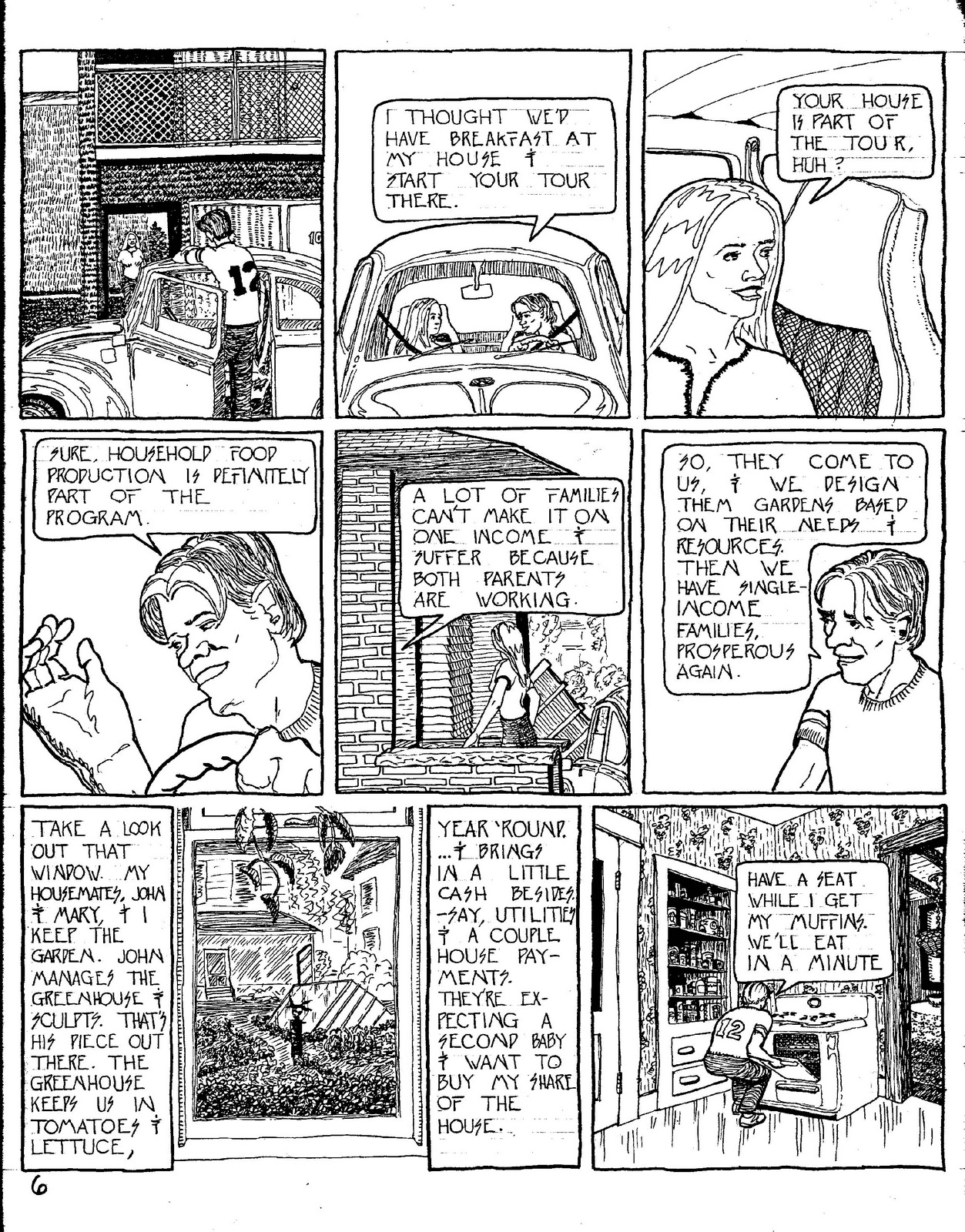
In 1986, I rode my bicycle from Minneapolis to Macomb, Illinois. In Macomb, I spent a week cleaning stalls at the Pres Oder Stables, and seeing friends. I spent a lot of time thinking about  permaculture -- although I didn't know the word -- and the adventure energized me. Back in Minneapolis, I did a comic I called "Altgeld Portfolio" about Altlgeld, a fictional college town which had found a way to thrive in a time when other small towns were dying. (John Peter Altgeld was an Illinois governor who sacrificed his career to behave with integrity toward labor, and toward three condemned activists who were framed for murder.)

I showed this thing all over the Twin Cities energy and environmentalist scene, but the nicest reaction I got was back in Macomb, where Rick Meloan told Joe Alexander that they should get John Long to travel around West Central Illinois buying up derelict VW Bugs, and bring them back to Alexander's farm for rehab.

Permaculture Comic Book (1987)


Sunday, April 18, 2010

The Rain Garden Grows

Neighborhood permaculture workshop on Saturday. There were ten or so of us, visiting four households, with local landscaper Russ Henry. Russ emphasized baby steps, rather than grand permaculture campaigns. He gave us insights into things like planting, soil health, pruning, native plants, and so on, recognizing the permaculture principles of storied planting, and energy flows. It was nice getting a small-p permaculture tour. Tell me when to plant the damned thing, and how to prune it. I've got the big idea, but I don't know jack.

Pictures are a continuation of my cherry tree rain garden project. The berm remains unplanted, and I've planted clover in the lower part, mostly to get a cover. (Click on the close-up and you can see the seeds. Amazing what the modern snapshot cameras can do.) Barbara is starting perennials in pots, and they'll go into the ground as they get some size.

Tuesday, January 5, 2010

Christopher Alexander's A Pattern Language & Pattern Languages


The Whole Earth Catalog called Christopher Alexander’s A Pattern Language “possibly the most important book we’ve ever reviewed.” One of my teachers had studied with Alexander at the University of Oregon, and said that he communed with the gods of space.

The book is a collection of 253 “patterns” for designing human habitation, ranging from regional design (“Wherever possible, work toward the evolution of independent regions of the world; each with a population between two and ten million people; each with its own natural and geographic boundaries; each with its own economy; each one autonomous and self-governing; each with a seat in a world government, without the intervening power of larger states or countries.”), to the detail of home decor (“Do not be tricked into believing that modern decor must be slick or psychedelic, or “natural” or “modern art,” or “plants” or anything else that current taste-makers claim. It is most beautiful when it comes from your life -- the things you care for, the things that tell your story.”) Alexander (with colleagues) presents the patterns as hypotheses -- statements of possible truth needing testing, and possibly, refinement -- ranked by a system of asterisks, two for patterns in which Alexander is very confident, one for patterns in which his confidence is qualified, and no asterisks for patterns which solve problems that might be solved otherwise. (The first pattern above sports two asterisks, the second, one.)

My favorite pattern is Number 106 (two asterisks), “Give each (space surrounding a building) some degree of enclosure; surround each space with wings of buildings, trees, hedges, fences, arcades, and trellised walks, until it becomes an entity with a positive quality and does not spill out indefinitely around corners.” The idea is that we enjoy a sense of space, but don’t recognize spaces until they’re defined. Barbara made a beautiful little secret garden, with a pond, brick walk, and bench, in the slot between our shed and a corner in the cyclone fence around our lot. Early on, we’d planted bittersweet on the fence, making a hedge. Bittersweet is tough and pretty aggressive, and started popping up everywhere. I dug out the bittersweet, and the garden lost its charm. We’ve replace the bittersweet with less assertive species, but it’s taking time to get the nice sense of space back.

The idea is to involve everybody in design, by publishing a complete design “language.” Having the language, we aren’t bound to rely on authorities like architects and bosses for the infrastructure in which we live. (An individual project wouldn’t require coordinating the entire 253-pattern language, any more than an individual statement takes the entire English dictionary, and Alexander says that we can use the pattern language for poetry or prose.)

Alexander calls his book a pattern language, implying that there are others, or that others might evolve. These could be competitive with his 253 patterns, or they could be languages used in other kinds of design. I’ve noticed a number of patterns in my drawing, including “gauge the size of details against larger, unmoving masses,” and “use blacks to lighten darks by comparison.”

Permaculture is a pattern language, although nobody seems to have organized it this way yet. Some of the permaculture principles could be classified as patterns, but they might be a little broad, grammar than vocabulary. Certainly, though, “Obtain a yield by combining species to support each other,” “Arrange your plantations in zones in which those used more frequently or needing more frequent attention are nearest,” and “Trellis fruiting vines on fruit or nut trees” would be included in the vocabulary.

Thursday, October 15, 2009

New Alchemy Strategy


Two pages from a comic I drew in 1986. It was based on an ecological design swiped from the New Alchemists. Back then midwestern places like my home town were hurting. (I think they still are, but the pain is even further removed from the decision makers.) I hoped that I was spreading the word that strategies existed for real and permanent revitalization. Everybody I knew, and a lot I didn't, got a photocopy. I never built one of these either.

Wednesday, October 14, 2009

John Todd: Making The World Safe For Itself

John Todd came to me via the Whole Earth Catalog, and its subsequent incarnations. In 1969, Todd, his wife Nancy Jack, and other colleagues like Bill McLarney founded the New Alchemy Institute on Cape Cod, and that organization catalyzed my hippie fantasies.

I believed that madness like segregation and the war in Viet Nam happened because we lived wrong, and what we needed was experiments in how we might live so as to avoid war and oppression. These people were living my dream! They were collaborating with like-minded people to turn waste into food. They had gardens, wind turbines, passive solar heat, methane generators, and they were recycling garden wastes through these big, interesting-looking fiberglass tanks full of fish. They were ending the war by creating wealth.

Like a lot of hippies, I was wondering, “Why aren’t we doing something like that here.” I wasted a lot of time waiting for New Alchemy-Midwest to materialize.

Todd went on to design systems for cleaning polluted bodies of water, living machines which turned the sewerage in small towns and ski resorts into salable bait fish and decorative plants, and an Ocean-Going Pickup, an inexpensively manufactured small sailboat for third world fishermen. Todd won the 2008 Buckminster Fuller Challenge grant for his proposal, “Comprehensive Design for a Carbon Neutral World: The Challenge of Appalachia.”

Challenge of Appalachia is a plan for repairing existing damage from coal mining, managing ecological succession to reforest the area, and building ecologically sensitive industries and other institutions to afford citizens comfortable and self-reliant livelihoods for generations to come. The idea is that this would spread, and in his proposal, Todd says they have a similar project in operation in Cost Rica.

I was at a permaculture discussion once, in which somebody said, “If John Todd doesn’t get a Nobel Peace Prize, there’s something wrong.” You can quibble about theories and strategies, but peace prosperity and stability are only going to come to stay where people have learned to live as part of the planetary ecosystem. John Todd is somebody who has spent forty years building reproducible examples of how that can be done.

Tuesday, October 13, 2009

Dune And Permaculture

First: This book is a turkey. A very long turkey. This is a story -- with appendices and a glossary -- which takes place against the background of an alien ecology. The ecology is practically a character, and yet it’s on a planet with a few scattered faunal and floral odds and ends, and zillions of predatory worms big enough to eat battle ships. Dune turns the trophic pyramid on its pointed little annelid head. Written in 1965, the characters -- the entire universe, in fact -- are addicted to a drug, maybe a stand-in for LSD, that makes them live for centuries and see the future. At a critical moment, Jessica, who gave birth to a son despite a promise to bear daughters, proclaims her word, straight-faced, as unfailing. Dune relies on inheritance of acquired characteristics (ancestral memories) as a plot device, in spite of its scientific pretensions. It’s primary theme, I think, is the unreliability of prescience. Anybody who needs that advice didn’t need to read it in sensational novels. Another theme is that heroes are bad news. They embody out-of-control history, and the Dune characters go jihadding around the universe beheading bad guys after securing their planet. Author Frank Herbert lets us know, by-the-way, that the chief female characters get a bad deal, then finishes the book with a grand summing up by one of them, telling us that even though they were only mistresses history will remember them as their men’s great loves.

Dune is probably Moammer Khaddafi’s favorite book.

And yet Dune featured ecology at a time when neither word nor concept were well known. Even if it appeared now, flawed as it is, Dune would be ahead of the curve! There is a chapter in which Liet Kynes, the Imperial Planetologist (see, I told you it was goofy!) is dying. As he waits for the ecological coup de grace, he hears his father’s voice lecturing him about -- what else? -- ecology. I’ve selected passages from Dune and from Bill Mollison’s Permaculture: A Designer’s Manual, which echo each other.

Liet thinks, “The real wealth of a planet is in its landscape, how we take part in that basic source of civilization, agriculture.”

Bill Mollison: “Permaculture (permanent agriculture) is the conscious design and maintenance of agriculturally productive ecosystems which have the diversity stability and resillience of natural ecosystems. It is the harmonious integration of landscape and people providing their food, energy, shelter, and other material and non-material needs in a sustainable way. Without permanent agriculture there is no possibility of stable social order.”

Liet’s father, speaking out of Liet’s delerium: “The more life there is within a system, the more niches there are for life.”

Bill Mollison: “...life itself cycles nutrients, giving opportunities for yield, and thus opportunities for species to occupy...niches.”

Mr. Kynes: “Life improves the capacity of the environment to sustain life.”

Mollison (referring to James Lovelock’s Gaia Hypothesis): “(Lovelock) sees the earth, and the universe, as a thought process, or as a self-regulating, self-constructed and reactive system, creating and preserving the conditions that make life possible, and and actively adjusting to regulate disturbances.”

Mr. Kynes: “You can’t draw neat lines around planet-wide problems. Ecology is a cut-and-fit science.”

Mollison: “In life and in design, we must accept that immutable rules will not apply, and instead be prepared to be guided on our continuing exploration byt flexible principles and directives.”

Mr. Kynes: “(An ecologist’s) most important tool is human beings. You must cultivate ecological literacy among the people.”

Mollison: “The only limit on the number of uses of a resource possible within a system is in the limit of information and imagination of the designer.”

Dune would make a Tralfamadorian blush, but this chapter is a gem.

Friday, October 9, 2009

Open Arms: T Minus 612 Months

Bill Rowe liked to cook, and in 1986, began feeding five or six friends with AIDS from his kitchen. Rowe, born around 1930, taught Anthropology at the University of Minnesota -- including a course in the “Anthropology of AIDS” -- was a leftist before a leftist was anybody more progressive than Orrin Hatch, served seven years in an antecedent to the Peace Corps, and once drove from London to Mumbai.

Demand expanded Rowe’s mission at the height of Reagan and company’s supply-side festivities. An informal act of charity became Open Arms of Minnesota, dedicated to feeding people too weak to feed themselves. Kitchen table became church basement, became stand-alone kitchen. Clients continue to include people with HIV/AIDS, but Open Arms also embraces anyone coping with a chronic, progressive illness -- MS, ALS, breast cancer -- and reaches out to people with AIDS in South Africa’s Guguletu township.

In 2008, Open Arms’ kitchen provided a quarter of a million meals. Cooks and volunteers play a game of musical work-surface to make that happen, and Open Arms is building a new, larger facility half a dozen blocks from the current shop.

Thursday night, with less than half a million to go in its eight million dollar building-fund drive, Open Arms toasted its volunteers, and unveiled its new, non-AIDS-specific logo. Executive Director Kevin Winge, usually comfortable in jacket and tie, appeared in a tee shirt to reveal the logo tattooed on his right deltoid, just above a bandaid covering his flu vaccination. He remarked that he had never had a tattoo before, but that his first demonstrates confidence that Open Arms will endure.

I was gratified. Illness is a commons, just as surely as the air, and you and I own pieces of every sufferer’s struggle.

Guests wrote comments on a roll of paper for inclusion in a time capsule aimed at 2060. Free associating, I drew a picture of Michigan J. Frog, later regretting it. After all, who’s going to recognize a poorly drawn character from a hundred-and-five-year-old cartoon, and it’s kind of a wet-blanket image. All I was trying to say was “Frog in a time capsule, nyuk nyuk.” Michigan’s joke, though, is that he sings and dances for his discoverer, but remains stolidly amphibian before the talent scout.

I read fear into it, as I recalled my drawing, fear that new facilities signal the senescences of organizations. Volunteering in the kitchen, I know there’s a dilemma. On one side there are people too incapacitated or impoverished by disease to cook, and Open Arms needs more parking, storage, and work space. On the other, Bill Rowe had the historical advantage over Kevin Winge. Rowe began feeding people on the buyer’s-market side of peak oil. Winge will have to do the job on the seller’s market side, and supporting the new building could become an embarrassment.

Open Arms has the support of umpty-ump volunteers, who put in the equivalent of seventeen staff people. Squeezing more time or effort from them would work against the mission. Chances are Open Arms has identified and recruited all its major donors, and philanthropists give from income -- slow for the foreseeable future -- not capital, and return to the community will never match extraction. Many small donors might do the trick, but KFAI’s fall pledge drive looks like a serious bust, in spite of the station’s new third-ring-suburban reach, and repeated encouragements to listeners to pledge any amount.

The permaculture take is that yield increases the more cycles the energy goes through. Relationships, meaning ways that elements relate, rather than number of elements, are critical. There are no easy answers, but Open Arms could find a clue in the Minnesota Public Radio business model. MPR, a nonprofit owns several for-profit businesses, and has owned others. Open Arms imports handmade tchotchkes from South Africa, but food is its strength, and one leg of the existential tripod of food, shelter, and meaning. Open Arms has existing relationships with organic, community-supported agriculture. Its future may lie in cycling energy through those relationships.

Wednesday, October 7, 2009

End of Summer

Summer lingered through September, a sensual pleasure but odd enough here on the forty-fifth parallel that I shivered at what it might mean. We bumped into Annie, Monday night, and she pointed out that the trees are still green. She’s a transplant here, as are we, but we’ve all been in the north country long enough to expect autumn a month earlier. The last week has been cool and rainy, but still without frost. The Arboretum included advice in its newsletter that we should have our grass short when the snow sticks, so as to deny cover to the tree-girdling mice. After losing two trees last winter, and fearing for the rest, I’m on it. It’s sunny today, and that should dry the grass, making it mowable.

Old hippie-friend KatieMae recommended Waltz with Bashir, which I rented and watched, and Barbara left alone. It’s an animated documentary about post-traumatic shock among middle-aged Israeli men who were young soldiers during the 1982 invasion of Lebanon. Kate is a Viet Nam vet who is wrestling with war demons she managed to keep waiting for forty years. Waltz is visually striking, and I found myself feeling protective toward its various protagonists. In one of the special features, director Ari Folman says that war is a useless horror caused by evil, charismatic men. (Bashir was Bashir Gemayel, leader of a right-wing, largely Christian party, assassinated in a bombing. Paramilitary followers avenged his death by the massacre of civilians in two refugee camps, while Israeli forces enclosed the camps.) My own take is that the egomaniacs steer and shape war, to a small extent, but war is a golem, set in motion by society’s thoughtless choices. The traumatized veterans of the Lebanon invasion were merely bystanders to the massacre that scarred them; what demons will haunt the veterans of last year’s Gaza adventure. Or haunt America’s Imperial legions.

Tuesday night was drawing group, thinly attended because of the loss of one parent, the infirmity of another, a long weekend at the cabin for two, and unknown. I liked what I did, drawing Liz, using a Sharpie in a five-and-a-half by eight-and-a-half notebook, staying loose, and getting decent proportion and foreshortening. A lot of the conversation was about the economy, and justifiably worried. People’s livelihoods seem precarious, and that's perverse. If society is in trouble, you’d think we’d want all minds on deck and ready for assignment. If you can’t afford to have them there, you’re doing the wrong thing. The economy doesn’t stop on a dime and make change, but full, meaningful employment should be part of the design program.

I continue my slog through the permaculture Designer’s Manual. It’s not a kind of reading I enjoy or do well, but despite that, I feel I have found my path with a heart. Mollison’s program for H. sapiens has ultimate potential for soothing our hurts and the ending the hurt we cause the planet, yet we’re so far from following it -- there’s so much to learn and it's so different from what we know -- that the odds seem long indeed.

Friday, October 2, 2009

Notes On Permaculture: A Designer's Manual: Intro

This is a book that will become more dear as we scoot the post-peak downslope. Not only will anybody who bought it want to hang onto it and sensible people want to get it, it’s the equivalent of a college textbook with similar prices ($94.28 new at Alibris, $98.00 at Seeds of Change, and $104.99 at Amazon, with used copies ranging from an even seventy-nine bucks up to more than two ninety), getting spendier as prices in general go up and discretionary cash goes down. When I got my copy from the Hennepin County Library, it owned five copies, there were holds on all, and I had to wait more than two months for my turn.

I’m reading the first four chapters of Bill Mollison’s Permaculture Designer’s Manual (Tagari Press, Tyalgum, NSW, Australia, 1988). This post will be an outline of Chapter One, the introduction.

Mollison argues from general to specific in three sections: Philosophy, Ethics, and “Permaculture in Landscape and Society.” That’s consistent with permaculture practice in which we patiently watch places and systems, relationships behaviors and patterns, then act respectfully to provide for ourselves. Mollison begins with the most general, with the result of his observation, and derives his action from that in stages.

Mollison is unequivocal in revealing his design philosophy. He says, “We are in danger of perishing through our own stupidity.” He is concerned with extinction and human appropriation of wilderness, and says that taking responsibility is “the only” ethical decision. Reductionism, the approach to understanding in which we isolate parts from systems, then study the parts of parts to understand what they are, has kept the western, dominant culture from being able to foresee results or to design integrated systems. Life, he says, is cooperative, we are not, and cooperation is the key to our future.

As an example of cooperation, Mollison mentions the relationship between mycorhiza and trees. This went over my head the first time I read it, but since then I’ve read Paul StametsMycellium Running, and found a pretty interesting anecdote. There are three basic ways fungus make a living. They scavenge dead things; they parasitize living things; and they cooperate with living things. Mycorhiza work the third way, penetrating trees’ roots and extending them. Researchers shielded some trees in a grove, and were able to trace the transfer of nutrients from trees in sun to trees in shade, via the fungi in the ground.

We are in transition, from what Mollison would probably say is a philosophy of soulless accountancy to one in which we can engage with the world honestly and down through millennia. It’s a meeting of science and mysticism. He quotes James Lovelock, author of the Gaia Hypothesis, as saying that life conditions the world for life, it is a “self-regulating system.” We may be the only exception, and maybe the Earth can’t accept that. He quotes native peoples as believing that the ideal way to spend life is to “lead the most evolved life possible and to assist and celebrate other life forms.” Life is trying for perfection and maybe transcendance. Native people understood this and suffered from contact with our technological materialism. Mollison believes that heaven and hell are here and now, and we choose between them.

Ethically, Mollison bases permaculture on three principles: Care of the Earth and preserving life systems; Care of People, in which everybody gets necessary resources; and Setting Limits to Population and Consumption.

He qualifies the third principle by saying, “By governing our own needs, we can set resources aside to further the above principles,” and says we must be self reliant as individuals and cooperate as groups. Cooperation observed in nature becomes and ethical basis. He says he has evolved a philosophy that’s close to Taoism: “Work with rather than against nature. Observe thoughtfully for a long time. Look at systems and people in all their functions. Let systems demonstrate their own evolutions.”

Questions are more important to Mollison than answers. He says we should refuse or reframe mistaken questions. For instance, “What can I get from this land or person?” becomes, “What does this person or land have to give if I cooperate with them?”

Human beings can learn what’s appropriate, and stop doing harmful things. Conservative behaviors evolve this way, and this is the source of tribal taboos. He articulates two rules: “The Rule of Necessitous Use,” in which we leave natural systems alone until we need them, and “The Rule of Conservative Use,” in which we reduce waste, replace lost minerals, and assess long-term harms to life and society and buffer them.

Observing these rules, we may realize that we are connected to the rest of life, maybe by noticing help we receive from species that we did not extinguish. Mollison mentions the mycorhiza, and says we may learn the value of community from examples like this. He hopes that this awareness will expand from family and friends to the entire human species. According to Mollison, the Permaculture Designer’s Manual is about “mechanisms of mature ethical behavior.” Unequivocal. He mentions a global nation of people who share this ethic.

If industrialism is ephemeral, permaculture is permanent. Mollison mentions three approaches to permanence, the peasant or “feudal” approach, the modern or “baronial” approach, and the forest or “communal” approach. In the first, peasants gather and haul manure and other nutrients to fertilize grain. The second uses the most land, few people, machinery, and single species. He says this is the least productive use of land we can devise, destroys landscapes and soil life, and makes “agricultural deserts.” The forest approach needs generations of care, and reverence. This is the permaculture approach. The further you get from this, says Mollison, the greater the risk of “tyranny, feudalism, revolution, toil.” Modern agriculture is unstable and vulnerable to natural disaster or economic attack, it needs energy from outside the system, and it subordinates the needs of people to the needs of commerce.

Mollison has a two-page illustration at this point. The left side pictures three stages of transition from “Contemporary Western Agriculture” in year 1, through “Transitional and Conservation Farming” in year four, to “Permaculture; 70% of Cropland Devoted to Forage Farming” in year eight. The right side has bar graphs for each of the three stages showing improvement from year one to year eight in fifteen areas:

Total Cash Income (+ over time)
Total Cash Cost (- over time)
Oil or Calories Used for Fuel, Fertilizer, Biocides (- over time)
Energy Produced (+ over time)
Soil Loss (- over time)
Efficiency of Water Use and Soil Water Storage (+ over time)
Pollution (- over time)
Genetic Richness of Crops and Livestock (+ over time)
Soil Life (+ over time)
Forest Biomass (+ over time)
Loss to Pests (- over time)
Farm Employment (+ over time)
Food Quality (+ over time)
Human and Environmental Health (+ over time)
Life Quality as “Right Livelihood” (+ over time)
Caption: “Selected forests not only yield more than annual crops, but provide a diverse nutrient and fuel resource for such crops.”

Permanent agriculture is necessary for stable social order. Going from permanent agriculture to commercial, annual agriculture takes our society from low-energy to high-energy consumption, and leads us to exploit the third world. Mollison says he tells people to “go home and garden and not try to improve mechanized agriculture.” He sees a new ecological synthesis using whole-system energy flows as described by Howard Odum. (Howard Odum was an American ecologist, of the World War II generation. He was interested in general systems theory, and developed the concept of embodied energy, or “emergy,” which is commonly used by permaculturists to mean things which can be harnessed or harvested to promote yield. Examples are sun, rain, wind, and soil fertility. Embodied energy might also be the leaves that get caught in a fence or hedge. Odum used electrical circuits as analogies in discussing the flow of chemicals like carbon in natural systems. Larger ecosystems are more stable, with the world itself being most stable. I think Mollison would say that people should take advantage of this by integrating our systems with the largest and most stable.)

Permaculture designers should concentrate on rehabbing and rethinking already settled areas. This amounts to designing ecosystems. Focusing on food, fuel, and water supply will free most of the world’s natural systems and let wilderness come back, so designers will select species for yields that benefit humans. In natural ecosystems, organisms digest the native dead plant and animal matter. In designed ecosystems, humans have the responsibility of selecting and arranging it for the organisms to recycle. There would be cycles in which garden waste, kitchen scraps, graywater, and manure would become soils, along with occasional imports. Talking with Sam about brewing, and the effect yeast selection has on flavor makes me wonder if, someday, gardeners would select the organisms that live in the compost pile, designing compost to encourage some species or enhance the flavor of another.

Mollison reminds us that we can catch rainwater, and build soils to hold water longer, but we still need forests to feed clouds and rivers and “lock up gaseous pollutants.” Our survival demands conservation. He says, “We have abused land and laid waste to systems we need never have disturbed had we attended to our home gardens and settlements,” and stipulates four “Natural Systems Ethics: Implacable and uncompromising opposition to further disturbance of remaining forests; rehabilitation of damaged systems to steady states; establishment of our plant systems on the least amount of land; and establishment of refuges for threatened species.

Mollison says permaculture is most interested in establishing plant systems on the least amount of land. He insists that “all people who act responsibly” subscribe to these statements:
“Implacable and uncompromising opposition to further disturbance of any remaining natural forests where most species are still in balance,” and “vigorous rehabilitation of degraded and damaged natural systems to stable states.”

That said, he goes on to say that we should use all species that would be useful to our settlement designs, “provided they are not locally rampant and invasive.” This is probably the source for criticisms that permaculture promotes importing invasive species (despite Mollison’s disclaimer). How do you know what a foreign species will do in a new location? Due diligence would seem to require a survey of a species’ relationships in its native range before importing it, but someone like me would find that beyond practicality, and might be tempted to just go ahead and introduce “that Caucasian perennial spinach that’s been in all the permaculture magazines.”

Mollison says that the world changes naturally -- glaciation, continental drift, wind, birds, rafting on bodies of water -- the implication that we wouldn’t be doing anything that nature doesn’t do itself, just doing it a little faster. What he’s suggesting is that we mimic the natural, larger ecosystem, and integrate with it locally, but can we trust ourelves to do that, taking species for our purposes from foreign contexts? “Can you hunt the prey for the lions or satisfy the appetite of the young lions?”

In a period of deforestation and extinction, Mollison says there are “three parallel and concurrent responses to the environment: “Care for surviving natural assemblies to leave the wilderness to heal itself;” “Rehabilitate degraded or eroded land, using complex pioneer species (what is a complex species?) and long-term plant assemblies” (meaning trees, shrubs, and companion ground covers); and “Create our own complex living environment with as many species as we can save, or have need for from wherever on Earth they come.”

Mollison is talking about building useful, designed ecosystems. I’m all for that, but can we know enough about an exotic species and its relationships to add it to the backyard. There are at least two large operations within a half day’s drive from Minneapolis where the owners began by planting several varieties of apple, and selecting the varieties that did best on their sites. Without spraying, both these permaculture orchards yield tasty, unblemished fruit. How could the growers have anticipated whatever it was that made the varieties that succeeded thrive? Eathworms aren’t native to Minnesota. They are good for garden soil, but make forest soils hard, endangering the trees. Who knew?

Mollison says we need refuges for all global life forms. We should try to observe systems that remain and build “new or recombinant ecologies” to stabilize degraded ones.

The chemistry of the air, soil, and water is in flux because of human-invented materials.

The first thing Mollison says we need to do is to get our house (and garden) in order so that we can count on it to support us and not feed the poisons we have made back to us. The second one is to limit our population. These are “intimately connected duties,” and if we don’t perform them, we are a “plague.”

Unequivocal and implacable again, Mollison insists that “responsible conservationists” support themselves with gardens, and work to reduce their energy needs to what can be supplied locally and harmlessly. Mollison is not shy about saying that it’s hypocritical to call for conservation on one hand and live on mass-produced products on the other. Nor is he shy about implying that religion shares in this hypocrisy. Wonder and feeling for the environment are necessary, and religions need to cultivate an “live by” that wonder. My guess is that Mollison came out of a non-sacramental kind of Protestantism, but would he approve of a new religion that made compost as a sign of grace?

Or to sacramentally create and support wilderness? He believes permaculturists should support wilderness-conserving organizations, and maintain some wilderness on the land for which we are responsible, be it a butterfly garden in a backyard, or a forest preserve on larger property.

Mollison finishes the chapter by saying, “Design is the keyword of this book: design in landscape, social and conceptual systems, and design in space and time. I have attempted a treatment of the difficult subject of paterning, and have tried to order some complex subjects so as to make them accessible. The text is positivistic without either the pretended innocence or the belief that everything will turn out right. Only if we make it so will this happen.

“Adoption of permaculture strategies will reduce land needed to support us and release land for wildlife and wild systems. Respect for all life forms is a basic, and in fact essential ethic for all people.”

Wednesday, September 23, 2009

Flubs, Fibs, Microbrew, And Permacommerce

Monday I mis-quoted a friend, Scott, about the business of brewing. Saturday Sam had given me a taste of very promising ale between fermentations, and, in my enthusiasm, I misunderstood Scott's conversation. I wrote:

“A commercial brewing start-up, even for micro-brewing is prohibitively expensive. Scott has been researching ways of making it happen. According to my understanding...farmers, even urban farmers, can make things like beer cider and mead, without all of the government-mandated investment required of stand-alone breweries. One small batch used all of Sam’s 2009 hops, but Scott says you get to import to fill the holes in your own production.”

Later I got to thinking that saying that without talking to Scott myself put me out on a limb. I asked Scott to comment, and he wrote me”

“That's pretty close. To be very precise, the only change would be ‘...,can make things like...’ to ‘...may be able to make things like mead, wine and possibly even cider and beer without...’ “The general idea being that I'm still not certain. The Minnesota Farm Wineries Act appears to be pretty simply worded and certainly appears to allow for urban farm wineries (at least by omission)...”

Scott goes on to say that sales in the city would be a problem because a farm winery’s sales happen mostly on site, and an urban business would have more licensing and zoning restrictions than a place in the country.

Scott writes, “...I'm not quite as optimistic that it could apply to beer. I'm fairly confident about wine. Mead is usually not distinguished from wine so I'm pretty confident about that too.”

I don’t even know what mead tastes like. I wonder how it would go with seasoned almonds. Gotta get a bottle.

“My understanding is that cider is already regulated fairly minimally, and since it is made directly from a minimally processed ag product, I think it's also pretty likely. Beer, though, is a bit different, so I'm not quite as optimistic.

“One other clarification, my understanding of the Act is that importation of ingredients from other states is only allowed to cover shortfalls in production due to natural agricultural variability. I don't think it applies to shortfalls due to production constraints that are implicit to your operation (like urban micro-acreage).”

All this means that I let my enthusiasm get the better of me. I've changed the original post. I think that it’s probably possible for a permaculture operation like Barbara’s and mine to feed us, create some beauty, and take pressure off the city’s storm sewers. What I was searching for in my brewing discussion was ways to live in the cash economy, without helping steer it toward destruction.

Barsy’s Almonds are a beginning. There’s an infant upper-midwest hazelnut industry that might eventually make a marriage with Barsy’s. It seems like very good beer would be another transition product. (Sam's Christmas beer received an honorable mention at the 2008 State Fair.)
Link
Buckminster Fuller wrote to a young admirer, “The things to do are: the things that need doing: that you see need to be done, that no one else seems to see need to be done.”

One of the things that I see needs to be done that no one else seems to see needs doing is building a transitional economy. The old economy is adapted to conditions that will not continue, abundant cheap fuel, and an unsaturated world as sink for waste (familiar explanations of current economic problems consider proximate causes, with little consideration of the sand where our foundations wiggle their toes). Beer and flavored nuts, as well perhaps as art, are cash products which might weather disruptions to the oil-and-waste-dependent economy, while we reduce our personal dependences.

I drew the accompanying illustration at a week-long permaculture design course in the newly built cidery at Mark Shepard’s New Forest Farm, near Viola, Wisconsin.

Monday, September 14, 2009

Prairie Clover: Roots In The Ground

This truly is a case of “Can’t learn less,” because I don’t know nuthin’.

The photograph is a baby prairie clover. Barbara and I had been nursing this one and ten others in pots, out of reach of the bunnies.

“What do you want to do with them over the winter?”

“I don’t know. What do you want to do with them over the winter?”

“We should decide where we want them. What do you think?”

“I don’t know. What do you think?”

And so on.

Finally I decided to put them in the weed patch/rain garden, the swale that I’d dug and mulched with cardboard and wood chips. I put them there in spite of not knowing how prairie clover likes getting its roots wet intermittently. Something needed to go in that spot, but it’s pretty close to the bottom of Barbara’s and my personal watershed, so we might want the clovers’ nitrogen-fixing benefit in some other place. This raises the issues of how easy are they to move, and how readily they propagate.

Other permaculture questions are, how many prairie clovers do I need, and what can I do to make life better for them. Herbaceous perennials are part of my campaign to turn my urban lawn into a bonsai ecology.

I planted, thinking about a Wendell Berry essay I wanted to review. It’s in the September issue of the Progressive. Berry is in his mid-seventies, a prolific writer about place and ecology, an emeritus university professor, and a farmer who works his northeastern Kentucky land with horses. The Progressive essay was “Inverting the Economic Order.” He writes, “In ordering the economy of a household or community or nation, I would put nature first, the economies of land use second, the manufacturing economy third, and the consumer economy fourth.”

I kept balking as I read the essay, thinking “Nobody’s going to understand this. It’s too strange.” It’s not that it’s illogical -- it’s very logical -- but it is foreign to us, and that’s disturbing.

I may write about Berry’s essay, or I may decide it’s too tough to tackle, but here’s an idea: Every human eneterprise occur somewhere on a continuum from “degrading to humans in the short term and guaranteed to impoverish us in the long run,” through “necessary to short-term welfare, but ultimately degrading to human welfare,” to “vital to both short- and long-term welfare.” Berry says human wealth derives from our environment and human virtue; the bulk of our enterprise reduces our real wealth.

Thursday, August 27, 2009

Hops In The Urban Permaculture Plantation

The picture is of Sam’s hops. Hops are a perennial vine, very prolific, and essential in beer making. Sam is my son, and an amateur brewer.

There are two mature hop plants, Chinook and Centennial, both very bitter and used to flavor American pale ale, Indian pale ale, or jes’ plain pale ale. Chinook and Centennial are both on branches about eight feet long, taken from a lilac. Sam says the branches could have been fifteen feet long. I believe him. These are very lush plants.

A friend has given Sam another plant that currently looks like green wires cut short just above the sod. It’s either Nugget, another bitter hop, or Fuggle, which is milder.

I can’t say much about the plant itself, about what it looks like underground, what good it is to those of us who aren’t brewers, or what it might add to or need from a permaculture plantation. An old rocker back home, Roger Vail, had me smoke it, but Roger has a peculiar worldview, and it didn't do nothin' for me. I like the occasional pale ale, and Sam appears to be an afficionado, so hops seem like an obvious choice for the urban farm.

No barley, though. I’m running out of room.

Grape harvest today, and a brief stint at the Open Arms kitchen.

Thursday, August 20, 2009

Got To Find A Way...

Thirty years ago San Francisco writer Anne Herbert wrote that God kicked us out of the Garden because we started keeping score.

About the same time, biological polymath Gregory Bateson said what happened was that Adam and Eve were so full of themselves, because they’d managed to pick the forbidden apple, that they kicked God out of the garden.

Maybe one is a different way of saying the other. Adam and Eve made nature’s purposes subordinate to their own. Scorekeeping amounts to subordinating nature (play) to our vanity. I most definitely keep score, but I’m trying to break the habit, invite God back into the garden. Permaculture is my method, learning to provide for myself in a way that mimics -- and integrates with -- the rest of the biological world.

This is a picture of a young grape vine (given to me, variety forgotten) trellised on the Beacon apple tree. The physical closeness of the two plants isn’t part of a deep ecological relationship. The grape gets a place to hang out, but I can't think of what the apple gets from the grape. In fact, the grape doesn’t naturally grip the slick apple bark, and needs me to tie it up. A defense against vines, maybe, evolved by apple trees? Permaculturalists say that growing food in “guilds,” combinations of plants that do things for each other, yields less per plant but more per acre than monocrops.

Maybe a grape trellised on an apple is getting close to the critique that permaculture is an attempt to mimic climax ecosystems, systems at a stage when they don’t yield a lot of food. I don’t know. You can’t learn less.

Thursday, August 6, 2009

Pulling Weeds

I’m lying on my belly in the alley. Our driveway is the dirty slope on the left. I’ve been pulling lots of weeds, for my sins, preparatory to filling the cracks they're in and seal-coating the driveway. I mentioned this in my Post-Apocalyptic Salad blog. What you’re looking at is dirt that collected where the driveway asphalt is lower than the alley concrete. You can see some of the vegetative devastation, too. Weeds, feel the wrath of Tom! Two alleys make a tee here, which explains how I can be on my belly in the alley and looking across another alley at somebody else's garage door.

It’s probably criminal abuse of tools, but the best thing I’ve discovered for yanking weeds out of cracks is a pair of needle-nosed pliers. I also use a screwdriver and a putty knife to scrape and pry. I tried my fingers, and wound up leaving a lot of root below grade. Fire from a propane torch was likewise useless: tops blackened, but there was plenty of juice only nanometers below. Ancient herbivores were browsing weeds long before hominids started chipping flint and laying asphalt, so weeds have adapted, and I expect new growth, even through seal coat, from tissue left behind. Gretchen, fellow scullery volunteer at Open Arms of Minnesota, suggested salting the cracks, and I may so do before applying petroleum products.

Something interesting I’ve discovered is that purslane, for all its above-ground branches, has but a single root, only a few short hairs wisping from it. A small white carrot.

I’ve thought about dentistry as I’ve worked, and I’ve thought about cancer surgery, but only a little, recognizing that there are similarities between weeding the driveway and removing decay or treasonous cells from a body. I dig in and try to get all of the offensive growth. In case I miss something, I leave a little poison (salt) behind to thwart new growth.

I’ve also thought about succession. Cracks appear in rock/asphalt for whatever reason. Winter moisture freezes in the cracks and enlarges them. Soil and seeds drift into the cracks. One plant makes things congenial for another. Some make the environment cozy for animals, ants mostly in the driveway. Animals plant more seeds. Maybe it’s coincidence, but there was a pretty messy mix of purslane, quack grass, eensey-teensey ants, and a couple of other things where I took the picture. Still, I couldn’t help thinking of some permaculturists I met who kept getting volunteer raspberries next to their hazelnuts.

Interesting as all of this may be, I'd rather have questions. Answers make me too comfortable, and I haven't come up with many questions. So far only, "Should I add the soil in the picture to my garden? Does the city salt the alleys? (Maybe not; I've never seen them do it; nobody's speeding there; I've fallen nether bits-over-teakettle on slick ice under fresh snow; I'll call.) If it does salt the alleys, is the salt still in the dirt?"

Friday, July 31, 2009

Round and Round The Mulberry That Ate South Minneapolis


This is a mulberry tree, red mulberry (murus rubra) I think. (Click on the picture to discover the species of the vine in the top-left corner.) There are several other mulberries growing in this fence in South Minneapolis. This tree is probably closely related to the mature mulberry at the near end of the next block north. The mature tree is 25-30 feet tall, with a similar drip-line diameter. The blotchy gray picture is the sidewalk below the parent, taken several weeks after the fruit was long gone from the tree’s branches.

Whoever is responsible for the fence should dig these plants out before they get bigger and wreck it. Mulberries are edible, and the trees have various uses, medicinal, fibrous, dyeing, and hallucinogenic, but probably not for an arborista with a small site. (Small, dry, kind of sweet, and not very flavorful; kids and birds eat them.) They grow and spread quickly, and thrive on being cut back. They’re weeds.

I removed one from the bank in front of our house when it was a foot or so tall. I was in junior-scientist mode, so I took some pains and excavated the entire root. It was between two and three feet long. (Junior-scientist mode, but not enough so's I'd write down what I'd found.)

Mulberries are often included in permaculture prescriptions. This may be an artifact of permaculture’s down-under origin. Or in larger plantations, mulberries might be commercially useful. Hypothesis: Mulberries would enhance growing and nutritional conditions for the rest of a site, if placed at the top of its slope. If the roots of older trees are proportional to my baby’s, they’re very deep. They would lift minerals from way down in the clay. Rainwater flowing downslope, and birds, would distribute minerals from fallen berries and leaves.

Thursday, July 30, 2009

Wabbit-Proof Fence


They bring out my inner Elmer Fudd. Fudd was dumpy, pompous, middle aged, and hellbent on banging what must have been an already frayed ego against Bugs Bunny’s insouciance. He couldn’t get a break. But in the Wagnerian spoof What’s Opera, Doc? Fudd manages to “kill the wabbit,” then carries Bugs’ broken body off in a cloud of grief and remorse. Even then, Bugs gets the last word, rising from Elmer’s embrace, shrugging to the camera and saying, “What’d ya expect? It’s opera.”

Kumo, the kitty, and I like to chase them. Wabbits. We try to trap them with a pincer maneuver. “You go that way. It’ll watch me circle this way, and you can get it.” The rabbits have bumped into both of us as they fled the other.

But maybe I’m more like Farmer MacGregor in Beatrix Potter’s Peter Rabbit. (Potter was the first Brit to realize that lichens are colonies of symbiotic algae and fungus.) I have a stake, after all, and the rabbits nibble the things I plant. If they wind up in a pie, they’re only making restitution. They (it?) go mostly for the prairie clover, but they’ve also done a number on a plum I’ve been trying to nurse back to health after the mice girdled it last winter (my fault...the mice will starve this winter).Link

And speaking of winter. Speculation is that we're seeing more rabbits than usual because milder winters have given the local population an extra breeding cycle every year. Maybe I can send my bill for rabbit damage to ExxonMobil.

Prairie clover (Petalostemum or Dalea purpureum) is a native perennial, and a nitrogen fixer. It’s cousin to clover. It’s one of the mix of herbaceous plants I’m trying to establish in my sideyard ecology. Rabbits seem to like it. A lot. It’s starts out small, and seems to take two years to get blooms. What’s on the menu this year was in pots last year, and it’s still tiny.

The bunnies chew it back to stems. Maybe this is something the clover has adapted to over the milennia, and needs it, the way prairie needs fire. Maybe the plants will be fuller for their pruning. I don’t know. They’re mine, they cost two or three bucks apiece, they take a long time to grow, and I don’t want the consarn idjit varmints running experiments in my lab.

So I’ve wired together little cylinders of hardware cloth, and stapled them into the ground. One for every clover. Mwahaha!

Now for the squirrels.