Showing posts with label Brewing. Show all posts

Wednesday, September 23, 2009

Flubs, Fibs, Microbrew, And Permacommerce

Monday I mis-quoted a friend, Scott, about the business of brewing. Saturday Sam had given me a taste of very promising ale between fermentations, and, in my enthusiasm, I misunderstood Scott's conversation. I wrote:

“A commercial brewing start-up, even for micro-brewing is prohibitively expensive. Scott has been researching ways of making it happen. According to my understanding...farmers, even urban farmers, can make things like beer cider and mead, without all of the government-mandated investment required of stand-alone breweries. One small batch used all of Sam’s 2009 hops, but Scott says you get to import to fill the holes in your own production.”

Later I got to thinking that saying that without talking to Scott myself put me out on a limb. I asked Scott to comment, and he wrote me”

“That's pretty close. To be very precise, the only change would be ‘...,can make things like...’ to ‘...may be able to make things like mead, wine and possibly even cider and beer without...’ “The general idea being that I'm still not certain. The Minnesota Farm Wineries Act appears to be pretty simply worded and certainly appears to allow for urban farm wineries (at least by omission)...”

Scott goes on to say that sales in the city would be a problem because a farm winery’s sales happen mostly on site, and an urban business would have more licensing and zoning restrictions than a place in the country.

Scott writes, “...I'm not quite as optimistic that it could apply to beer. I'm fairly confident about wine. Mead is usually not distinguished from wine so I'm pretty confident about that too.”

I don’t even know what mead tastes like. I wonder how it would go with seasoned almonds. Gotta get a bottle.

“My understanding is that cider is already regulated fairly minimally, and since it is made directly from a minimally processed ag product, I think it's also pretty likely. Beer, though, is a bit different, so I'm not quite as optimistic.

“One other clarification, my understanding of the Act is that importation of ingredients from other states is only allowed to cover shortfalls in production due to natural agricultural variability. I don't think it applies to shortfalls due to production constraints that are implicit to your operation (like urban micro-acreage).”

All this means that I let my enthusiasm get the better of me. I've changed the original post. I think that it’s probably possible for a permaculture operation like Barbara’s and mine to feed us, create some beauty, and take pressure off the city’s storm sewers. What I was searching for in my brewing discussion was ways to live in the cash economy, without helping steer it toward destruction.

Barsy’s Almonds are a beginning. There’s an infant upper-midwest hazelnut industry that might eventually make a marriage with Barsy’s. It seems like very good beer would be another transition product. (Sam's Christmas beer received an honorable mention at the 2008 State Fair.)
Link
Buckminster Fuller wrote to a young admirer, “The things to do are: the things that need doing: that you see need to be done, that no one else seems to see need to be done.”

One of the things that I see needs to be done that no one else seems to see needs doing is building a transitional economy. The old economy is adapted to conditions that will not continue, abundant cheap fuel, and an unsaturated world as sink for waste (familiar explanations of current economic problems consider proximate causes, with little consideration of the sand where our foundations wiggle their toes). Beer and flavored nuts, as well perhaps as art, are cash products which might weather disruptions to the oil-and-waste-dependent economy, while we reduce our personal dependences.

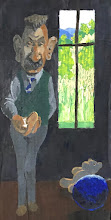
I drew the accompanying illustration at a week-long permaculture design course in the newly built cidery at Mark Shepard’s New Forest Farm, near Viola, Wisconsin.

Monday, September 21, 2009

How Green Was My Weekend


There were four farmers’ markets over the weekend, and I worked two, New Hope and Uptown. Sam helped at Uptown. I’d asked if he would because I wanted to see if anybody at the cool-neighborhood market would be interested in my drawings. Selling Barsy’s Almonds is a constant performance, and I figured one of us could take care of business, while the other minded the art.

It turned out that only a handful of people checked out the drawings, and were entirely capable of flipping through the stack by themselves, so I could have handled themarket alone. It was nice to have Sam along, though, and he was a natural with the customers.

Sam opened his bucket of Mad Scientist India Pale Ale over the weekend, siphoning the brew out for the second fermentation. We had a little suspense when he tasted it. There’d been a little clumsiness with the yeast and the equipment sanitizer when he’d mixed the batch, and he said the beer might taste foul. It was great, though: not carbonated yet, but a nice combination of sweet and very bitter. Sam pointed out a faint floral note, and the slight sting from the alcohol. His first original recipe is a success. The used hops went back into the garden, via the compost pile, along with the yeast.

Barbara talked to Scott, a forward thinker and another urban farmer and brewer, at the Kingfield Market on Sunday. A commercial brewing start-up, even for micro-brewing is prohibitively expensive. Scott has plans for small-scale mead production, and believes that can be done with a conceivable amount of capital.

Saturday, at New Hope, I talked to a Princeton farmer who was selling Haralson apples. Taking a hint from somebody who knows more than I do, we picked Haralsons when we got home. Now they get juiced or sliced and frozen.

Saturday, September 5, 2009

Mad Scientist India Pale Ale

Sam and Marissa are here tonight brewing. The beer is his Mad Scientist India Pale Ale. Sam says it’s entirely experimental and he doesn’t plan to make it again. He plans to test it on his friends this Halloween. Mwahaha!

When he started, the house smelled pleasantly like downtown Peoria. Or St. Louis near the Ralston plant. (I haven’t been in either city since the sixties, and for all I know both are now entirely sweet-smelling.) There’s a lot of malt in this brew, and the beer should be strong. After it came to a boil, and he had explained the proteins’ unwinding and rewinding, Sam added baskets of hops from the garden. Now the house has a perfumey-citrusy smell. Boy, you got the place smellin’ like a Kansas City fancy house.

The three gallons of water, malt, and hops will boil for an hour, with occasional stirring. Toward the end of the boil, Sam will add more hops. At the end of the hour, he’ll take the kettle outside, and dunk a copper coil into it. Running water from the garden hose through the coil will cool the liquid, which is called “wort,” and pronounced “wert.” Like a good permaculturist, Sam will water plants with the runoff. Yeast goes into the cooled wort, and the whole mess goes into a seven-gallon bucket, with enough additional water to make five gallons, and a little gadget on top that lets air out but doesn’t let air in.

Two weeks from now, he’ll siphon the liquid off, leaving a layer of yeast behind, add some more water, and let the proposed beer sit for four more weeks. (The water at this step wouldn’t be necessary, if he had used dried hops instead of what he’d just found by the alley. It’s a matter of volume.) More yeast settles out, and the beer and some corn sugar go into a keg to grow bubbles.

Sam already has his costume, a white lab coat. He plans to smudge it with charcoal, blacken his face, and make his hair stick out wildly with gel. Marissa is keeping her costume a secret.

Thursday, August 27, 2009

Hops In The Urban Permaculture Plantation

The picture is of Sam’s hops. Hops are a perennial vine, very prolific, and essential in beer making. Sam is my son, and an amateur brewer.

There are two mature hop plants, Chinook and Centennial, both very bitter and used to flavor American pale ale, Indian pale ale, or jes’ plain pale ale. Chinook and Centennial are both on branches about eight feet long, taken from a lilac. Sam says the branches could have been fifteen feet long. I believe him. These are very lush plants.

A friend has given Sam another plant that currently looks like green wires cut short just above the sod. It’s either Nugget, another bitter hop, or Fuggle, which is milder.

I can’t say much about the plant itself, about what it looks like underground, what good it is to those of us who aren’t brewers, or what it might add to or need from a permaculture plantation. An old rocker back home, Roger Vail, had me smoke it, but Roger has a peculiar worldview, and it didn't do nothin' for me. I like the occasional pale ale, and Sam appears to be an afficionado, so hops seem like an obvious choice for the urban farm.

No barley, though. I’m running out of room.

Grape harvest today, and a brief stint at the Open Arms kitchen.