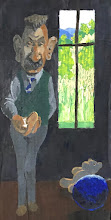
I realized it was life that looked after the climate and the atmosphere.
James Lovelock
James Lovelock was born in 1919 in the English county of Hertfordshire. He was a conscientious objector at the beginning of World War II, but Nazi atrocities convinced him to enlist. The military turned him down because he was engaged in medical research. He is the inventor of the electron capture detector, which can detect CFCs or pesticides in quantities as low a one part per trillion.
In the 1960s Lovelock was working for NASA, developing ways to detect life on other planets. He reasoned that chemical reactions would have stopped in the atmospheres of planets without life. This is the case on Mars and Venus, planets NASA thought might have life. Earth has lots of reactions in the atmosphere. For instance, methane and oxygen are constantly reacting in the air. But the composition of our atmosphere remains constant.
This was the beginning of Lovelock's "Gaia Hypothesis." (Say Guy-uh) Gases like oxygen and methane come from living things, so living things must be regulating their relative amounts. Beyond this, the Gaia Hypothesis says that life actively controls the temperature and composition of the Earth's atmosphere, and other parts of the Earth's surface. If the temperature or the atmospheric composition is disturbed, life will correct it by changes in the ecosystem. The climate, the air, the rocks, the ocean, and life are a single system.
Showing posts with label Gaia Hypothesis. Show all posts
Tuesday, January 4, 2011
Friday, December 31, 2010
Lynn Margulis
I never believed what they told me, I believed what I saw myself.
Lynn Margulis
Lynn Margulis was born in 1938. She is a biologist and teaches in the Department of Geosciences at the University of Massachusetts at Amherst.
Margulis is interested in how the cells that we're made of came to have parts called "organelles." She believes that complex cells, called "eukaryotes," are the descendants of simpler cells. The ancient, simpler cells tried to eat each other. Instead they began working relationships. They became parts of something new. Margulis says a cell isn't like a bacterium. It's "a microbial community."
When Margulis first published these ideas, scientists didn't believe them. Now they are accepted by most biologists.
She believes that new species happen when existing species take on genes from other species. The traditional theory says that genes mutate, and if the mutations help, the new species survive. Margulis also helped originate the Gaia Hypothesis. The Gaia Hypothesis says that life works to keep the world's oxygen and other elements at the levels that life needs.
Marie Curie's Beauty Tips Department: Margulis was married to the late astronomer and television personality Carl Sagan, and is the mother of five.
Lynn Margulis
Lynn Margulis was born in 1938. She is a biologist and teaches in the Department of Geosciences at the University of Massachusetts at Amherst.
Margulis is interested in how the cells that we're made of came to have parts called "organelles." She believes that complex cells, called "eukaryotes," are the descendants of simpler cells. The ancient, simpler cells tried to eat each other. Instead they began working relationships. They became parts of something new. Margulis says a cell isn't like a bacterium. It's "a microbial community."
When Margulis first published these ideas, scientists didn't believe them. Now they are accepted by most biologists.
She believes that new species happen when existing species take on genes from other species. The traditional theory says that genes mutate, and if the mutations help, the new species survive. Margulis also helped originate the Gaia Hypothesis. The Gaia Hypothesis says that life works to keep the world's oxygen and other elements at the levels that life needs.
Marie Curie's Beauty Tips Department: Margulis was married to the late astronomer and television personality Carl Sagan, and is the mother of five.
Tuesday, October 26, 2010
Sidearms At Wounded Knee
Stony says art shouldn’t tell you things; a work of art should invite you to consider something.
The Balinese have a saying, sayeth McLuhan: We have no art; we do everything as well as we can. Lovelock says life optimizes conditions for life, and he shows how life on Earth affects various planetary material cycles. I train my own nervous system, and I train my environment the way I think will optimize conditions for human growth.
Wednesday, July 29, 2009
Bill Mollison Permaculture & Abundance
What he means is that social and environmental ills come out of scarcity, and he meant to pitch in on the side of abundance. People starve because of scarcity; that’s a no-brainer. The next step is that people worry that somebody will steal what they have, so they organize to defend themselves and their treasure...and maybe swipe a little of somebody else’s. After that we soil our own nests because we don’t have, or believe we don’t have, the means to keep them clean. Mollison believes that by studying natural systems and trying to imitate them, people could cultivate plenty. A variation on Buckminster Fuller’s thought that, “If you want to change a system you cannot amend it. A new system which makes the old one obsolete is the only true change.”
Homo sap hasn’t really figured out yet what it is, and figuring it out means fitting in with all the other living things on Planet Gaia. Permaculture is still at the pre-Model-T stage, but by following its principles and ethics, our species will come of age.
Yeah, but what is it? Here’s what David Holmgren says: "Consciously designed landscapes which mimic the patterns and relationships found in nature, while yielding an abundance of food, fibre and energy for provision of local needs."
Here in Minnesota, and much of the central United States, what you do is try to mimic the native oak savanna, substituting plants that will fulfill your needs. Anchor your garden with oak or, more usefully, a chestnut or two. Below that, plant hazelnuts, apples, and cherries, with grapes trellised on the branches. The next story is fruiting shrubs, bush cherries, currants, gooseberries, blueberries, etc., oriented to the larger plants according to how much sun they need. Then herbaceous perennials, pollinator attractors, pest repellants, long-rooted plants to bring minerals from deep in the soil to the surface, and nitrogen fixers. Bees, ducks, chickens, hogs, etc., according to your site. Mushrooms, medicinals, ginseng.
1. Observe and interact;
2. Catch and store energy;
3. Obtain a yield;
4. Apply self-regulation and accept feedback;
5. Use and value renewable resources and services;
6. Produce no waste;
7. Design from patterns to details;
8. Integrate rather than segregate;
9. Use small and slow solutions;
10. Use and value diversity;
11. Use edges and value the marginal;
12. Creatively use and respond to change.
Criticism has mostly been that permaculturists import non-native, invasive species, and that mature, or “climax,” ecosytems are not very productive of fruit, etc. The invasive-species critique may have been true once. I found reading Mollison infuriating because I wasn’t familiar with the species he prescribed. Maybe people with more expertise jumped the gun and tried to build Tasmanian ecosystems in the US. The fact is that current Minnesotan and Wisconsin permaculturists use familiar plants. As for the objection that climax ecosystems aren’t productive from a human point of view, that’s a management problem. Finesse it by thinning, planting, pruning, coppicing, and you wind up with a kind of bonsai ecosystem. Even if what we call “permaculture” were shown to be humanly useless, the objective of designing “landscapes which mimic the patterns and relationships found in nature, while yielding an abundance of food, fibre and energy," or at least figuring how to do that, is the best use of human time as of the early 21st century.
Access:
Permaculture Activist Magazine -- Good, dry articles about permaculture in the US, with beautiful color covers;
Permaculture 101 -- Series of short videos about permaculture;
Midwest Permaculture -- Three designers in Wisconsin and Illinois who offer instruction (my teachers); these guys say their style of food growing has an eighteen hundred-year rotation; they also claim you can get 25% more ethanol per-acre from apples than from corn, and you can graze the orchard, since you aren't worried about human consumption of fecal coliform bacteria;
Permaculture Research Institute - Cold Climate -- Minnesota-based designers working to learn more.
Subscribe to:
Comments (Atom)