We stand now where two roads diverge. But unlike the roads in Robert Frost's familiar poem, they are not equally fair. The road we have long been traveling is deceptively easy, a smooth superhighway on which we progress at great speed, but at its end lies disaster. The other fork of the road -- the one less traveled by -- offers our last, our only chance to reach a destination that assures the preservation of the earth.
Rachel Carson
Rachel Carson was born to a farming family in western Pennsylvania in 1907, and died in 1964. There was never an election in her adult life in which she was ineligible to vote, and she was old enough to have been glad when the United States ratified the Nineteenth Amendment. She was the smartest kid in her class, and enjoyed nature and literature. Her college graduated her with honors, but she delayed graduate school because of family financial difficulties. Carson did receive a master's degree in zoology from John Hopkins, but further financial difficulties, including her father's death kept her from continuing.
Carson went to work for the Bureau of Fisheries, and wrote and edited Fisheries publications and radio broadcasts. She went on to write for newspapers and The Atlantic Monthly, and published a trilogy of books about the ocean, Under Sea and Wind, The Sea around Us, and The Edge of the Sea.
We remember Rachel Carson for her 1962 book, Silent Spring, which is one source for the environmental movement. Silent Spring documented pesticide -- particularly DDT -- damage to the environment. Bald eagles, which are fairly common now, were once threatened with extinction because pesticides, concentrating at the higher end of the food chain, made eagle eggs fragile. Carson took a lot of heat, particularly from the chemical industry,
The chief criticism of Carson and Silent Spring was that banning DDT would condemn people in the tropics to death from malaria, although Carson had argued for study and judicious use, rather than abandonment. The criticism continues half a century later, although a lot of that time has been spent trying to understand relationships and context, the workings of systems. Carson should be remembered as a pioneer in systematic thinking about problems, in a time of pure purposiveness.
Friday, February 25, 2011
Thursday, February 24, 2011
Warming Up For Rachel Carson
I've heard and read artists and illustrators who can draw from life crowing about people who use photographic references. I'm here to tell you drawing from life and drawing from pictures are separate -- if related -- skills. My study of Rachel Carson for my Faces of Wisdom series, has given me fits. I just don't know how to draw from pictures. Picking up that skill is one point of the series.
There was an earlier study that I didn't include in this post. It used a different source photo, and was even further from being a likeness than the top drawing. The story of the drawings you see here is this:
Pencil underdrawing for the top study. It's interesting that I didn't realize how far from a likeness it was until I'd inked it. My hypothesis explaining that is that getting a likeness and recognizing one probably use different parts of the brain, parts that don't work at the same time. Okay, I said, if I'm not getting it, I'll use a crutch, and maybe learn something from the crutch. The crutch was a pair of compass dividers and a ruler. The grid or diagram you see below and to the right of the face is the measured layout for the final drawing, and you can see how I took the measurements on the source photo of Rachel Carson. Next you see me thinking out loud, below some quotes from Rob Hopkins. Next the measured layout for the final drawing. Then a quick try with a similar layout. Finally the pencil underdrawing for the finished product.
Tomorrow, Rachel Carson.
If you want to see some really great drawings from photographs, take a look at my friend Julie Rathmann's website. http://www.julierathmann.com/
Friday, February 18, 2011
Hazel Henderson

What I have been trying to do for 20 years is to change the debate about development and move it outside of the box marked "economics."...Trying to run an economy using only such economic indicators as the gross national product is rather like trying to fly a Boeing 747 with a single oil pressure gauge. What we need to do is fill out the instrument panel.
Hazel Henderson (in a 1988 interview)
Hazel Henderson is a British-born (1933) American citizen who is concerned with how the technological changes of our time alter how we live. Some of the alterations are pernicious, but some are merely confusing. For instance, academia business and government are adapted to analysis and reductionism -- to things instead of relationships -- but our understanding of the world increasingly demands synthesis. Henderson is essentially conservative, but according to the perversity of our time, any "conservatives" who even know her name would know that she believes economics is subsumed by ecology, and think of her as as leftist.
Henderson believes that industrialism and free-market economics represent a brief anomaly in human history. She rejects the belief that human well being demands technological progress. Simultaneously experiencing a more global understanding of existence and the limits of industrialism shocks us and seems paradoxical. Increased technological complexity makes laissez-faire economics unworkable and makes democracy difficult, because none of the players -- you, me, Obama, the Tea Partiers, al Quaeda -- has enough information to make intelligent analyses. She sees alternative movements forming to replace the dominant economic model -- alternative publishing, cooperatives, renewable energy, etc.
Tuesday, February 15, 2011
Rob Hopkins
Change need not be a hair shirt exercise. It can be something which is exhilarating, has a feel of being a historic process, a collective call to adventure. What Transition is about is unlocking the collective genius of the community.
Rob Hopkins
Without cheap oil you wouldn't be reading this book now.
Rob Hopkins
Rob Hopkins was born in London in tumultuous 1968, the year of Prague Spring, the beginning of Ulster's "Troubles," and rioting assassination and abdication in the United States. He came of age with the collapse of the Soviet Empire. He is the author of the Transition movement, an effort to deal with the end of cheap fossil fuels by cultivating resilience in communities.
The idea of the Transition Movement is that peak oil, global warming, and various other serious challenges will inevitably change the global economy, and that the best way to affect the nature of that change is locally, by strengthening communities. Specifics necessarily come from individual communities, but some strategies are:
* Community gardens;
* Learning skills that we have largely abandoned because of abundant high-quality fuel;
* 100% recycling;
* Obtaining supplies locally;
* Getting to know our neighbors;
* Local currencies.
Many in the movement believe that living post-peak will be more fulfilling and enjoyable than the alienation and stress of the consumer economy.
In 2005 Transition came out of a class project in 2005 when Hopkins was a permaculture instructor at the Kinsale Further Education College in Kinsale, Ireland. He went on to co-found Transition Town Totnes in Totnes, Devon, England, and to publish The Transition Handbook. He gardens in Totnes and blogs at http://transitionculture.org.
Rob Hopkins
Without cheap oil you wouldn't be reading this book now.
Rob Hopkins
Rob Hopkins was born in London in tumultuous 1968, the year of Prague Spring, the beginning of Ulster's "Troubles," and rioting assassination and abdication in the United States. He came of age with the collapse of the Soviet Empire. He is the author of the Transition movement, an effort to deal with the end of cheap fossil fuels by cultivating resilience in communities.
The idea of the Transition Movement is that peak oil, global warming, and various other serious challenges will inevitably change the global economy, and that the best way to affect the nature of that change is locally, by strengthening communities. Specifics necessarily come from individual communities, but some strategies are:
* Community gardens;
* Learning skills that we have largely abandoned because of abundant high-quality fuel;
* 100% recycling;
* Obtaining supplies locally;
* Getting to know our neighbors;
* Local currencies.
Many in the movement believe that living post-peak will be more fulfilling and enjoyable than the alienation and stress of the consumer economy.
In 2005 Transition came out of a class project in 2005 when Hopkins was a permaculture instructor at the Kinsale Further Education College in Kinsale, Ireland. He went on to co-found Transition Town Totnes in Totnes, Devon, England, and to publish The Transition Handbook. He gardens in Totnes and blogs at http://transitionculture.org.
Wednesday, February 9, 2011
M. King Hubbert
In terms of human history, the episode of fossil fuels is a very brief epoch.
M. King Hubbert
Marion King Hubbert was a geologist whose life spanned from the year the Wright Brothers first flew at Kitty Hawk to the collapse of the Soviet Union. A native Texan, Hubbert received his BS, MS, and PhD from the University of Chicago, and worked for Shell Oil from 1943 until 1964, was a research geophysicist for the US Geological Survey, and taught at Columbia University, Stanford, and UC Berkeley.
In 1956, Hubbert ssuggested that production in a geographic area -- ranging from a single oil field to the planet -- will follow a bell curve, and predicted that production in the United States would peak around 1970, which proved to be the case. Later he predicted a global peak around 1995, a little earlier than what happend, but close. The so-called Hubbert Curve is based on historical trends rather than estimates of reserves and consumption. Subsequent researchers have found similar curves in fisheries.
Hubbert also showed that rock in the Earth's crust is plastic -- it changes shape under pressure -- and formulated the correct statement for Darcy's Law, which describes the relationship between the rate flow of a fluid through a permeable medium and permeability, area, pressure drop, viscosity, and length.
He was a Technocrat, a founder of a Depression-era movement that advocated that scientists and engineers, not politicians, coordinate the economy. Hubbert believed in an economy in which goods and services were priced according to the energy consumed in their production.
Drawing Method
I'm trying, with intermittent success, to make a concentrated effort with my drawing. I'm working on a series of forty or so portraits of people who have been sources for the ideas that make up my worldview, the "Faces of Wisdom Series" ten or so of which I've already published.
Above: three scans to demonstrate my method, a photograph of geologist M. King Hubbert, a pencil copy of the photo, and the beginning lines of the ink rendering. Besides the chance to personify ideas I wish were more common in society, what I get from this series is practice at catching proportions, a skill I need to work on, and practice making clean and meaningful lines with a fairly shaky hand. And, I'm learning a lot about the relief of the human face by making the lines I shade with wrap around the forms.
The real surprise is that drawing from photos is harder for me than drawing from life. I never make pencil under-drawings when I draw from life. I've used snapshots of subjects for my newspaper profiles, to spare my subjects the tiresome chore of sitting still for half an hour or more, but it takes a lot longer for me to get things right. Hubbert's head, for instance, started out about the length of his hair longer, and it still looks a little tall.
Monday, February 7, 2011
Dorothy Day
First of all, let it be remembered that I speak as an ex-Communist and one who has not testified before Congressional Committees, nor written works on the Communist conspiracy.
Dorothy Day
Knitting is very conducive to thought. It is nice to knit a while, put down the needles, write a while, then take up the sock again.
Dorothy Day
I believe that we must reach our brother, never toning down our fundamental oppositions, but meeting him when he asks to be met, with a reason for the faith that is in us, as well as with a loving sympathy for them as brothers.
Dorothy Day
The greatest challenge of the day is: how to bring about a revolution of the heart, a revolution which has to start with each one of us?
Dorothy Day
We believe in loving our brothers regardless of race, color or creed and we believe in showing this love by working for better conditions immediately and the ultimate owning by the workers of their means of production.
Dorothy Day
Dorothy Day was born in 1897, and lived until 1980. She was an atheist and a Communist who converted to Catholicism in 1927, and who founded the Catholic Worker movement. The Catholic Workers are pacifist servants of the poor, self-reliant, and adamant opponents of big government and big business. Day was a (Federal) tax protester, and was arrested repeatedly for ignoring nuclear air raid drills in New York City. She opposed all the American wars of her lifetime. She was a distributist, a believer in a "third way" -- between capitalism and socialism -- in which land and machinery are owned by those who use them, as opposed to business or state ownership and largesse.
The Vatican has allowed the Archdiocese of New York to open Dorothy Day's case for canonization. My understanding of canonization is that in declaring a person a saint the church recognizes the force of God's grace in her. It's easy to believe that the integrity of Day's Christian life was too strong for religious bureaucrats ever to acknowledge. (In fact, people called Day a saint during her life. She said she didn't want to be dismissed so easily.)
This non-believer recognizes something that we might call sainthood in Day, though. She has become for me the focus for an unresolved personal controversy: As near as we are to the limits of Earth's carrying capacity, can we afford to meet in loving sympathy with sincere wrongdoers and call them brothers? Steven LeBlanc and Garrett Hardin make my case for force.
Dorothy Day
Knitting is very conducive to thought. It is nice to knit a while, put down the needles, write a while, then take up the sock again.
Dorothy Day
I believe that we must reach our brother, never toning down our fundamental oppositions, but meeting him when he asks to be met, with a reason for the faith that is in us, as well as with a loving sympathy for them as brothers.
Dorothy Day
The greatest challenge of the day is: how to bring about a revolution of the heart, a revolution which has to start with each one of us?
Dorothy Day
We believe in loving our brothers regardless of race, color or creed and we believe in showing this love by working for better conditions immediately and the ultimate owning by the workers of their means of production.
Dorothy Day
Dorothy Day was born in 1897, and lived until 1980. She was an atheist and a Communist who converted to Catholicism in 1927, and who founded the Catholic Worker movement. The Catholic Workers are pacifist servants of the poor, self-reliant, and adamant opponents of big government and big business. Day was a (Federal) tax protester, and was arrested repeatedly for ignoring nuclear air raid drills in New York City. She opposed all the American wars of her lifetime. She was a distributist, a believer in a "third way" -- between capitalism and socialism -- in which land and machinery are owned by those who use them, as opposed to business or state ownership and largesse.
The Vatican has allowed the Archdiocese of New York to open Dorothy Day's case for canonization. My understanding of canonization is that in declaring a person a saint the church recognizes the force of God's grace in her. It's easy to believe that the integrity of Day's Christian life was too strong for religious bureaucrats ever to acknowledge. (In fact, people called Day a saint during her life. She said she didn't want to be dismissed so easily.)
This non-believer recognizes something that we might call sainthood in Day, though. She has become for me the focus for an unresolved personal controversy: As near as we are to the limits of Earth's carrying capacity, can we afford to meet in loving sympathy with sincere wrongdoers and call them brothers? Steven LeBlanc and Garrett Hardin make my case for force.
Wednesday, January 26, 2011
Wealth, Slavery, And Tuberculosis
John C. Calhoun died of tuberculosis in 1850. TB was shown to be contagious in 1869, and the responsible bacterium identified in 1882. Quarantining infected people reduced the incidence of the disease, and a vaccine was first used on humans in 1921. Streptomycin, developed in 1944, and subsequent antibiotics, Isoniazid and Rifampin improved results and hastened recovery.
Calhoun said, "I hold then, that there never has yet existed a wealthy and civilized society in which one portion of the community did not, in point of fact, live on the labor of the other." Six years after his death, Edwin Drake drilled the first oil well near Titusville, Pennsylvania. In the subsequent century and a half, fossil wealth, and the technology it allowed, more than replaced the emancipated slaves. High quality fuels and powerful technology have fed more people, made more comfortable, and spared more from disease than Calhoun could have imagined. We can condescendingly understand his apology for slavery as coming from someone without our advantages.
And yet, at this moment of peak human wealth, some of us still live on the labor of others, people starve, and we foul our planetary nest. Frightening, when you think that we are near the limits of growth, and must soon do better with less. Absent an unprecedented technological save -- or saves -- we can expect relative impoverishment, post peak. We can't bathe in the same river twice, so slavery as Calhoun understood it probably isn't in our future, but we must anticipate that decreased wealth will tempt us, or our descendants, to thrive at each other's expense, and plan to avoid it.
Tuesday, January 25, 2011
Donella Meadows
Your paradigm is so intrinsic to your mental process that you are hardly aware of its existence, until you try to communicate with someone with a different paradigm.
Donella Meadows
Donella Meadows lived from 1941 until 2001. She studied Chemistry as an undergraduate at Carleton College, and received a doctorate in Biophysics from Harvard. She went as a researcher to MIT, and worked there with Jay Forrester, the inventor of magnetic data storage, in the early days of computer modeling.
In 1972, Meadows published the book The Limits to Growth with her husband, Dennis Meadows, as well as Jorgen Randers and William Behrens. The book was a report to a private group, the Club of Rome, that is interested in challenges facing all of humanity. Limits modeled the consequences of a rapidly growing world population using finite resources, and predicted economic behavior.
Limits' conclusions indicated that humanity's situation is perilous. It has been criticized by commentators of widely ranging sincerity and understanding, and twenty- and thirty-year updates have been published.
The thing to take away from Limits and from Donella Meadows, though, is a way of thinking. For instance, predicting how long a resource, say oil, will last takes more than just dividing known reserves by barrels per year. Modelers need to predict discoveries of new reserves, relative difficulty of getting existing and predicted reserves, increases in population and industrialization, and changes in consumption due to new technologies. Good citizenship may not require fluency with modeling these variables, but it does demand that we know they are there and how they interact.
Meadows' Places to Intervene in a System is probably her best know paper (about two thousand words). It is available as a PDF at http://www.sustainer.org/?page_id=106,
As html at http://www.developerdotstar.com/mag/articles/places_intervene_system.html,
in the Winter, 1997 Whole Earth Review, in her posthumous book Thinking in Systems: A Primer, and outlined at Wikipedia. She wrote a syndicated column, Voice of a Global Citizen, which is archived at http://www.sustainer.org/dhm_archive/.
Monday, January 17, 2011
John C. Calhoun
I hold that in the present state of civilization, where two races of different origin, and distinguished by color, and other physical differences, as well as intellectual, are brought together, the relation now existing in the slaveholding States between the two, is, instead of an evil, a good—a positive good.
I hold then, that there never has yet existed a wealthy and civilized society in which one portion of the community did not, in point of fact, live on the labor of the other.
John C. Calhoun
I wanted to begin this post with something like "John Caldwell Calhoun is my favorite villain from American history, villain because he believed that slavery was a positive good, favorite because he understood, unlike most of his contemporaries and ours, that the wealthy always live on the labor of others." Calhoun was deeper than a simple-minded cracker insisting on racial prerogatives.
Calhoun lived from 1782 until 1850. (Delegates to the Continental Congress signed the Declaration of Independence in 1776, and Cornwallis surrendered in 1781, but British troops remained in America until late in 1783. The War between the States began in 1861.) He represented South Carolina's 6th District in Congress from 1811 until 1817, served as Monroe's Secretary of War, Vice President for Presidents John Quincy Adams and Andrew Jackson, and as Senator from South Carolina from 1832 until 1843, and then from 1845 until his death. He was also John Tyler's Secretary of State, was eager for the War of 1812, and founded the Bureau of Indian Affairs.
Although he was only born late in the Revolution, we can see Calhoun as one of the founders. He began as a nationalist and advocated for public works like roads, canals, harbors, and for a national bank, and for tariffs to pay for improvements, and to protect the nation's infant economy. As the country grew, he came to see these same institutions enriching the northern states at the expense of the South. His mature positions -- nullification, concurrent majority, and expansion -- come from a need to defend his home. In the same 1837 speech I've quoted, Calhoun says apparently without irony, "...encroachments must be met at the beginning, and that those who act on the opposite principle are prepared to become slaves." He's speaking specifically about abolition -- although the hypothetical slaves mentioned would be southern planters. But abolition is a just a special case of federal policy designed to favor the North.
Calhoun seems to have believed, with evidence, that humans will seek their individual survival and advantage, at each others costs, and that our duty is to protect ourselves. Defense requires security and resources seized from other hands.
Thursday, January 13, 2011
Monday Night Drawing And James Lovelock
My live drawing has been in a slump. It's been hard for me to keep my proportions straight, and it's mystified me. I thought I knew how to do this. When this drawing started coming together Monday, it was like the spell had broken.
Thinking about James Lovelock, after drawing his portrait a few days ago, I kept remembering his notion that we're experiencing a Gaian immune response, and before too long those of us still on the scene will be too busy surviving to do much else -- like draw pictures or blog about them. Lovelock thinks that climate change due to increased atmospheric carbon dioxide levels, and positive feedbacks like methane released from thawed permafrost have gone too far for civilization to continue as we know it.
I'd misplaced my copy of Lovelock's 1979 Gaia: A New Look at Life on Earth, so I refreshed my memory by noodling around on line. Among other things, I found this video:
http://www.youtube.com/watch?v=29Vip-PbuZQ
Lovelock's 90, so I cross my fingers and hope that his pessimism is an instance of the world's seeming old to an old man.
Wednesday, January 12, 2011
Paul Hawken
We cannot turn back the clock or return to any prior state on the planet, but we will never know ourselves until we know where we are on the land. There is no reason we cannot build an exquisitely designed economy that matches biology in its diversity and integrates complexity rather than extinguishing it.
Paul Hawken
Paul Hawken was born in California in 1946, and attended UC Berkely and San Francisco State without taking a degree. He was active in the civil rights movement of the 1960s, and was Martin Luther King's press coordinator for the Selma march, and staff photographer for the Congress of Racial Equality in Louisiana.
Hawken turned a Boston health food store into a national natural foods brand, Erewhon Foods, and co-founded Smith & Hawken, manufacturer of quality garden tools. These days he heads One Sun LLC, an energy company that works with biomimicry, and Highwater Global, an equity fund that invests in companies working to solve environmental challenges. He is the author of a number of books, including The Next Economy, which came out of essays about economics written in the mid-eighties for CoEvolution Quarterly and interviews with Stewart Brand. Other titles include Natural Capitalism, How to Grow a Business, and The Ecology of Commerce. He has collaborated with Amory and Hunter Lovins of the Rocky Mountain Institute.
Paul Hawken's current book is Blessed Unrest: How the Largest Social Movement in History is Restoring Grace, Justice, and Beauty to the World. Blessed Unrest describes a movement made of thousands or millions of non-profits acting for the environment, the rights of indigenous peoples, and social justice. It describes this movement as a worldwide social immune system.
http://naturalcapital.org/
http://wiseearth.org/
Tuesday, January 4, 2011
James Lovelock
I realized it was life that looked after the climate and the atmosphere.
James Lovelock
James Lovelock was born in 1919 in the English county of Hertfordshire. He was a conscientious objector at the beginning of World War II, but Nazi atrocities convinced him to enlist. The military turned him down because he was engaged in medical research. He is the inventor of the electron capture detector, which can detect CFCs or pesticides in quantities as low a one part per trillion.
In the 1960s Lovelock was working for NASA, developing ways to detect life on other planets. He reasoned that chemical reactions would have stopped in the atmospheres of planets without life. This is the case on Mars and Venus, planets NASA thought might have life. Earth has lots of reactions in the atmosphere. For instance, methane and oxygen are constantly reacting in the air. But the composition of our atmosphere remains constant.
This was the beginning of Lovelock's "Gaia Hypothesis." (Say Guy-uh) Gases like oxygen and methane come from living things, so living things must be regulating their relative amounts. Beyond this, the Gaia Hypothesis says that life actively controls the temperature and composition of the Earth's atmosphere, and other parts of the Earth's surface. If the temperature or the atmospheric composition is disturbed, life will correct it by changes in the ecosystem. The climate, the air, the rocks, the ocean, and life are a single system.
Friday, December 31, 2010
Lynn Margulis
I never believed what they told me, I believed what I saw myself.
Lynn Margulis
Lynn Margulis was born in 1938. She is a biologist and teaches in the Department of Geosciences at the University of Massachusetts at Amherst.
Margulis is interested in how the cells that we're made of came to have parts called "organelles." She believes that complex cells, called "eukaryotes," are the descendants of simpler cells. The ancient, simpler cells tried to eat each other. Instead they began working relationships. They became parts of something new. Margulis says a cell isn't like a bacterium. It's "a microbial community."
When Margulis first published these ideas, scientists didn't believe them. Now they are accepted by most biologists.
She believes that new species happen when existing species take on genes from other species. The traditional theory says that genes mutate, and if the mutations help, the new species survive. Margulis also helped originate the Gaia Hypothesis. The Gaia Hypothesis says that life works to keep the world's oxygen and other elements at the levels that life needs.
Marie Curie's Beauty Tips Department: Margulis was married to the late astronomer and television personality Carl Sagan, and is the mother of five.
Monday, December 27, 2010
Julian Assange And Marshall McLuhan
Marshall McLuhan was a Canadian scholar, born in 1911, died 1980, author of the books The Mechanical Bride, Gutenberg Galaxy, and Understanding Media among others. He is the author also of the statement "the medium is the message," and the phrase "global village." In fact another of his books is titled The Medium is the Massage, its idea being that media are extensions of our senses, whose use condition our nervous systems differently from each other. In other words, a television watcher will be have different, but no less real strengths than readers. McLuhan claimed that electronic media condition people in this culture to behave more like pre-literate villagers than like our great grandparents.
Julian Assange is an Australian-born activist and journalist, the editor of Wikileaks, the publisher of government and corporate files submitted by whistleblowers. Assange is currently in England battling extradition to Sweden to face charges of multiple sexual assaults. He asserts that he is resisting extradition because Sweden would be more likely than the UK to extradite him in turn to the United
States. PayPal and various credit cards have stopped handling donations to Wikileaks, Wikileak apps are verbotten on the iPhone, and Wikileaks' Swiss bank has frozen its accounts. My take on it is that Wikileaks is the first of a phenomenon -- along with Stuxnet, improvised explosive devices, and extraordinary rendition, part of war as the planet now wages it -- and that whatever happens to it, the idea of an internet platform for whistleblowers to publish documents from the vaults of transgressing governments and companies is established and will co-evolve with efforts to defend against it.
There is a systematic tendency on the part of human beings to avoid accountability for their own decisions. That's why there are so many missing feedback loops -- and why this kind of leverage point is so often popular with the masses and unpopular with the powers that be, and effective, if you can get the powers that be to permit it to happen or go around them and make it happen anyway.
Donella Meadows, "Places to Intervene in a System"
In 1986, the US government required that every factory releasing hazardous air pollutants report these emissions publicly. Suddenly everyone could find out what was coming out of the smokestacks in town. There was no law against these emissions, no fines,no determination of "safe" levels, just information. But by 1990 emissions dropped by 40 percent. One chemical company that found itself on the Top Ten Polluters list reduced its emissions by 90 percent just to "get off that list."
Donella Meadows, "Places to Intervene in a System"
Missing feedback is a common cause of system malfunction. Adding or rerouting information can be a powerful intervention, usually easier and cheaper than rebuilding physical structure.
Donella Meadows, "Places to Intervene in a System"
Real total war has become information war. It is being fought by subtle electric informational media -- under cold conditions, and constantly.
Marshall McLuhan, The Medium is the Massage
A new form of politics is emerging and in ways we haven't yet noticed. The living room has become a voting booth. Participation via television in Freedom Marches, in war, revolution, pollution, and other events is changing everything.
Marshall McLuhan, The Medium is the Massage
The instantaneous world of electric informational media involves all of us, all at once. No detachment or frame is possible.
Marshall McLuhan, The Medium is the Massage
The new electronic interdependence recreates the world in the image of a global village.
Marshall McLuhan, The Medium is the Massage
(Wikileaks defends itself against litigation) by using every trick in the book that multinational companies use to route money through tax havens, Instead we route information.
Julian Assange
Friday, December 10, 2010
Altgeld Portfolio
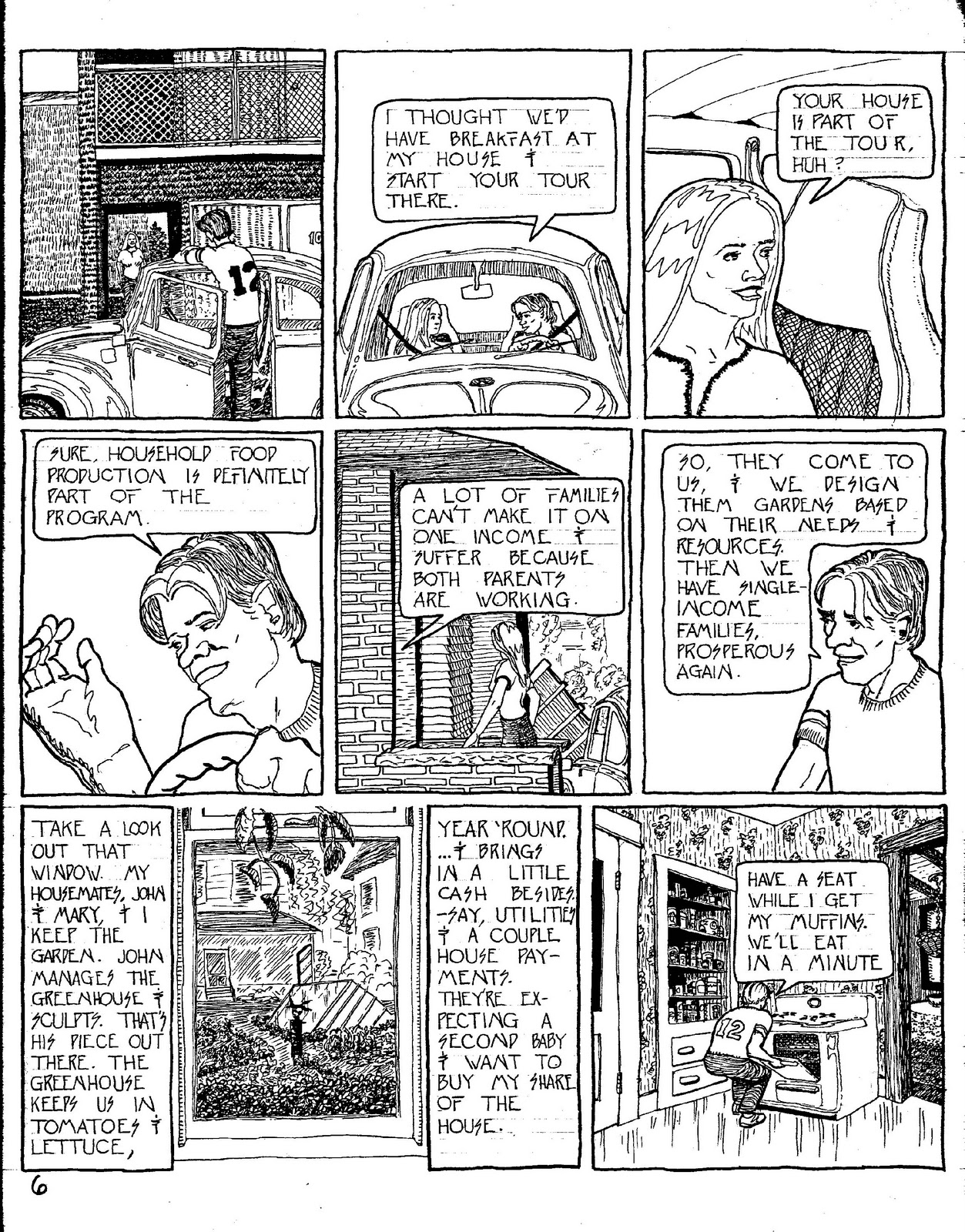
In 1986, I rode my bicycle from Minneapolis to Macomb, Illinois. In Macomb, I spent a week cleaning stalls at the Pres Oder Stables, and seeing friends. I spent a lot of time thinking about permaculture -- although I didn't know the word -- and the adventure energized me. Back in Minneapolis, I did a comic I called "Altgeld Portfolio" about Altlgeld, a fictional college town which had found a way to thrive in a time when other small towns were dying. (John Peter Altgeld was an Illinois governor who sacrificed his career to behave with integrity toward labor, and toward three condemned activists who were framed for murder.)
I showed this thing all over the Twin Cities energy and environmentalist scene, but the nicest reaction I got was back in Macomb, where Rick Meloan told Joe Alexander that they should get John Long to travel around West Central Illinois buying up derelict VW Bugs, and bring them back to Alexander's farm for rehab.
Subscribe to:
Posts (Atom)