Sunday, April 18, 2010

The Rain Garden Grows

Neighborhood permaculture workshop on Saturday. There were ten or so of us, visiting four households, with local landscaper Russ Henry. Russ emphasized baby steps, rather than grand permaculture campaigns. He gave us insights into things like planting, soil health, pruning, native plants, and so on, recognizing the permaculture principles of storied planting, and energy flows. It was nice getting a small-p permaculture tour. Tell me when to plant the damned thing, and how to prune it. I've got the big idea, but I don't know jack.

Pictures are a continuation of my cherry tree rain garden project. The berm remains unplanted, and I've planted clover in the lower part, mostly to get a cover. (Click on the close-up and you can see the seeds. Amazing what the modern snapshot cameras can do.) Barbara is starting perennials in pots, and they'll go into the ground as they get some size.

Thursday, April 15, 2010

Hauling Number Five For The Cherry

Number and quantity aren't the same. You can have exactly one or two or 96 apples, but you can't have exactly a bushel.

Spring has hit the Minneapple, and my first project is to build a little berm around the cherry tree so that rain will soak into the ground and we'll have to irrigate less (or never). Two things mean we have to irrigate now, the dense mat of roots in turf, and the way the rain drains down the bank to the sidewalk. I think these show in the picture. I'll remove the turf inside the berm, and replace it with deeply rooted native plants. Between the berm and the roots, I'll hang onto more of whatever water hits my ground, and keep it out of the storm sewer, too.

Minnesota is right on two lines; go east and it gets wet, go west and it gets dry. North is cold, and south is warm. You can see the temperature difference in the suburban vegetation, but you have to go to the western part of the state to find plants that are adapted to a drier climate. I'm betting on climate change making my urban homestead drier. Even if it doesn't happen that way, I'm betting on an economy that makes irrigating with city water impractical (duh!).

Monday, I hauled a (cubic) yard of number five dirt, across with two twenty-five-gallon plastic tubs in the back of our seventeen year-old sub-compact Mazda. Call me Mad Max.

There are 46, 656 cubic inches in a yard. There are 231 in a gallon. That works out to within a quarter cup of 202 gallons in a yard. I wrote off the last two gallons, and made four trips. It's interesting that I was measuring so precisely. Given my tools, I couldn't do otherwise, but the guys at the yard were pretty loose. A yard is two buckets on the little Bobcat end-loader they were using. Since I could only take a quarter yard at a time, they dug out half a bucket whenever they saw me. Twice it was too generous, twice it was stingy. The last time, I figured I wanted as much as I could get, and they let me top off my bins.

It cost forty-two bucks plus tax, and I put forty-two city miles on the car. "Back of the envelope calculation,"based on the yard boss's guess that five gallons weighed sixty pounds, I flung 48 hundred pounds of dirt (between loading and unloading) one shovel at a time, plus wheelbarrow work unloading. Didn't make me stiff, which made me feel like a hot dog.

Monday, April 12, 2010

David Barash And Economics As Ponzi

I really had this idea when I heard about Bernie Madoff. Honest.

The human economy, as currently practiced, is a Ponzi scheme. A Ponzi scheme, for which Madoff is suffering the soul-deadening regimentation of a life-long prison sentence, works like this: The operator persuades investors that he has an attractive investment; the initial investors are enriched -- without knowing the real source of their good fortune -- with revenue from subsequent investors. Ultimately there are no new investors, and the con collapses.

Check out this article, We Are All Madoffs, by David P. Barash, on the Chronicle of Higher Education website.

Not to give any more away than I already have, but to give the analogy some specifics, "Nearly all economic models of 'development' rely upon an unsustainable assumption: that the discovery of new resources (or, alternatively, new inputs of capital, technological saviors of one sort or another, and so forth) will always come to our rescue, enabling us to postpone, indefinitely, any final audit."

Sunday, April 11, 2010

How To Tame Your Dragon And The Hollywood Outline

With Barbara in Pennsylvania, visiting her mother, I spent Friday night with Sam and Marissa. After pasta salad and beer, we went to a suburban mulitplex to see the film, How to Tame Your Dragon, a CGI animation about Vikings feuding with dragons on some foggy rock in the North Sea.

The typical Hollywood script has a hero with an explicit desire and a real need. The story appears to give the hero his or her wish. The hero becomes smug or complacent, loses the object of desire, shapes up and does the right thing. Doing the right thing puts the hero in position to have the deeper need satisfied.

Dragon's identity figure is a skinny, dreamy blacksmith's apprentice named Hiccup, surrounded by beefy blusterers, the beefiest of whom is Hiccup's  father, chief dragon fighter, Stoick. Hiccup invents a gadget to kill dragons, but winds up secretly befriending the dragon he injures, and building it a prosthetic tail fin. Everything works out in the end, and the dragons turn out to have pretty kittenish personalities, but Hiccup's character is consistent throughout. He has successes and failures, and his spirits rise and fall, but his dragon learning curve is quick, and his circumstances are either changed for him, or improve because of virtue that was there from the first scene.

The ensemble, Viking village, does go through the Hollywood outline, though. At first, they just want to get rid of the marauding dragons. Things improve from the audience's perspective, because Hiccup rides his tamed dragon, has a romance, and demonstrates stellar dragon handling skills in Viking boot camp. The monkey wrench comes when Stoick drags his dragon-raiding party back in smoldering tatters, finds out Hiccup is his class' star dragon handler, expects to see -- and is disappointed -- him slay a dragon in a right of passage. Stoick disowns Hiccup, and sails off again to kill the dragons in their nest. Hiccup saves the day, and Stoick apologizes (does the right thing). Instead of ridding themselves of the dragons, the Vikings get a deeper payoff in befriending and riding them. The second-person possessive in the title is significant. We do watch Hiccup tame a dragon, but more importantly, we see the Vikings tame their -- metaphorical -- dragon.

Friday, April 9, 2010

Tough Girl Detective Tackles Holocaust Reparations

Chicago author, Sara Paretsky's fictional Chicago detective V. I. Warshawski digs into the issue of reparations for Jewish Holocaust survivors, and the descendants of American slaves, in 2001's Total Recall. The Warshawski formula features major villainy on the part of the rich and powerful, reflected by the indifference of the police and other institutions, rudeness on the parts of minor characters, and perversity and skepticism among friends and others who should know better. In Total Recall, an unstable man, who may have recovered memories of the Holocaust under hypnosis, appears, opening old wounds for Warshawski's friend and mentor, Lottie Herschel, whose family did perish. The personal turmoil distracts Warshawski from the case she should concentrate on, that of a black widow refused -- on the funeral day -- payment of her husband's burial insurance. Coincidence gradually weaves the two stories together, with the reader puzzling over several mysteries.

In the novel, the American insurer, merged with a Swiss company, lobbies against a bill in the state legislature to force audits of Illinois insurers which had been active in pre-War Europe. Warshawski says this would turn the Swiss company's expected gold mine into a bankruptcy court.

Americans could expect similar results if our society were to indemnify the descendants of slaves -- or first Americans -- for the wealth that their ancestors built but couldn't bequeath. Haiti could bankrupt the French, if France were to make it whole for the ninety million Francs the Haitians paid for their freedom. I'm thinking of asking the English Crown to pay for its occupation of Eire. You can make your own list.

The interesting mystery is, "Where did the money go?"

Thursday, April 8, 2010

Scarcity, Abundance, And Sketchbook Pages

Violence comes from a sense of scarcity that's real, not an illusion. People do starve. One of the notions that The world's goods are unevenly distributed. Some of us have appropriated more than our share, some of us hate, but ultimately, we murder and steal because that seems better than starving. One notion that comes in a range of brands is "abundance." "There is no scarcity." "Scarcity betrays an unwillingness to exercise our imaginations." "We can reach abundance."

Talking with a friend the other day about human prospects, we were both pessimistic. I said it was up to sixtyish Americans. We're the ones with the information and the leisure to create abundance; besides, we have some unfinished business from forty years ago.

Wednesday, April 7, 2010

Sketches From The Morning After Drawing Group

Another sketchbook page, and some drawings from my Tuesday drawing co-op. The five scratchy figure/portrait drawings are each from two-minute poses in a figure-dedicated sketchbook. I used an ultra-fine Sharpie, as I did in my free association. The other life drawings are charcoal pencil on Strathmore charcoal paper. Both papers are 9x12, with minimal cropping in PhotoShop.

Tuesday, April 6, 2010

My Sketchbook And Pablo's

More sketchbook. I've been reading Picasso and Portratiture: Representation and Transformation, published by the Museum of Modern Art. Cool book with lots of reproductions of pictures by the best draftsman of the last century. Ken, if you can read this where you are, Picasso wasn't cheating. I'd give my teeth (but not my soul) to be able to draw the way he could. His paintings ranged from fevered Lautrecean naturalism, through the flickering transmutations of Cubism, to smooth and cool Neoclassicism, then nightmarish distortion. Picasso was into Tarot, and his drawings were populated by stock characters, illustrating their creator's inner life with little improvised plays.

Monday, April 5, 2010

Sketchbook Pages

I've always been torn. Part of me is optimistic, believing ours is the time in human history during which we take active control of evolution, and integrate with the rest of the world. The other half is paralyzingly pessimistic. It's natural to think that the time when humans quit fooling around and consciously find our niche(s) in the ecosystem would be perilous. Buckminster Fuller's Utopia or Oblivion comes to mind. The material wealth that has made our global and empirical understanding of our situation nominally belongs to individuals and groups of individuals who can't afford to integrate.

Reading Constant Battles truly freaked me out. I can't write my way out of the puzzle it presented, and I don't want to pollute anybody else's thinking with my dire fascination. So I'm shifting gears.

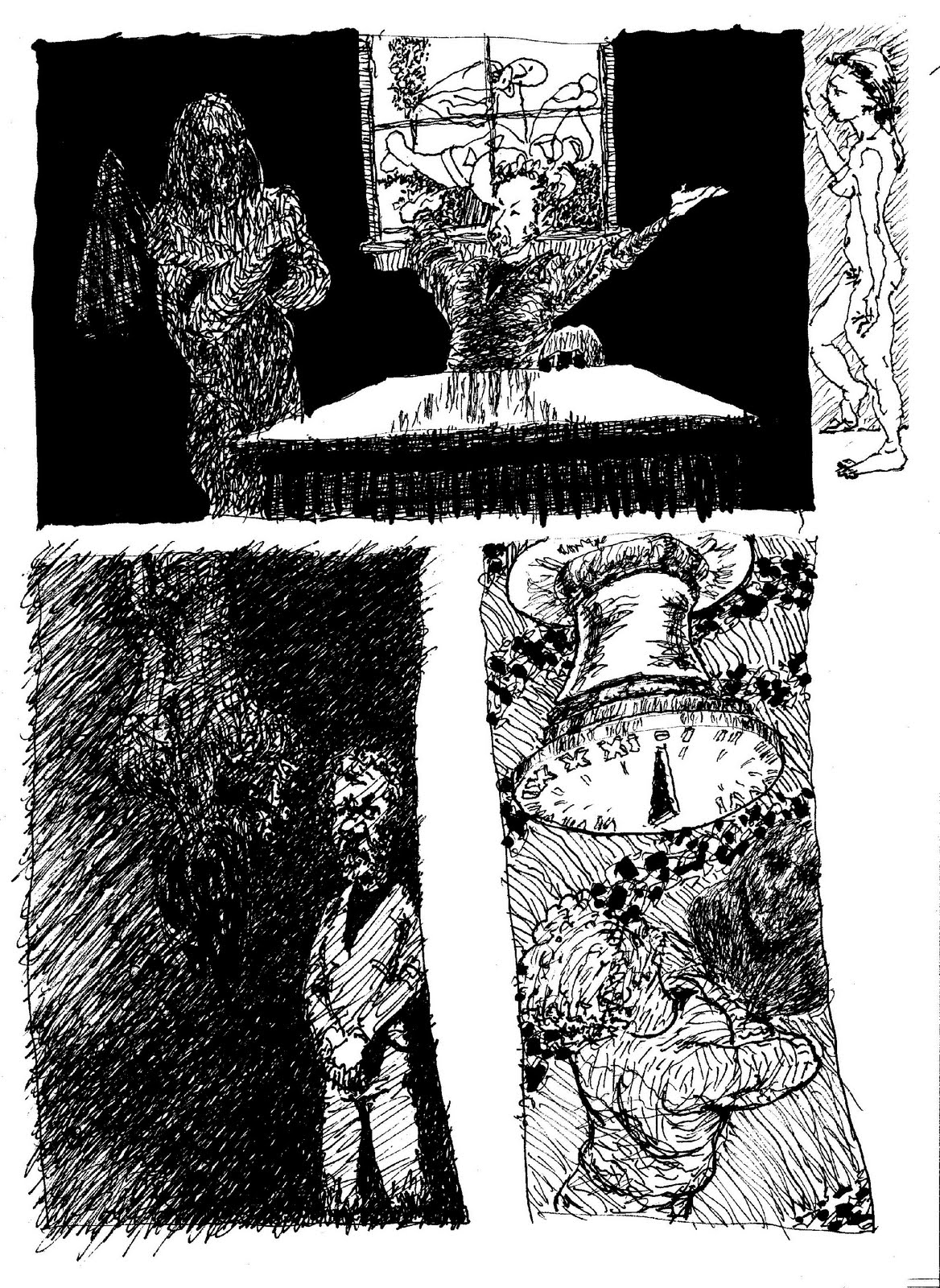
I've changed sketchbook size, so I can get whole pages onto the scanner. The way I work sketchbooks is to use permanent markers, with no under-drawing. I make a mark on the page, and it suggests something. I draw that suggested something, then ask myself why that particular something. I add entourage to illustrate the subject's raison d'what. Sometimes the drawings are good. Sometimes less so. I'd like to think that I'm channeling something in my drawings, something meaningful that I can't reach otherwise. Sometimes, the drawings seem merely inane. I keep moving.

Tuesday, March 23, 2010

Constant Blues and Battling The Art Of Portraiture

I haven’t posted for more than a week, the reason, either a case of the late winter blues, or one of being utterly spooked by LeBlanc’s Constant Battles. I took that sumbitch back to the liberry, leaving the last chapter unread. I did read the last couple of pages, so I know there’s no surprise happy ending.

LeBlanc is an academic, and the book, for him, is a way to show us what we’ve overlooked in studying our ancestors. For me, their benighted behavior is an allegory for our own, and it makes me think of something fictional adventurer Travis McGee said to Meyer, his economist sidekick: “Right now I’m...trying to work out a jigsaw puzzle where every piece is square, and when I get them in the right places, they make an abstract painting. But they also make an abstract painting any way I fit them together.” McGee settled on the right arrangement, and it was dangerous. For me the peril implied by our history of perfidy, is compounded with irritation. Where do we go from here? Not being able to solve the puzzle bugs the daylights out of me.

Enclosed, some recent drawings, good, bad, and promising.

The nice clean portrait of the young man with the soul patch, I did for the first of what I hope is a series of short newspaper pieces about busy and interesting neighborhood residents. Eric is a guitar teacher at the park building, with a plan to provide music instruction, something being scaled back in the financially strapped schools.

The double caricature is one whose subjects asked me to draw it. First iteration. The drawing of the man is on the money, the woman, recognizable, but hmm. Men are easier to caricature than women, because -- feminism notwithstanding -- even comical renderings must render them as desirable. How do I get a likeness of Lila that is as lush and alluring as she, and still a little goofy?

I think the messy one is the most exciting. I like the textures and contrasts. It is, in a word I have begun using to myself, painterly. On the other hand, I traded the clear and articulate quality, that I can get with simpler means, for excitement. I hope that the former will gel from the latter.

Friday, March 12, 2010

The Ramp Meter And The Counter-Intuitive

Some things surprise you. Sometimes, after you’ve thought about them, or somebody tells you how they work, they make sense. I’m not competent to do more than mention sub-atomic physics.

Once I was tutoring the adopted daughter of some friends. This kid was in the ninth grade, and had endured the kind of traumas you wish were media fantasies. She was bright, but had tentative diagnoses of all the mental disabilities about which you might’ve heard. Man, she could frustrate me. Areas. Volumes. Fractions. It was fascinating how much she couldn’t get, but I taught her to play chess, and she could clean my clock. That’s got nothing to do with things that are counter-intuitive, but once, probing a little bit, I asked her what weighed more, all the whales in the ocean or all the plankton.

I really didn’t learn anything. She answered wrong, but so would most of us. The answer is plankton. Why are there more foxes than mice?

Here’s one. Decades ago, a researcher at the University of Washington removed the (predator) starfish, Pisaster ochraceus, from an intertidal pool that contained fifteen species of marine invertebrates. You’d think that you’d get more of the starfish’s prey, or at least that the prey populations would rise until there was a crash. What happened was that the number of species dropped to eight. In fact, a kind of sponge, and its predator, neither of which had an obvious relationship with ochraceus, disappeared. The hypothesis is that the starfish cleaned the habitat for the sponge.

Here’s another. A. C. Crombie, of the University of Cambridge kept two species of beetles -- Tribolium and Oryzaephilus -- in flour. Usually I try to keep bugs out of my grain, but -- you know -- British academics have a reputation for eccentricity. Usually Oryzaephilus disappeared, and the Tribolium population would level off at about 125 beetles per ten grams of flour. Then old A. C. stuck some glass rods into the flour. (A. C., you maniac!) Oryzaephilus got up into the eighties or nineties per ten grams, and Tribolium -- wotta champ! -- leveled off around 225.

Here in Minneapolis, we have these things called ramp meters. Between us, St. Paul, and the suburbs, we have 433. They’re like stoplights, only there’s no yellow, just red and green. During rush hours, they act like valves, letting cars onto the freeway at measured intervals to keep us from bunching up. Actually, the one I use lets the cars through quickly enough that we end up queuing again right at the freeway. I can’t see how this helps, but I’m not a traffic engineer.

Anyway, ten or a dozen years ago, a state legislator from out in the country somewhere, didn't budget enough windshield time once too often, and made ramp meters his personal hobby horse. There was a bombastic morning-drive disc jockey who whined about them, too. In 2000, Minnesota paid a firm called Cambridge Systematics $650, 000 to turn the ramps off for eight weeks and write a report. During the eight weeks, freeway volume went down nine percent, travel time went up 29%, speeds dropped 7%, and the number of crashes went up 26%. So a politician’s and a disc jockey’s ignorant peevishness cost Minnesotans six hundred and fifty grand, plus whatever the price of those other inconveniences was. And the engineers shortened the ramps’ cycle times. Hmmm.

Dick Day could probably still get his constituents stirred up about ramp meters, but he has retired from the legislature. He’s now a lobbyist for the -- ahem -- gaming industry.

Wednesday, March 10, 2010

Earthquakes Cripple Haiti, Chile, Gotham City

I wanted to write about the Haitian earthquake, and then the Chilean quake came, five hundred times as powerful. The Richter Scale is base-ten-logarithmic, so a difference between a 7.0 and an 8.8 quake is ten to the one-point-eight, taken to the one-point-five. (I’d forgotten how logs work, and I only had the vaguest of ideas of how the Richter Scale works, so I had to look this up.) While the mechanics of the planet’s continental drift are interesting, what insensitive jerk keeps score, when human beings are getting kicked in the shorts.

Instead, I’m going to review a series of comic books. I discovered Batman: No Man’s Land at the neighborhood branch of the Hennepin County Library. Can you believe they have comics at the library? This is probably one of the more sophisticated ones. It comes in five volumes, and I read One and Four.

When Frank Miller wrote Batman: The Dark Knight twenty or so years ago, readers and the funny-book industry took notice. The Dark Knight is a gritty, noir thriller, and Miller has a feeling for character and plot, as well as a satirical outlook on our moment in history. DK was comic’s High Noon, an adult read in a puerile millieu, and it gave comic book writers and artists permission to examine the darkness in the souls of their characters, and our world, if few did it with Miller's art.

Batman is, of course, the masked and muscular vigilante who guards Gotham City -- a stand-in for the island of Manhattan -- from quirky supervillains like Two Face, the Penguin, the Joker, etc. He is aided by Robin the Boy Wonder, Commissioner James Gordon, Batgirl, etc., etc., and etc. No Man’s Land’s premise is that Gotham City has suffered a massive earthquake. The rest of the United States, presumably with problems of their own, have abandoned Gotham to its own devices, dynamited its bridges, and posted patrols to keep Gothamites on the island, and the infrequent smuggler or maniac out.

Each story begins, “...and after the Earth shattered and the buildings crumbled, the nation abandoned Gotham City. Then only the valiant, the venal and the insane remained in the place they called NO MAN”S LAND.”

Various gangs, including the police and a splinter faction of cops, neighborhood thugs, and the supervillains’ organizations, control territories within the city.

NML was published in 1999, and probably would have been different -- at least by not representing ruined skyscrapers as leaning, largely intact, above rubble -- if produced after September, 2001. The twenty or thirty writers and artists have imagined post-disaster poverty pretty well. Food, water, tools, and ammunition are all bought and sold at a premium. There is a barter network, ruthlessly controlled by the parasitic Penguin. People risk their lives and dignity for beans and bullets. A pacifist physician, friend of Batman’s murdered parents, operates a hospital under tents, giving what comfort she can to the teeming injured, and caring for their wounds with what few supplies Batman can find.

Writing is about on the prime-time soap level of Dallas or The X-Files. You have stock characters interacting, and revealing themselves, over time, within a difficult setting. Exposition is uneven. I found myself going “Who the hell is that,” or “What just happened,” on one page, and "Just shut up and tell the story," on the next. NML"s characters are, let’s just say, preposterous, and one way the comic medium advances a story is through speech balloons, so cut the denizens of Gotham some slack when they get a little windy. The most articulate of the characters, though, is the mute Batgirl, whose mask completely obscures her features.

Drawing, composition, and color vary, from the exaggeratedly veined musculature and color and value extreme contrasts of the Deodato, Parsons, and Rambo team in Volume Four's “Homecoming," to the decorative, almost anime, style of  Scott, Floyd, and Mulvihill in “Jurisprudence.”

Although the US abandons Gotham City for purposes humanitarian, Gotham is not forgotten by Superman’s nemesis, Lex Luthor, who appears on the final page of Volume Four, ready to rebuild and claim it for his own.

Friday, March 5, 2010

March Comes In With Pruning Shears

We've had a string of beautiful blue-sky days, with highs in the mid-forties. Winter isn't through with us yet; March is usually the snowiest month, with a proverbial State Basketball Tournament Blizzard, but we can see the promise of La Primavera.

I took my pruning shears out to give the apricot, which you're looking at, and one of the plums their first haircuts. I don't know what I'm doing, but I have a few principles I'm trying to follow.

Prune the trees while they're still dormant. They stored a bunch of sap last year, and I want them to use it to heal, rather than make leaves.

Don't take more than a third of the branches.

Try for a chalice shape.

Make sure that remaining branches don't shade each other.

Cut just outside of the "bark collars." These are the wrinkled, folded-looking bark that covers the places where the branches leave the trunk. This is where the trees heal best, and prevents rot.

Some of my older trees suffered from having a chicken for an owner. I put off pruning them because I didn't know what I was doing, and when I finally pruned them I had to cut bigger branches and make compromises. You can see where there just has to be rot getting into their trunks. Ya live an' learn, but I'm sixty-one years old. Shoulda started this stuff in the Summer of Love.

Wednesday, March 3, 2010

Telstar And Constant Battles

An interesting idea in Steven LeBlanc’s Constant Battles is that farmers are harder on a region’s carrying capacity than foragers. Foragers, like the Kalahari’s !Bang or Australia’s various aborigines range over the landscape, picking fruit and vegetables and hunting game. They do eventually exhaust an area, and move on, but the farmer lifestyle is more resource intensive, and farmer populations are larger.

Forager women give birth about every four years. Children nurse longer, nursing depressing fertility, and there are several incentives for limiting family size. Foragers are mobile daily, as they search for food, and groups move periodically. Several small children are harder to tend on the move than one. Beside the logistical problems, children aren’t knowledgeable to be genuine contributors, and are liabilities until puberty or later.

Farm crops require more processing and cooking, and a larger tool kit, so farmers need fuel and materials that foragers don’t. Staying in the same place for generations, farmers deplete soil. LeBlanc documents soil depletion with the history of the Mimbres Valley in the southwestern United States, beginning in the early Common Era, and ending with collapse in the thirteenth of fourteenth century. Farmer populations are larger. Since farmers are sedentary, and since they get more calories out of an area than foragers would, they can afford more children. Ground and cooked grains make good baby foods, so children nurse for less time. There are farm chores that don’t require a lot of knowledge and expertise -- ones that children could do -- so there’s an incentive to reproduce to get more workers. There's an incentive to reproduce, as well, so that someone can take care of you in your dotage.

It might have seemed to early farmers, rubbing shoulders with foragers, that they were the ones who used their resources better. After all, they were providing for more people, living better, and staying in the same place for a long time. In fact, they were mining their soils.

LeBlanc explains the sudden shift from foraging to farming (10,000 years ago in the Middle East, soon after in China, 6,000 years ago in America), not with some teleological inspiration, or people’s recognizing a good idea and embracing it. He says that farming spread because farmers warred on foragers to take their territories, when farmer populations had exceeded their territories’ carrying capacities.

Buckminster Fuller liked to say that we would succeed by “doing more with less.” He called it “ephemeralization.” One example he used was Telstar, the first commercial communications satellite. Fuller said that this quarter-ton sphere replaced thousands of tons of transoceanic cable. I always wondered about the infrastructure supporting the two communications devices: ship versus rocket, steel mill versus transistor factory. Which industries use more water, fuel, noxious chemicals? What changes in society did each communications device inspire, and what were their consequences for the planet’s carrying capacity. Was Fuller correct that Telstar did more with less?

If Telstar did use more of the world’s wealth, I recognize that it could still have been benign. For instance, widespread, rapid, global, electronic communication might be necessary in an Earth which had recently experienced World War II, in which the United States and Soviet Union aimed hydrogen bombs at each other, and in which global commerce was introducing us all to each other. It’s the old conundrum in which you wonder if polio vaccine was worth Madison Avenue.

I wonder if it’s possible for us to find our way to a forager lifestyle, informed by what we’ve learned along the way. The foragers weren’t able to control their populations and stay out of conflict, but they might have, if they’d had our biological and technical knowledge.

Tuesday, March 2, 2010

Its Apostrophe: It's Not As Simple As It Used To Be

I learned when to put an apostrophe between the tee and the ess in its from Mrs. Stiffler in the Ninth Grade. The apostrophe is used with it to indicate the missing letter and space from “it is,” but not to indicate possession. This made sense to my tiny fourteen year-old mind. The rule reduced ambiguity, and seemed to indicate a hierarchy in which the contraction counted for more than possession.

Little did I know that it would make me gnash my teeth, as a working grownup, to see the rule casually flouted by e-mailing co-workers.

I know how it’s done. You can prove I’m right by scanning for its and it’s in edited copy. Here are two sentences from R. Fiore’s article about The Simpsons television show, The Glory that Was the Simpsons, in the Winter, 2004 Comics Journal.

“Because it had a satirical bent and lots of minutes to fill, its concerns of necessity became wideranging; developing into a comprehensive picture of its times.” (Its indicates possession -- and I would have punctuated the sentence differently.)

“The problem is that because it’s easy and imposes little up-front cost to the viewer, it causes more difficult and expensive cultural forms to atrophy.” (It’s is a contraction of “it -- meaning television -- is.”)

It’s interesting that I would get upset about such a small thing. I’m fairly easy-going about spelling. If you’re in the ballpark, great. I know spellings have changed over the centuries, America, Great Britain, and Australia currently spell some words differently, and a lot of English spellings don’t make sense anyway, except as indicators of source languages. (Another reason for my being laissez faire about spelling may be that I have a family name which is not usually spelled are-oh-ay-are-kay. I may have given up.)

I’m comfortable with -- at least -- archaic grammar, having once cultivated a hick persona who said things like “ain’t got,” and “that don’t scare him, none.”

I think my being a grammar nazi about its/it’s (and your/you’re -- although I have written yer for both) probably comes from some mild obsessive compulsive disorder. I correct as I type, not being able to let an error stand until I get to the end of a sentence, let alone until I finish the draft. Still, its and it’s have two entirely different meanings. You wouldn’t write “I rote my mother a letter.” Well, maybe James Joyce would have. Its is possessive -- a modifier, and it’s is a contraction for "it is" -- subject and verb.

Then I read this poem by that old Belle of Amherst, Emily Dickinson.

The Brain, within it’s Groove

The Brain within it’s groove
Runs evenly -- and true --
But let a Splinter swerve --
Twere easier for You --


To put a Current back --
When Floods have slit the Hills --
And scooped a Turnpike for Themselves --
And trodden out the Mills --

Monday, March 1, 2010

Syncronicity With The Daily Dish

I promise I won’t ever do a story on Brad Pitt’s love life, but I can’t help myself about Sting. Graeme Wood, filling in for Andrew Sullivan on The Daily Dish wrote about Sting’s taking two million bucks to play a concert for Gulnara Karimova, daughter of brutal Uzbeck kleptocrat Islam Karimov.

Barbara says there are a lot more rich conservatives creating mischief than rich liberals, and that's probably true. Sting says that cultural boycotts are a bad idea, and probably believes that he could squeeze a few people (and the Aral Sea) out from under the iron boot heel of oppression by modeling a peaceful and ecologically-aware attitude for the self-deluded Karimovs.

It reminds me of a bumper sticker I gripe about around town now and again: “There is no way to peace. Peace is the way.” That reminds me of the ancient Coca Cola commercial: lovely young interracial crowd holding hands in a circle in a beautiful meadow. “I’d like to teach the world to sing in perfect har-Mo-neeeee...”

I don’t doubt that individuals who are calmer and less avaricious will commit fewer atrocities, or that seeing people with different skin as equally human will make it harder to kill them, but facing starvation, your basic tofu-eating, yoga-posing Quaker will be up for a little cross cultural mayhem.

The way to peace is economic. Figure out the planet’s carrying capacity for this species. Keep population within that capacity, globally and locally. Create abundance by integrating with and mimicking the local ecosystems. Share unevenly divided natural wealth, locally and between regions. Pay attention and allow for the counter-intuitive. Everybody gets fed, housed, and educated. Enforce all of the above, locally and globally.

People will complain, but if you think about it, the developed world will be getting a bargain.

Friday, February 26, 2010

Brit Rock Star, Wife Destroy Civilization

Meet the Geezers:

Name: Tommy

Instrument: Rhythm Guitar

Height: 6’ 2”

Hair: Gray

Eyes: Blue

Ideal Date: Barbara

Pet Peeve: Rich Liberals

The March Yoga Journal has an interview with Sting and his wife, big-deal British movie producer (Lock Stock and Two Smoking Barrels), Trudie Styler. Styler has a yoga DVD to flog, so the two chat about their introductions to yoga, its effect on their lives, and famous yogis they have known.

F’rinstance, the late Ashtanga Yoga founder, K. Patabhi Jois visited the couple’s Tuscany estate and scolded Styler when she complained about being stiff: “Bad woman. Body not stiff, mind stiff.” He was a famous and talented wog, though, so she could allow certain liberties.

I do asana -- what we call “yoga,” you know, the weird poses -- five or six times a week, and every once in a while, I see if meditation works yet. Yoga, which I very casually...no...which I’m marginally aware of, is a way of life based on Patanjali’s “Eightfold Path.”  I’m too much of a sensualist, and I like my anger too much, to get further than maintaining a capable body, and behaving well enough to stay married and out of jail.

Patanjali (pat-Angelie) was one of those historical presences, like Moses or Lao Tsu who left us something valuable, but whom we don’t know outside later hagiography and their written work. Patanjali may have been contemporary with Lao Tsu and the Buddha, or with Jesus, a five hundred-year anachronism. He studied medicine and grammar, but we know him for the eight limbs of yoga.

(Sanskrit is an Indo-European language, descended from the same lost tongue, spoken in what is now northern Turkey, as the modern European languages. The word “yoga” comes from the same root as “yoke,” and means “union,” union of body and soul, self and god, man and nature.)

The Eightfold Path includes five Yamas and five Niyamas, disciplines for social harmony and emotional stability; Asanas, postures to cultivate strength balance and flexibility; Pranayama, breath exercises; Pratyahara, withdrawal of the mind from sensuality; Dharana or concentration; Dhyana or meditation; and Samadhi or enlightenment. I like the Yamas and Niyamas a lot. They’re sort of a yogic Ten Commandments, but they cover the same territory in a way that is both more flexible and demanding. Isvara Pranidhana is devotion to God; Svadhyaya is self study, examination of conscience and application of scripture to our paths; Tapas is austerity and rigor; Santosa is acceptance; Sauca is hygiene, including mental hygiene. Those are the Niyamas. The Yamas are Ahimsa, or non-violence; Satya, truthfulness; Asteya, recognizing that there are things which are not ours; Brahmacharya, recognizing the full humanity of our sexual partners and conserving our energy; Aparigraha, non-covetousness, but more importantly, the reluctance to burden ourselves with things which don’t help us follow our paths (Aparigraha is the one to remember for this essay).

In grade school catechism, we learned that there was more forbidden by the Commandment, “Thou shalt not kill,” than the lethal, special case. Mere anger was a sin against it, as were gluttony, or even the apparent virtue in which, say, a daughter sacrifices her chances of family or career to care for an infirm and manipulative parent. There have been at least two Vatican encyclicals in the last century and a half which have included injustice toward labor among the sins against life (Rerum Novarum and Quadragesimo Anno).

The Yamas and Niyamas are more positive than the Commandments. They are disciplines (“yama” means discipline) rather than prohibitions, practice rather than obedience, something you can get better at. The Christian notion of sin derives, no doubt, from ancient social reform (and possibly from intuited understanding of a relationship between virtue and mental health), but the most grievous sins aren’t necessarily the ones with the greatest consequences; they are the ones in which we consciously reject God’s grace. The Yamas and Niyamas assume grace as a sort of natural resource, which can be cultivated. We don’t need to walk on eggs, avoiding sin, or depend on Jesus’ ransom, paid on the cross.

Sting (nee Gordon Sumner) is a baby-boom singer and bass player, an advocate internationally for justice, and a former tax exile. He is married to Trudie Styler, an actress and producer, likewise born in postwar England. In the Yoga Journal interview, Sting says that he does 60 to 90 minutes of yoga a day. Styler does yoga three times a week, and meditates twice every day. Sting says, “Yoga is a great way to offset the downsides of touring by bringing much-needed peace and sanity into what can be a hectic life.”  Styler says her morning meditation “sets me up for the day and gives me a great sense of calm. I can go into meetings feeling calm and empowered. I can stay clear and really listen to what’s coming up.” Together they founded the Rainforest Foundation Fund to preserve the disappearing rainforest, and seek justice for its indigenous people.

Styler produced a film called Crude. She says “yoga has given me a lot of courage to fight injustice.” Crude documents the disease and displacement of Ecuadoran Kayapo Indians due to oil drilling.

When asked where she got her sense of justice, Styler answered, “My mother. We lived in government housing and had no money.” She continues, “When I was two, I got hit by a truck.” The company tried to avoid responsibility for Styler’s injury and disfigurement, and her mother took them to court, “and got some money to compensate for this severe injury that I sustained. So this voice has been active in me for many years. My mom had a great sense of justice and compassion.”

Hmm. Two year old hit by truck. Mother sues responsible party for medical costs and rehabilitation, and becomes example of compassionate justice. Maybe litigiousness meant something different in 1956 England than it does now in Minnesota. And where was National Health?

They own homes in Wiltshire, the Lake District, New York, Malibu, and Tuscany. Sting’s net worth is estimated at more than a third of a billion dollars. Did I say he used to be a tax exile?

In 2007, a British employment tribunal found that Styler had been responsible for the discriminatory dismissal of Jane Martin, one of her cooks. Martin had become pregnant, and ill. Styler’s management firm had done the actual firing, but the tribunal found that Styler was the “driving force, manipulating others to perform her dirty work.”

The Stings appealed. An appeals tribunal upheld the finding, and awarded Martin twenty-five thousand pounds. This tribunal’s transcript quotes Styler as saying, “Who the fuck does she think she is? She is my chef in the UK. She needs to be available when I need her, or she needs to re-think her position.”

Boil an egg, honey.

Of course a family worth nine figures is de facto a business, and the homes are places to network. Sting has said that bars and clubs are the shop floor of the music business, and he’s apparently been promoted to the board room. Jane Martin’s pregnancy was more than a personal inconvenience; it interfered with Trudie Styler’s deal making. In a way, she must think of herself as the leader of a tribe, with responsibility for the cooks, and lawyers, and blue-jeaned chanteuses who make the beds and entertain the grandkids. If a member of the tribe doesn’t pull her weight, she needs to rethink her position.

Styler needed Martin’s cooking to entertain artists and backers, provide a relaxed entertaining atmosphere in which the next movie could find funding. Crude brought information to its audiences about injustices visited upon other human beings for the sake of fueling the developed world. Styler’s yoga video, Warrior Yoga, was “created for everyone, but especially for women who are in the battlefield of life.”

The thing, though, is that authentic tribal membership is automatic and permanent. Organizations like Sting and Styler’s (or the Cosmodemonic Bus Company or your employer) usurp the prerogatives of the tribe, but are indifferent to the humanity that make them run. Tribal leaders are part of their tribes, not the tribes’ owners. Besides that, the system which told us about Indians poisoned by oil companies runs on stolen oil. Styler greases the wheel that grinds the real tribes.

Rich liberals depend on the system that they abhor to maintain the way of life to which they have become accustomed. You can’t put more into the system than you take out, gatekeepers don’t create wealth, they distribute shares, and if the system is essentially entropic, quit trying to pull my leg. Money equals fuel equals money. From now on we’ll be pumping less and less gas and oil, and it appears that burning any of it alters the climate to which our civilization is adapted. If you’re rich, you own more fuel than I do, and I defy you not to burn way more than your share.

The February Yoga Journal had two items that seem apposite. First a full page ad for the mPulse Smart Sauna. Under the headline, “Want to generate Tapas?” is a photograph of a woman performing some kind of lunge, taken through the glass wall of a very large and beautiful free-standing sauna. (You’ll recall that Tapas is one of the Niyamas, and means austerity, and I wonder how many of these boxes Trudie and Gordon own.) The other is a quote from one Douglas Brooks, “a Tantric scholar and professor of religious studies at Rochester University.” In a philosophical article, “Aim High,” about something that I won’t bore you over called the Purusharthas, the author quotes Brooks as saying, “Wealth is not a bad thing, and there is no zero-sum game.”

Buckminster Fuller once pointed out that there are three things, matter, energy, and intellect. He was saying that human ingenuity could make it possible for the whole world to survive comfortably, each one realizing his or her potential. Douglas Brooks, the tantric-econ professor,  must be saying something similar, but there are zero sum games, and contemporary commerce is one. There’s only so much fuel, and people do starve.

Exxon, or whoever, is pumping oil out from under the Kayapo Indians to fly the Stings from Heathrow to Malibu, and deliver their Tuscan honey and olive oil to Harrod’s. NATO is in Afghanistan for Sting and Styler’s three hundred and some million. My friend Greg Klyma, a talented musician and witty lyricist, the “Rust Belt Vagabond,” tours endlessly and kind of scrapes a living, because some guy in a suit figured he could get a cut if Sting were rich, and life was harder for journeyman rockers. Who knows how many very low-budget movies didn’t get made or distributed because Trudy Styler hogged the gravy. Making a living and making a killing: Maybe they're more than just figures of speech.

In a 2003 interview with the Sydney Morning Herald’s Neil McCormack, Sting said, "I have no excuses. But this is a conundrum faced by anyone who has a car, central heating, air-conditioning. I don't know how to alter the paradox. I could go and live in the middle of Hampstead Heath with a blanket around me and eat grass. Maybe as a gesture that might be heroic and even considered useful."

Sure. I’d vote for that, but why take the blanket. The cops would eventually chase you out of Hampstead Heath, though.

He’s right though, about the conundrum, and, with a household fortune about a thousandth of Sting’s, I wonder if I’m on the venal side of the privilege line. I don’t have air-conditioning, but I live where the scorching weather doesn’t last more than a couple of weeks (yet), and I do my asanas in January wearing nothing but a pair of trunks, not unlike the little blue number Sting wore to fight Maud’Dib in David Lynch’s Dune. I’m privileged, and so are you.

Fuller said that if you want to get rid of something, replace it with something better. So what would I do with Sting’s unimaginable treasure? Sting’s three-and-a-half zillion dollars isn’t his. He owns a share of it, but so do you and I and Mahmoud Ahmadinejad. Still, Sting’s in possession, and I won’t make him disembowel himself, if he does the right thing. Here it is -- no charge.

There’s a ninety-one year old architect in the Arizona desert. His name is Paolo Soleri, and forty years ago, he wrote a book that could give you a hernia, called City in the Image of Man (if you follow the link, scroll down a little more than halfway). It’s not the first adult book I ever read, but it’s the first book I read as an adult. Soleri’s thesis was that replacing sprawling cities with ones that were, in his ballsy neologism, “neogeolgical,” would be a form of miniaturization that would be the appropriate next step in evolution. The book's cities were human-made mountains. This would free up land that’s currently under concrete for agriculture and wilderness; it would reduce logistical costs, because everything would be in this sort of giant parking ramp covered with tipis -- okay, a shabono for Sting; and it would increase creativity by putting us comfortably closer to each other. Soleri is actually building one of these bungalows. It’s called Arcosanti, and it’s about zero-point-zip percent done. Soleri has said that he’d have it finished by now if he’d had the price of a single 747.

Now, 747s cost between two and two-and-a-half zillion dollars, so if Sting moved into Arcosanti, and dumped his fortune -- "sorry kids, you’re not exactly out of the will, there just isn’t one" -- on Soleri, or whoever winds up running the show next, they could build a really good city in the image of man. (Note to James Cameron: Sorry I haven’t seen your latest yet. I hear it has kind of an environmentalist message. Maybe you should have skipped the message and took the cash to Soleri.)

Don’t like that one? Same deal for Wes Jackson at the Land Institute. How about John and Nancy Todd’s Ocean Arks? The Buckminster Fuller Institute. Bill Mollison or David Holmgren? How about first blowing a couple million locating the thirty-year old whose PhD thesis has an answer to our situation. And trading him your fortune for a (small) annuity.

‘Cause, I tell you, it’s not about the planet. And the Kayapo are no innocents. We don’t recognize it, but we’ve made war on the Kayapo. They’ve been on both sides of the rapine and murder, since long before the oil and timber companies came on the scene; they just never came up against as formidable enemy as Homo corporation. We will either wise up, and the Kayapo can go about their business, or we’ll take ourselves out, and they can go about their business. It’s about civilization, and justice for eight billion people. You and your tribe are in the way, Macbeth.

(Today’s picture of me in front of Macy’s was taken in November by a downtown beggar. He had some genuinely clever patter that involved slight of hand with a War-era zinc penny -- two pennies, if the truth were known.)

Wednesday, February 24, 2010

Local Grouch Only One Who Knows

I'm grouchy and impatient today, working on a longer essay that is coming slowly, and which I'm not sure is entirely creditable. Meanwhile, I've torn my drawing technique apart, trying to get a more painterly style. It's more painterly, but it's clumsier and takes longer (it should be quicker and give me better likenesses). People on the street and in authority seem stupid, and bent on frustrating anything besides the conventions that are stampeding us to the abyss. Inanimate objects seem to have sinister agendas, and I feel clumsy and incompetent.

I’m posting a scan of a cartoon by Michael Phillips from the Summer, 1977 issue of CoEvolution Quarterly. The theme for that issue was “voluntary simplicity,” and these three panels became a beacon for me. I e-mailed Phillips, asking for permission, but he didn’t get back to me. Probably an oversight.

The panels say, “The first year of ecology I changed my spending. More services and less products. I got Rolfed, saw a psychiatrist and hired a gardener.” "The Rolfer, the psychiatrist, and the gardener then bought summer homes at Lake Tahoe." "The second year I saved my money at Citizen's Savings." "Then I found out Citizen's is the biggest lender on condominiums at Lake Tahoe." "The third year I gave the money I didn't spend to my church." "Now they're building a retirement home at Lake Tahoe." "I know what to do now." "I'm reducing my income."

In modern language, your income determines your carbon footprint. Scary. A well meaning westerner has a choice between hypocrisy and marginalization. Blessed Saint Garrett Hardin, pray for us.

Decades later, I’ve thought of an exception. If you could divert a large income to developing a just and sustainable world, the large income is okay, but that itself is a vocation, and skimming is cheating.

Tuesday, February 16, 2010

More Constant Battles

Continuing with LeBlanc’s Constant Battles, I’m realizing that it’s useful, despite its thesis’ "going without saying." We’re beings which seek resources, as all do, and will plunder to get them, if that’s what it takes. There’s a pornographic appeal in reading about pre-historic atrocity, or stories from aboriginal sources about torture killings. If there’s value, though, in following LeBlanc’s grim telling of our past, it has to be that, in seeing our situation with new clarity, we can design a future that sidesteps the old horror, perpetrated with modern genius. Ka-boom!

We get out of ecological balance when we exceed our territory's carrying capacity, then we go to war so we can continue in our profligate ways. (I’d guess that the people we call conservatives have a more pressing sense of this than liberals, but lack the vocabulary to allow understanding and correction. Consequently, they’re morally content with empire, and practically confuse liberty and regimentation.)

Toward the end of Chapter Three, LeBlanc spins a scenario that resonates with Hardin’s The Tragedy of the Commons. He tells us that a given period’s competitors will have approximately the same technology, and that the larger population will prevail. (Bad news for the developed world, and -- from a limited point of view -- a sensible reason for the double standard over who gets to own nuclear weapons.)

He imagines two neighboring cultures. “Assume for a moment that by some miracle one of our two groups is full of farsighted ecological geniuses.” They keep their population far enough below carrying capacity, that they can survive minor changes in weather or climate.

“The second group, on the other hand is just the opposite -- it consists of ecological dimwits.” They don’t control their population, and operate right at their territory’s carrying capacity. They get a bad year, and raid the geniuses next door. Over the decades, the dimwits eliminate and replace the geniuses. It’s high school all over again, unless everybody does the right thing.

Hardin’s solution was “mutually agreed mutual coercion.” Figure out carrying capacity, and regulate reproduction. It’s a little more complicated with a global culture that converts fossil fuels into food, but avoiding catastrophe is the agenda for the rest of your lifetime, and mine.

Saturday, February 13, 2010

Gregory Bateson: Atheist Prophet Of The Sacred

The following, starting with the story of the oak beams, is a collection of Gregory Bateson quotes. Bateson was a fourth or fifth generation atheist, fascinated by the sacred.

By default, I guess I'm an atheist, but I imagine there's a high correlation between atheism and Asperger's Syndrome, and I'm fairly empathetic. I wonder what is sacred, and what do we owe to it? Is there anything more important? It must be timeless, and unchanging. Esthetics and ethics must square with it, and those are definitely situational. Bateson seemed to understand.

The teachings of traditional religions become mere metaphors, from an informed 21st century perspective. An expanding universe, evolution, and a periodic table of the elements, filled in like a crossword puzzle, are the beginnings of a hard-won global understanding of existence. Archaeological and anthropological reconstruction of scripture's anecdote, show us the feet of clay, or even emptiness where we had imagined footsteps. We analyze scripture itself for vocabulary and diction to identify and date its authors. How far did Jesus have to ascend before he got to heaven?

Here is a story that Gregory Bateson told.

New College Oxford is of rather late foundation, hence the name, It was probably founded around the late 16th century. It has, like other colleges, a great dining hall with big oak beams across the top, yes? These might be eighteen inches square, twenty feet long.

Some five to ten yars ago (circa 1960), so I am told, some busy entomologists went up into the roof of the dining hall with a penknife, and poked at the beams, and found that they were full of beetles. This was reported to the College Council, who met in some dismay, because where would they get beams of that caliber nowadays.

One of the junior fellows stuck his neck out and suggested that there might be non College lands some oak. These colleges are endowed with pieces of land scattered across the country. So they called in the College Forester, who of course had not been near the College itself for some years, and asked about the oaks.

And he pulled his forelock and said, “Well, sirs, we was wonderin’ when you’d be askin’.”

Upon further inquiry it was discovered that when the college was founded, a grove of oaks had been planted to replace the beams in the dining hall when they became bettly, because oak beams always become beetly in the end. This plan had been passed down from one Forester to the next for four hundred years. “You don’t cut them oaks. Them’s for the Colege hall.”

A nice story. That’s the way to run a culture.

***

I surrender to the belief that my knowing is a small part of a wider integrated knowing that knits together the entire biosphere or creation.

***

Love is contrary to conscious common sense, because love involves the total systemic mind.

***

We never see in consciousness that the mind is like an ecosystem -- a self-corrective network of circuits. We see only the arcs of these circuits. And the instinctive vulgarity of scientists consists precisely in mistaking those arcs for the larger truth, i. e., thinking that because what is seen by consciousness has one character, the total mind must have that character.

***

Magic is what the vulgar and purposive consciousness snipped out of religion.

***

The point is that even before modern technology, something had to be done about the innate split between consciousness and the rest of mind, because the unaided consciousness would always wreck human relations.

***

Religion is what they did.

***


Because the unaided consciousness must always combine the wisdom of the dove with the harmlessness of the serpent.

***

Here is “The Garden of Eden” -- the myth in biblical form (as is so oftent he case) upside down. Adam and Eve ate the fruit of knowledge, an apple high on the tree. They had to place one box on top of another to reach it. They then ate it -- the sweet reward of a successful short-sighted scheme, consciously planned. This made them drunk with partial arrogance.

The arrogance was partial in the sense that what they were arrogant about was that miniscule part of themselves which achieved the consicous plan (no arrogance is total)”

In this arrogance, they threw out all the rest of themselves -- thus breaking up the total systemic thing they called “mind.”

I. e., they threw god out of the garden.

***

After that, the ecosystem of the garden got out of kilter -- because God is the inner and outer systemic character of everything -- mind and garden. So they said, “It’s a vengeful god.”

***

Cain was, appropriately enough, an inventor. He invented agriculture. God (Cain’s total systemic mind, or the systemic human ecosystem in which Cain lived) refused the cabbages which Cain sacrificed. God then told Cain that Abel loved him (Cain). “His desire shall be unto thee, and thou shalt rule over him.” (c. f. the curse on Eve in the previous chapter -- “Thy desire shall be unto thy husband and he shall rule over thee.”) This was the last straw because love is precisely that to which the pragmatic headstrong purposive consciousness must be allergic.

***

Eve began to resent the process of coition and reproduction, which always somehow reminded her of that larger life which Adam had sacrificed in order to buy her a washing machine -- which she had asked for.

***

The lineal arguments of human purpose necessarily conflict with the cybernetic arguments of physiology, sociology, and ecology, and that therefore, following his purposes, man almost ineveitably messes up his own physiology, social sytem, and ecology.

***

I suggest that one of the things man has done through the ages to correct for his shortsighted purposiveness is to imagine personified entities with various sorts of supernatural powers, i. e., gods. These entities, being fictitious persons, are more or less endowed with cybernetic and circuit characteristics.

In a word, I suggest that the supernatural entities of religion are in some sort, cybernetic models built into the larger cybernetic system, in order to correct for non-cybernetic computation in part of that system.

***

We shall have to ask, for example, what sort of corrective is introduced into an otherwise purposive system by the Mass.

Friday, February 12, 2010

Constant Battles: It Goes Without Saying

I’ve begun Steven LeBlanc’s Constant Battles. This is the book by the archaeologist from Stewart Brand's Whole Earth Discipline suggested reading list. Brand quoted it to show that we -- not Gaia -- are imperiled by global warming.

LeBlanc shows archaeological examples of fortification, genocide, erosion, extinction, etc., demonstrating that warfare has been a human activity from forager times until today. He eliminates the idea of our ever having had an Edenic or noble-savage existence using examples of modern forager cultures, in which a quarter of the males die in combat, and the behavior of our nearest primate relatives, the chimps. His thesis is that the pattern is one of each population’s expanding beyond its range’s carrying capacity, then doing what it must -- conquest -- to survive. The existence of war is evidence to LeBlanc of life out of harmony with its environment: if people were fed and comfortable, there would be no incentive for war.

(Fuller, writing during the Cold War, said that the ideological battle between Communism and Capitalism was over whose strategy would best allocate scarce resources. Twenty or thirty years ago, I quoted this to a guy at a party, who reminded me of the religious war brewing between us and Islam. Maybe some zealots can go to war over religion, but most people’s faith isn’t that deep. They go to war over resources, and blame it on God.)

Population is the villain. LeBlanc talks about a Samoan chief, Sila, from his Peace Corps days. Sila complained that the fruit trees didn’t bear the way they did when he was young. For LeBlanc, the problem was that the same harvest needed to feed more people. Slow population increase is the problem. Survival becomes more difficult gradually. There are occasions when the difficulty becomes apparent abruptly, as in the case of natural disasters, but it’s pretty much the case of the frog slowly brought to boil.

I believe I’ll finish Constant Battles, but I didn’t really need to crack the book to say, “Of course!” Organisms move toward nutrients. Why should we be any different? But -- and here’s the ray of hope -- we are the organism that can see the pattern, and organize to avoid the painful parts.

Here's the deal with extinction. Species aren't bad or in the way of some divine plan. What happens is that they are adapted to certain conditions, then the conditions change. But maybe we can notice what's happening, and adapt on purpose to the new conditions.

It won’t be easy. As a species, we are adapted to the global economy, and every one of us -- excepting people like the Yanomamo and !Kung -- included. The people in Brazilian favelas have cell phones, I’m waiting for the bone to heal around an implant for the installation of my new, four thousand-dollar molar, and the hygienist told me she had seen people who have twenty-eight permanent prosthetic toofers. There are people whose immediate struggle for survival is so urgent that they can’t think of anything else, people who haven’t caught on to the Copernican Universe yet, and people with weird, cobbled-together weltanschuaungen, that would see this essay as rankest heresy. And there are villains and demagogues.

Still, there’s hope. The Garden of Eden, and you and I as noble savages, are in the future, not the past. And the alternative kind of sucks.

Saturday, February 6, 2010

Open Letter To Representative Jim Davnie

Tuesday was Minnesota's night for precinct caucuses. Precinct caucuses are Minnesota's version of primary elections, although we have those as well. Citizens get together with other members of their parties to choose candidates for office. It's an off year; there's no presidential election until 2012, nationally no senators are running, and our Democratic House member -- Keith Ellison -- is pretty much of a shoo-in for re-election. There were a few resolutions in our precinct, including one that the DFL (Minnesota Democrats) support a Constitutional Amendment stripping corporations of personhood (passed unanimously). The main reason we got together was to choose among us who would go to the next meeting and choose candidates for governor and school board. Even then gubernatorial candidates come out of a primary, and the convention only endorses a candidate, who may or may not win the primary. I went because we are promoting the notion of transition towns, and the caucus seemed like a good place to invite people to our Sustainability Fair on the twenty-seventh.

Among notables who visited our gathering was our Representative to the Minnesota House of Representatives, Jim Davnie. I liked him, but his response to one question bugged me. I wasn't interested in sidetracking the caucus, but my own question remained. I e-mailed Representative Davnie what follows.

Dear Representative Davnie:

I appreciated your visit to my precinct caucus (9-6), and was impressed at your presentation, and at how organized your thoughts were. Your response to one man’s question was surprisingly frank, but left me with an even larger question.

Perhaps you remember the question I’m thinking of. It was a rambler, and you said that you hadn’t followed it all, but thought you might have caught the gist. You offered an answer and the option for the questioner to correct your understanding. Nice!

The question itself amounted to “How are poor working families supposed to accomplish what we need to in this economy?” You expressed understanding and sympathy, but pointed out that Democratic leaders have limited resources, and sometimes must ask their friends (your word) to wait.

I believe your answer satisfied the questioner, but it reminded me that poor families who lose their homes, or are thwarted in the pursuit of education, etc., ultimately won’t be satisfied. Wait for what?

There seemed to be an unspoken assumption, in your answer, that things will get better, that the trend in human progress will continue to be toward greater quality of life for more people. I wondered if you really believe that. If you do, how do you justify that belief in light of what I believe are facts, and which I will list in a moment. If you do not believe that things will get better, why not say as much, and why not be aggressive in remaking Minnesotan, American, and world society?

The “facts” which I claim are various trends, but they all argue that economic progress has stalled and will remain stalled (creating a needy, tractable population) until there is an economic sea change, be that change purposeful human integration with the ecology from which we came, or disaster.

The trends I see are:

* Human Population Approaching or having reached Carrying Capacity;

* Global Warming, and other pollution;

* Peak Oil, and Asian industrialization, changing the energy auction from a buyers’ to a sellers’ market;

* Debt;

* Concentrated Wealth;

* Offshored Manufacturing Base;

* Absurdly Extravagant, even imperial, Military Spending;

* Aging Population, and consequent changes in spending (putting this one next to Overpopulation is sure to bake your noodle).

There are no doubt other trends I have forgotten to include, but these outline the picture I see. The demographic trends should be enough to forestall real recovery for a decade, by which time the others will have put humanity in a genuine bind.

To a certain extent, this letter can’t help but be rhetorical, but, deep down, I don’t believe you need the facts of life outlined for you (nor, I think, does Barack Obama, who increasingly seems more like a rich lawyer, and less like a community organizer). I’m genuinely curious about how you guys -- meaning liberal elected representatives -- rationalize what appears, to this sixty-year old, as the end of the time during which humanity made progress.

What’s up? Are poor people, and most of the rest of us, out of luck?

Tuesday, February 2, 2010

Groundhog Day And The Rube's Liturgical Calendar

The folklore regarding today is that the hibernating groundhog (Marmota monax) leaves its burrow. Should said rodent see his shadow, it will be frightened and return to hibernation, portending six more weeks of winter. Leaving aside the fact that winter is already pretty close to gone in the Gulf States, and that the tilting planet can tease points not too far south of here with “false spring” in late January, you’ve gotta wonder what a sunny February 2 has to do with weather prediction.

Weather folklore is pretty common. “Red sails at night, sailor’s delight,” etc. “March comes in like a lamb, and goes out like a lion,” which can easily happen, given that the seasons are changing as we approach the equinox, or “A March that comes in like a lamb, goes out like a lion,” which is a much riskier proposition.

I like St. Swithin’s Day, July 15, which is unique, I think, to the United Kingdom, one of those cloudy gray rocks where the Gulf Stream enters the North Sea.  They say you can predict the next forty days’ -- almost six weeks’ --  weather by the weather on St. Swithin’s day. It even has a ditty:

St. Swithin's day if thou dost rain
For forty days it will remain
St. Swithin's day if thou be fair
For forty days 'twill rain nae mair.'

(Should Billy Bragg be reading this, mentioning promises made on St. Swithin’s Day, is apt in a song about lost love, but how does the Battle of Agincourt, associated with an entirely different saint, whose feast is three months later, fit?)

February 2 is also Candlemas, the Feast of the Purification of The Virgin. A Jewish mother of two thousand years ago was considered unclean for forty days after giving birth. She went to the temple on the fortieth day, sacrificed a lamb, received the priests’ prayers, and was clean once more. When Christianity became the Roman Empire’s official religion, Candlemas replaced Lupercalia (celebrated on February 15, the day after our St. Valentine’s Day), the feast of the god Lupercus, the Roman equivalent of Pan, which is getting closer to the real sense of Groundhog Day.

In the Celtic pagan calendar, Groundhog Day coincides with Imbolc, which is a feast of purification and returning warmth. In ancient Britain, people would watch, shivering in hope, to see if animals emerged from their dens, predicting an early spring. In fact they usually did emerge, even if the people kept shivering. This is a time when beasts and birds mate, and we have been hearing songbirds trying to hook up, here in Minneapolis, for about a week.

One of Sam’s grade school teachers pointed out to me, that a clear sky means a high-pressure area, and that warm weather won’t move in, until the high passes. Which doesn’t explain the six weeks business, but contains a reductionist kernel of sense.