Saturday, September 5, 2009

Mad Scientist India Pale Ale

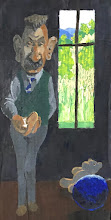
Sam and Marissa are here tonight brewing. The beer is his Mad Scientist India Pale Ale. Sam says it’s entirely experimental and he doesn’t plan to make it again. He plans to test it on his friends this Halloween. Mwahaha!

When he started, the house smelled pleasantly like downtown Peoria. Or St. Louis near the Ralston plant. (I haven’t been in either city since the sixties, and for all I know both are now entirely sweet-smelling.) There’s a lot of malt in this brew, and the beer should be strong. After it came to a boil, and he had explained the proteins’ unwinding and rewinding, Sam added baskets of hops from the garden. Now the house has a perfumey-citrusy smell. Boy, you got the place smellin’ like a Kansas City fancy house.

The three gallons of water, malt, and hops will boil for an hour, with occasional stirring. Toward the end of the boil, Sam will add more hops. At the end of the hour, he’ll take the kettle outside, and dunk a copper coil into it. Running water from the garden hose through the coil will cool the liquid, which is called “wort,” and pronounced “wert.” Like a good permaculturist, Sam will water plants with the runoff. Yeast goes into the cooled wort, and the whole mess goes into a seven-gallon bucket, with enough additional water to make five gallons, and a little gadget on top that lets air out but doesn’t let air in.

Two weeks from now, he’ll siphon the liquid off, leaving a layer of yeast behind, add some more water, and let the proposed beer sit for four more weeks. (The water at this step wouldn’t be necessary, if he had used dried hops instead of what he’d just found by the alley. It’s a matter of volume.) More yeast settles out, and the beer and some corn sugar go into a keg to grow bubbles.

Sam already has his costume, a white lab coat. He plans to smudge it with charcoal, blacken his face, and make his hair stick out wildly with gel. Marissa is keeping her costume a secret.

Friday, September 4, 2009

Objects In Your Mental Model Are Larger Than They Appear

The cars are actually larger than the fire hydrant. You didn’t need me to tell you that.

The distance from one thousand to ten thousand is much greater than the distance from one to ten. You didn’t need me to tell you that either, but in my own mental model of counting, they’re about the same size. As far as I know, I don’t have any kind of numerical disability. Barbara is quicker at mental arithmetic than I am, but I get along. I think my distorted model is my own version of scientific notation. You know: how you write ten with the little bitty nine in its upper-right corner instead of one comma zero zero zero comma zero zero zero comma zero zero zero. You gotta admit “ten to the ninth” is smaller.

New Yorker cartoonist Saul Steinberg hit on the same thing geographically when he mapped the US as seen from over an anonymous Manhattan street between Eighth and Ninth Avenues. The Hudson River and New Jersey are a pair of stripes (The Hudson's broader than Jersey's) between New York City and the rest of America, which, in turn, is only a little larger than the distance between Ninth and the River.

There’s a lot of psychological and economic literature about how we’re more generous to “identifiable victims” than we are to “statistical victims,” even if there are more statistical victims, or if the statistical victims suffer more than the identifiable victims. The World Food Program dubbed hunger the “Silent Tsunami,” after the 2004 Indian Ocean tsunami that killed a quarter million people. A quarter of a million people seem like they must be a statistic -- as are the ten million that were impoverished by the wave -- but they were “identifiable” because of the dramatic event that killed or dispossessed them. The tens of millions of people who are hungry become more like background. As do the species extinguished by the “Sixth Great Extinction.” As does the atmosphere.

Our ability to foreshorten distant, huge, or complex things is probably a permanent way of operating for most of us, but being aware of it, and learning to override it is too.

Thursday, September 3, 2009

Retirement An Option For Baby Boomers?

“Do we have a moral responsibility to retire?” Minnesota Public Radio blogger Bob Collins asks the question on his September 3 News Cut blog. He’s responding to a September 2, New York Times story, “A Reluctance to Retire Means Fewer Openings,” by Catherine Rampell and Mathew Saltmarsh.

Geezers took a major hit to our savings in last fall's economic correction. That's keeping poeple in the workplace who might otherwise have taken our shoulders from the wheel, and made room for young people.

Collins gives us a yes-or-no gadget for voting on a question where our opinion will have approximately zero influence, and which begs for nuance. Collins may or may not have a dog in the fight, but you might answer one way or the other because of what you think work means, here in the developed world, at this moment in history.

Our dependence on fossil fuels means we live in less than a zero-sum economy: With few exceptions, what you do reduces human wealth, and you get paid in what amount to chits for your share of the remaining oil wealth your team manages to claim. If you think that’s okay, or just the human condition, vote yes so somebody else gets a chance. If you think it means trouble for Homo s., vote no and get to work.

Wednesday, September 2, 2009

Life Drawing Group


Tuesday night is drawing co-op. Ten or so middle-aged artists hire a model each week and take turns hosting, with wine and snacks. It’s sort of like a book club, only with nudes instead of literature.

My degree, such as it is, is in art, and I’ve been part of similar drawing groups before. My drawing is pretty good, although my hand isn’t super-steady. I’ve always had a kinesthetic sense of which direction my line is going --not just right and left, and up and down, but in and out. I like a sense of space and volume. Besides having a good sense of space, in the last couple of years I’ve gotten pretty good at proportion.

Making pictures is fun, but it’s always in the back of my mind that my art is subordinate to something else, describing a better way we could live. For a while I was drawing from a model three times a week, all day on Wednesdays, and wishing I could find two more sessions. I was working mostly in charcoal, trying to develop a style similar to Henry Yan’s. I was also interested in a Russian-New Mexico contemporary of Hopper’s and O’Keefe’s, Nicolai Fechin. I kept doing the same things, not making progress, and forgetting that I was learning this skill to communicate. Stony, a friend from another co-op was pretty skeptical of art’s being able to influence history, but that’s another discussion.

Tuesday is my only group now. I enjoy my friends’ company -- they came to my birthday party -- and a weekly workout helps me remember how to draw. It ain’t exactly like riding a bike.

Tuesday, September 1, 2009

Answering Stewart Brand's Four Environmental Heresies

It was so startling a contradiction of how I would make the world, that I watched the video four times, practically transcribing it the third. For someone to take the problems of population, hunger, and climate change as seriously as I do, then concoct this paradoxical way of fixing them, seemed so important that I put a hold on one of the five copies of the book the library has on order.

We are at a dangerous moment in history. There are too many of us, and the things we do to get by degrade the world’s ability to keep us -- and to sustain other living things. We are altering the Earth’s climate. We concentrate wealth to the point of extravagance so as to avoid the deprivation we see in our wake. Somebody claimed this species uses forty percent of the planet’s photosynthetic capacity. We are in peril of extinction, and in denial of the peril. We have acquired god-like powers in a mickeymouse way, well in advance of getting the understanding needed to wield them.

Along comes Stewart Brand, the creator of The Whole Earth Catalog, and now Whole Earth Disciplines. In a sixteen-minute presentation, “Four Environmental Heresies,” given to TED, Brand claims that overpopulation and industrially driven climate change demand:

* Concentration of the developing world’s poor into cities (this is already a fact, and the longest and strongest part of Brand’s presentation documents it);

* Nuclear power;

* Genetic engineering;

* Geo-engineering (introduction of steam and gases such as sulfur dioxide into the atmosphere to mitigate climate change).

Brand reminds us before he begins of his environmentalist credentials, which are genuine. Brand studied biology at Stanford, particularly ecology and evolution. He is famous for conceiving and editing The Whole Earth Catalog, and its many later incarnations. As part of California Governor Jerry Brown’s administration, Brand helped to increase Californian energy efficiency and reduce the state’s carbon emissions with incredible foresight. He is serious, knowledgeable, and sincere.

Brand is a thinker who understands how systems grow, change, and decay. He reminds us that climate is a “profoundly complex, non-linear system full of runaway positive feedbacks, hidden thresholds, and irrevocable tipping points.” (This means that climate has many parts which influence each other. Changes can make more of the same bad thing happen. Once changes reach certain levels they can make other systems change (permafrost thaws and releases more carbon dioxide; higher levels of freshwater enter the oceans, braking the existing currents). Systems will reach levels that make fixing them impossible.

Brand says to expect surprises, few of them good. The “heresies” are his prescription for curing a sickness that will end civilization.

My own prescription is to mimic nature and integrate with it. Human beings should accept it that we are part of the web of life, and find fulfillment by fully participating in the flow of energy from species to species. Our problem so far has been that we have tried to cut a separate deal with existence, using technology to funnel and store energy in novel ways. Humanity has improved its survival and comfort by force, force to expand its range, force to grow food, and force to exert dominance within the species. An organism does what an organism has to do, but it seems as though the same ingenuity that invented bulldozers and automatic rifles could discover how to become one among a community of species.

I’m least interested in disputing Brand’s developing-world urbanization. It’s a fact that one sixth of humanity now lives in squatter cities. Brand shows us what look like vital, outlaw neighborhoods in places like Bangkok, Mumbai, and Sao Paulo. Their residents chose to go to these places, and Brand calls them “population sinks,” saying that population growth quickly drops to replacement levels there. Short of forced repatriation to the countryside, it’s a done deal. (What Brand wants from us industrial democrats for the squatters is water, electricity, sanitation, and protection from crime. The squatters should be connected to the countryside by good roads, cell phone service, and grid electricity.)

Still, it seems like a mistake. It seems like most people should be producing food. Here’s E. F. Schumacher, in Small Is Beautiful:

"The cities with all their wealth, are merely secondary producers, while primary production, the precondition of all economic life, takes place in the countryside. The prevailing lack of balance, based on the age-old exploitation of the countryman and raw material producer, today threatens all countries throughout the world, the rich even more than the poor. To restore a proper balance between city and rural life is perhaps the greatest task in front of modern man. It is not simply a matter of raising agricultural yields so as to avoid world hunger. There is no answer to the evils of mass unemployment and mass migration into cities unless the whole level of rural life can be raised, and this requires the development of an agro-industrial culture, so that each district, each community, can offer a colorful variety of occupations to its members."

Schumacher was writing in the early seventies. Maybe nobody was listening, and we’re going to be looking at some of that runaway positive feedback in the population system soon.

Objections to nuclear power include poor reliability, high capital costs, damage to the environment from uranium mining and from cooling-water discharge, unknown decommissioning costs, unknown cost for storing spent fuel, radioactive wastes’ remaining dangerous for longer than we could expect continuity of supervision, plant safety and public health concerns, vulnerability to attack, utility as part of national military nuclear strategies, wastes a components in “dirty bombs.” Brand scores points by showing that the volume and mass of nuclear waste is dwarfed by the waste from coal, and contained, while coal's waste is dispersed throughout the atmosphere.

The partial meltdown at Three Mile Island happened in 1979. There were no deaths at the time of the Three Mile Island meltdown, with disputed claims of increased cancer incidence subsequently. The explosion at Chernobyl happened in 1986, resulting in fifty-seven deaths at the time, and four thousand thyroid cancers among children and adolescents exposed at the time. The United Nations Scientific Committee on the Effects of Radiation reports no cancers from ongoing exposure. Nuclear power proponents will excuse the Chernobyl disaster as the result of poor design, and a corrupt political system, but can the world restrict nuclear power to countries of high competence and moral character, and can we expect governments and businesses to persist for the half life of plutonium which ranges from eighty-eight to 81 million years?

You have to wonder, too, how many of these things do we need, and how quickly can we build them. The Tennessee Valley Authority’s Watts Bar plant was the last nuclear power plant to come online in this country. Begun in 1973, it opened in 1996. Twenty-three years in the making. Brand dismisses wind and solar (although he hints at orbiting solar) because it’s diffuse and intermittent. We don’t have the renewable technology now to replace coal -- and, in fairness to Brand he is talking about widely distributed plants as small as one forty-eighth the size of existing nukes -- but Brand’s timetable can’t be brief. We want to be warm, have light, and keep our food cool. The techs I know who are still in the conservation business are still finding ways to save megawatts.

Beyond a list of objections to nuclear power, there’s the question of how does radioactive stuff integrate with the ecology of this planet. What’s this stuff got to do with life? If I want to come into my own as Homo sapiens, be everything and exactly what I’m able, do I want to fool around with nuclear power? Janine Benyus, author of Biomimicry: Innovation Inspired by Nature, says “When you look at the natural world you see that organisms do not use high heats or high pressures or toxic chemicals to achieve their ends.” I want conservation and high-level human innovation.

In genetic engineering, genes are transferred from one organism to another. Some modified organisms are transgenic -- genes come from other species -- and some are cisgenic -- genes come from other members of the same species. We’re worried about the transgenic organism, I think, because we could probably breed something similar to the cisgenic ones, or they might even happen spontaneously.

Why are we worried? Health, economics, and the integrity of existing populations are three reasons, with the third affecting the other two.

If you are allergic to a one food but not to another you could have a reaction while enjoying the supposedly safe food that was grown with DNA from the allergen. Given the frequency of people with severe food allergies, genetically engineered foods complicate too many people’s lives.

And the strange genes don’t just find new homes under human auspices. Researchers have found DNA from engineered strains of corn in ancient Mexican varieties of maize. The corn’s jumping the fence is more than a curiosity. Contaminating the antique plants denies us information from the past, crowding out unknown useful traits.

Canadian canola grower Percy Schmeiser ran up a four hundred thousand dollar legal tab, when Monsanto’s Roundup Ready variety of canola contaminated the variety Schmeiser had bred over fifty years. The Canadian Supreme Court found that Schmeiser had infringed Monsanto’s patent by planting seed he’d gathered from the contaminated crop. The Court didn’t do more than spank Schmeiser’s hand, but it set precedent, and four hundred thousand dollars in legal fees stings. On legal advice, Schmeiser destroyed his entire stock of seed, losing the result of a fifty-year breeding program. Interestingly, the question the case decided, can a life form be patented, has been decided differently in other countries, including the United States, but we can expect Monsanto and others to argue that it can be in all venues where it operates. The big objection has to be the way this concentrates wealth, turning any serious farmer, whether in the developed or developing world, into a Monsanto franchisee.

Genetic engineering is redundant for Brand’s purposes. Brand’s concern, a very real one, is preserving the soil. Standard agriculture wastes soil, a limited if not finite resource. Eroded into streams and ocean, it’s pollution. Besides that, soil stores carbon, and turning it releases carbon dioxide into the atmosphere. Genetic engineers introduce genes into crops that allow the crops to survive herbicides. This lets farmers eliminate competing weeds without disturbing the soil.
But “no-till” farming isn’t necessarily chemically intensive. Planting trees and other perennials together, and grazing animals in the same area -- planting what permaculturists call “guilds” builds and preserves the integrity of the soil without using engineered crops. Researchers, most famously at Kansas’ Land Institute have and are developing perennial strains of wheat, sorghum, and sunflowers. The Rodale Institute has developed equipment to mulch a cover crop and plant a cash crop in one pass, building the soil and preventing weeds organically, and without genetically engineered seeds.

Timothy LaSalle, CEO of the Rodale Institute writes, “Why spend the time, money and scientific ingenuity manipulating a handful of genetic materials to end up with a specific new attribute when we should, and could, be rigorously advancing regionally adapted varieties and building up soils organically to achieve enduring nutrient content cycling and resistance to drought, flood and disease resistance.”

When it comes to adding sulfur dioxide to the atmosphere or atomizing seawater to make the planet shinier, it’s so hard to take the scheme seriously, that part of me thinks it must be one of those so-crazy-it has-to-work ideas. I don’t know how to evaluate it, except by doing it and seeing what happens. Probably nobody else does either. Brand shows a photograph of the Mt. Pinatubo eruption, which put twenty million tons of sulfur dioxide into the atmosphere and cooled the planet by half a degree in 1991. This improved polar bear habitat to the extent that there was a bumper crop of cubs, dubbed the “Pinatubo Cubs.” Brand shows a slide of two cute bear cubs.

If the only unintended consequence of geo-engineering were an ursine population explosion, I’d probably vote yes, but this seems like a definite time to exercise the precautionary principle. Nature puts greenhouse gases into the atmosphere, too, but look what our adding to those has brought us.

Brand mentions that any medium-sized economy could geo-engineer, so maybe the genie will come out of the bottle, will we, nil we. And, to quote Brand, we are all down-wind. He says that nations would consider each other’s unilateral attempts to alter climate acts of war, which is probably appropriate. The diplomacy that would allow concerted geo-engineering might be healthy, in that it would demand nations and their citizens to recognize the fact that Earth is a single system. But let’s not tell North Korea about it.

I owe my exposure to a lot of what’s inspired me to Stewart Brand and the Whole Earth. I learned about the first book that I ever read energetically, Paolo Soleri’s City in the Image of Man in the Whole Earth Catalog. There’s a long list of books and ideas that moved me that either came to me via Whole Earth, or which Whole Earth encouraged me give a second look. Buckminster Fuller, Ayn Rand, permaculture, Kimon Nicolaides’ The Natural Way to Draw, Gregory Bateson, Christopher Alexander’s A Pattern Language, the Hernandez Brothers’ comic Love and Rockets, one crude little cartoon by Michael Phillips concerning the relationship between income and ecological footprint. My guess is that Brand is smarter than I am, not necessarily by a lot but some, and I know he’s more disciplined.

Then what’s the deal here? I remember reading a comment of Brand's to the effect that if cancer were ever cured, it would be by a kid with a Gilbert chemistry set. The unlicensed, untaxed cities devised by third world squatters must appeal to him in the same way that the spontaneous hippie solar and geodesic communes of the late sixties did. Certainly Brand knows all the objections and alternatives I’ve mustered. His friends invented the ideas I've built my world from. Why does Brand propose the heresies?

Brand’s a libertarian, a point of view I don’t understand. Still, it seems strange that I can’t do the math that must connect libertarianism and an authoritarian program. My feeling, instead, is that Brand’s heresy comes from his idea of what is possible. There are fortunes to be made and power to be claimed in building a nuclear, genetic and geo-engineered world. These solutions are proprietary, and belong to the already powerful. While solar tinkerers, permaculturists, and farm-equipment improvisers are disorganized and dispersed, nuclear power plant builders and big ag companies have the means to promote their interests and grease the political wheels to make change happen, then find the big credit necessary to ramp up production in a hurry. The "heretical" solutions also have the benefit of demanding the least from the complacent. So we solve the problem of global warming at the cost of other environmental problems. And at the cost of indenturing ourselves more deeply to concentrated wealth.

It’s a devil’s bargain, and Brand tries to enlist us, reminding us that the tragedy of Darfur is a climate change war, and that it is the world’s poor, not we, who will suffer most. He says that we “are as gods, and we need to get good at it.” Yes, we are at a critical moment in history, but that makes it all the more important that we leave certain fruit on the tree.

Monday, August 31, 2009

Swales, Grape Juice, and Environmental Heresy

I’d hoped to post a critique of Stewart Brand’s “Four Environmental Heresies” today. Brand told a TED conference that population and climate-change demand developed-world squatter cities, nuclear power, genetic engineering, and squirting the atmosphere full of chemicals to screen out and reflect sunshine. (TED is a non-profit whose job is to spread "great ideas." TED stands for "Technology," "Entertainment," and "Design.") My idea was to use my own doubts to illustrate the idea that The Rabbi’s Cat (August 28) is more universal than “Jewish.”

Two or three problems cropped up over the weekend.

* As I wrote, I became less doubtful that Stewart Brand is full of beans;

* I’m still working on it;

* Unfinished, it’s at twelve hundred words, and I promised myself to run less at the mouth.

Besides reading and writing, I picked grapes and juiced them. The amount of time growing my own food takes continues to amaze me. Call it research? Call it an investment in something that will get us through future desparation? Call it doubt.

Another chore was mulching Rain Garden One. A year ago, not understanding how water moves underground, I dug a swale below an apricot tree I wanted to water. I planted annual rye and clover, and got a mess. In an effort to get the mess off my desk, and spare my nice young neighbors my weed patch, I sheet mulched it.

The cardboard boxes that Jason and Barbara buy their almonds in lie flattened on the sod. On top of that go city wood chips. I’ve threaded the downspout from the roof under the cardboard. It remains to be seen if I will step on the pipe, or find it clogged with dirt, vegetation, and wood chips. Eventually -- maybe October -- I’ll dig a shallow trench and fill that with sand -- sort of an ad hoc cistern. Next year, the entire area gets herbaceous perennials. Who knows what. Eventually-eventually, there will be other swales here and there throughout the yard to hold onto water that currently runs NNE to SSW, and into the alley and storm sewer

"Four Environmental Heresies" tomorrow.

(In the picture, we’re looking NW toward the next-door duplex. The little plant at the base of the apricot is prairie clover. We’re looking over purple coneflower, and I’m steadying the camera on the compost bin. The sheet on the ground nearby covers Babara’s drying onions. Some of the foliage at the left margin is the Haralson apple tree.)

Friday, August 28, 2009

The Rabbi's Cat Reviewed By A Catholic Kid From The Midwest

There was a class, more of a book club really, about Jewish comic books. It was at a St. Paul library, in the Highland Park neighborhood, led by a perfesser named Judith Katz from the University of Minnesota. Every week it was a different book:

Will Eisner’s A Contract with God;

Art Spiegelman’s Maus;

Ben Katchor’s Julius Knipl, Real Estate Photographer;

Joann Sfar’s The Rabbi’s Cat.

I won’t say I was the only Paddy there, but -- turnabout is fair play -- I was in the minority. The interesting thing is that I was in another minority. I thought that The Rabbi’s Cat was the least Jewish of the bunch.

Sfar’s characters were the least goyische, orbiting the family of a Sephardic rabbi in pre-war Algeria. We attend two temples, listen to daily prayers, bury a respected elder, and sit down to dinner with Abraham, the titular Rabbi, to “witness the least kosher meal in the universe.” The comic fairly drips with menorahs, Stars of David, and Torahs. Nobody’s going to mistake the characters for Lutherans.

Sfar appears to draw directly, no underdrawing, color coming later, probably some markers or watercolor, but largely digital (a nice cool counterpoint to the red-hot penwork). Sfar says what he does as akin to jazz soloing, and a casual reader might say the art is naive. It isn’t smooth, but it’s very sophisticated. (It would be good to note that Sfar is French, but the lettering in the translation harmonizes with the rest of the art; he seems to have re-lettered this long book in a second language!)

The Cat narrates the story. Cat, Rabbi, and The Rabbi’s twenty-ish -- and dishy -- daughter, Zlabya, live comfortably together. Cat eats parrot; acquires speech. Cat wants Bar Mitzvah. Rabbi’s rabbi says no. Rabbi undertakes Cat’s religious instruction. Cat blasphemes and loses speech. Young rabbi, Jules, comes to town, courts Zlabya. Couple weds against The Cat’s wishes. All four go to Paris to meet Julius’ parents. Rabbi and Zlabya fight. Rabbi sleeps in Catholic church, has very secular adventures, enjoys convivial smoke with very-assimilated fellow father-in-law. Rabbi returns to his congregation, preaches cheerfully perplexed sermon.

There’s a Rabbi’s Cat II, but it isn’t the same. Everybody runs around having adventures, there’s a certain amount of commentary about racism, and it’s a lot of fun. The Rabbi’s Cat is closer to Huckleberry Finn. Two characters in Huckleberry Finn drift aimlessly through a series of comic adventures, but the account manages to show Huck’s growth, as he comes to recognize his companion’s humanity, in spite of conditioning that tells him he will go to “the bad place” for acting on the recognition.

The Cat in Rabbi’s Cat is a conceit for The Rabbi’s turmoil. He solves the problem of a noisy parrot by eating the bird. He scatters the papers on The Rabbi’s desk. At night he prowls the neighborhood, and “teaches” the female cats “a thing or two.” Convinced that one of The Rabbi’s students, a self-important know-it-all, is a hypocrite, The Cat follows him to an Arab brothel. Eager to report, he’s met with “The commandment ‘Thou shalt not kill’ counts malicious gossip as a blood crime” from The Rabbi. The Cat answers, “So?”

When the pair visit The Rabbi’s rabbi about The Cat’s Bar Mitzvah, the older rabbi’s objection shows he’s stiff-necked, and more than a little goofy. While they read by a fountain, having just been evicted from a restricted cafe, they are interrupted by a congregant with an inane question of law (this is where, I think, The Rabbi goes, "Who cares, but..."). The Rabbi’s best friends are a desert will-o-the-wisp cousin who is a law unto himself, and a sheikh who may be another cousin, and the wisest character in the book. Zlabya and Julius ask Abraham’s permission to marry, and he wants to forbid it, but knows he can’t. The Rabbi mopes around the garden, but The Cat, now silent, goes off on a silent rant about mortality, as though Abraham could forestall decay and death by withholding consent.

Abraham is any man of sixty, losing the child who always and only belonged to herself, and confronting the limits of the philosophy by which he has steered his life. The events in the story are the occasion for his doubts’ and insecurities’ becoming inescapable. Mortality and tautology are part of the human condition. You have to be particular to show the universal. Sfar gives us the universal in spades.

Thursday, August 27, 2009

Hops In The Urban Permaculture Plantation

The picture is of Sam’s hops. Hops are a perennial vine, very prolific, and essential in beer making. Sam is my son, and an amateur brewer.

There are two mature hop plants, Chinook and Centennial, both very bitter and used to flavor American pale ale, Indian pale ale, or jes’ plain pale ale. Chinook and Centennial are both on branches about eight feet long, taken from a lilac. Sam says the branches could have been fifteen feet long. I believe him. These are very lush plants.

A friend has given Sam another plant that currently looks like green wires cut short just above the sod. It’s either Nugget, another bitter hop, or Fuggle, which is milder.

I can’t say much about the plant itself, about what it looks like underground, what good it is to those of us who aren’t brewers, or what it might add to or need from a permaculture plantation. An old rocker back home, Roger Vail, had me smoke it, but Roger has a peculiar worldview, and it didn't do nothin' for me. I like the occasional pale ale, and Sam appears to be an afficionado, so hops seem like an obvious choice for the urban farm.

No barley, though. I’m running out of room.

Grape harvest today, and a brief stint at the Open Arms kitchen.

Wednesday, August 26, 2009

Ben Bernanke At Industrialization's End

Nobody wants to pull the emergency brake on a runaway train. If you try to make it stop, it may jump the tracks before it would have. At the least, you’ll have flattened the wheels. If you just let it go, it’s gonna crash, but they won’t point at you.

In the real world, we’re talking about the economy, and Hope Boy’s stop-lossing Ben Bernanke.

Bernanke is a Viet Nam-generation economist, who wields enormous intellectual firepower. Taught himself calculus in high school, Harvard summa cum laude, PhD from MIT, etc., etc. He taught at Stanford and NYU, then chaired Econ at Columbia. He’s been a Governor at the Fed since 2002, and Chair since 2006. Somewhere in there he chaired Commander AWOL’s Council of Economic Advisors.

Actually, I kind of like him. The Bernanke Doctrine (spoken in portentous basso profundo) is why. Bernanke is an expert on the causes of the Great Depression, believing that the Fed’s having reduced money supply, consequently reducing access to credit, caused the economy to tank in the early thirties. He’s a bear on deflation, and the Bernanke Doctrine would:

* Increase the money supply;

* Ensure liquidity;

* Lower interest rates, even to nothing;

* Control yield on corporate bonds;

* Depreciate the dollar;

* Buy lots of foreign currency;

* Buy industries with depreciated money.

Cowboy up, Ben! But two caveats from me. First economics has a moral dimension. Sorry, that's just the way it is. If the government is going into business, it should find opportunities beside hookers and blow. Or dissipation and pollution, which brings up the second warning. There are various economic cycles, the well known five-year boom and bust cycle of recession and recovery, based on consumer spending. Mainline academics are coming to recognize a fifty-year cycle based on capital spending, too. There are resource cycles, housing cycles, technology cycles, and so on. One cycle that hasn't crashed -- yet -- is what we call the Industrial Revolution.

In the first half of the eighteenth century, European deforestation forced conversion from charcoal to higher-quality fuel, coal. From this came steel production on a grand scale, steam power, and mass production. The second half of the nineteenth century gave birth to the petroleum industry. Oil, an even higher quality fuel than coal, accelerated technological and scientific innovation, giving us the weirdly comfortable life we know.

Resource depletion, and -- can you believe it -- saturating the planet’s capacity as a pollution sink have brought us to the point of changing our modus operandi again. This time in heroic ways that make the shift from charcoal to fossil fuel look like reaching for a book of matches. It’s pretty exciting, and I’m doing what I can, but somebody’s got to pull corporate capitalism's brake cord.

Pulling the cord would amount to recognizing the moment we have reached, and the necessity of choosing how we will live. Maybe whether we will live. Bernanke's willing to finance economic recovery by treating money as the abstraction it is. So far, so good. The problem is the moral dimension: Ben's going into the hole to do it. There's nothing you can do that can't be done, and so on, but somebody has to let you have the stuff to do it. They're going to want something later. Whatever we do with inflated cash has to pay, or we wind up with a lot of debt and no production. Cars and guns won't do it. Given our moment in history, making anything other than a world in which we and our heirs can sustain ourselves on solar gain puts us against the wall. And not everybody's green.

Good luck, Dr. Bernanke.

Tuesday, August 25, 2009

Buckminster Fuller

Buckminster Fuller was born a few months before my mother’s father, and eight years before the Wright brothers flew. It was the time when electrical utilities, telephones, and movies were novelties. Fuller’s lifetime went from cowboys and locomotives to astronauts tending geo-synchronous communication satellites. Hunger became less common during Fuller’s lifetime, and quality of life improved radically.

He was severely myopic, something nobody noticed until Bucky started school. Later, he said that his impairment forced him to pay attention to large patterns, and made him less likely to prejudge the things he studied. The United States Patent Office awarded Richard Buckminster Fuller twenty-eight patents, and he invented his own geometry (he would say he discovered nature’s coordinate system), but Fuller claimed that he didn’t set out to create the things he did. His goal was to improve the life of every human being, and he might have come up with “flying carpet slippers” if that was what the world needed.

Inventing what the world needed was his lifework. Those needs, and the way the world could work to provide for them, were the big patterns Bucky worked with. The world is the beneficiary of practically limitless solar and gravitational energy. A worldwide effort to discover how to provide for ourselves, a “Design Science Year,” would bring what Buckminster Fuller called “four billion billionaires as yet wholly unaware of their good fortune,” into their inheritance.

Monday, August 24, 2009

Bike Safety And Hard Times

Barbara and I were talking (in the car) about why people get angry with bicyclists. I’d gotten angry at a biker who, behind me on my right-hand sidewalk, had blown our stop sign and surprised me as I turned right. I knew he was there, and I dropped the ball by not tracking him. Barbara said she’d read speculation that bikers irritate drivers because drivers are afraid of how much we can hurt them.

I get mad at them because they’re boneheaded morons who do any fool thing they want, and expect me to cover for them because of their relative weakness. Barbara thought that relative weakness might evoke a sadistic impulse among a certain kind of driver.

So we have three different reasons drivers might feel unfriendly toward bikers:

1 Drivers are afraid of injuring the slower, lighter, and more exposed bikers;

2 Bikers’ vulnerability brings out the bully in drivers;

3 Bikers are themselves rude and provocative.

When I was in grade school, circa 1960 and in a town of about ten thousand, a couple of firemen would come to our school and tell us how to ride our bikes safely. (There were no female firefighters then, and I don’t know why it was the FD and not the PD.)

Apparently this practice is gone with the wind, or a lot of bikers weren’t paying attention that day. Some of riders who do the inattentive biking are adults who look like they aren’t used to bicycles. They aren’t the wiry, Lycra-clad yuppiletes, with shaved legs and funny shoes, but often wear jeans or slacks and smoke. I infer that biking is a recently adopted expedient. Circumstances recently obliged them to find more economical transportation than their ‘93 Catalinas, and they said, “How hard can it be?” A sign of hard times.

Recently my neighborhood paper, the Corcoran News, printed a story on bike safety (“Bike Safety” by Tiffany Smith, July 2009). Here are that story’s recommendations:

“Seek to be seen by acting like a vehicle:

“Ride on the street, with traffic. Bicycling on the sidewalk is illegal in some parts of the city, and dangerous to both pedestrians and cyclists. It’s easy for drivers to accidentally hit fast-moving cyclists coming off sidewalks, where drivers don’t expect them.

“Use front and rear lights at night.

“Ride predictably: signal your intentions and avoid swerving.

“Follow all traffic lights and stop signs.

“...but ride defensively and don’t assume drivers can see you.

“Avoid getting ‘doored’ by people exiting parked cars. Give the cars several feet clearance and look for taillights or other signs of imminent door-opening.

“Watch for right-turning vehicles driving next to you -- they could end up in your path.”

Riding a bicycle isn’t for sissies. You’ve got to do it mixed in with much faster and heavier vehicles, driven by drunks, rage-aholics, and cell phone users. You need to know what you’re doing, stay tough, stay courteous, and pay attention like you’re operating a sheet metal brake.

Friday, August 21, 2009

Cider Station

The White Elephant Exception

The Beacon is prolific this year, and we’re losing a lot of apples because we can’t keep up. Barbara and I pick them and gather windfalls, with -- say -- six person hours going to gathering and sorting maybe five bushels. Thursday night I had a serious juicing session, cutting apples, tossing spoiled pieces, and running pieces, mostly quarters, through the Champion juicer. Three hours yielded a little less than two gallons.

It was discouraging to see what value the apples put on my labor. Sometime in the future, I’ll network with other urban apple growers, and use larger equipment, saving time. Better planning may shorten the time we spend gathering by getting me up in the tree early, and avoiding windfalls, which are more likely to spoil, and require more time spent sorting. I may get ahead of the curve this year with the grapes and the Haralson, whose apples are supposed to be better after a light frost.

But what is labor worth? A former career had me driving and dispatching interstate buses. With a motor coach, you can take forty-five people and their luggage one mile for less than a dollar, assuming four-buck diesel. Let’s have the bus break down a mile from the terminal, and walk the passengers and their luggage in at two miles per hour. Let’s be generous, and say the fuel cost a whole dollar. Split the dollar forty-five ways. That’s about four point forty-four cents per hour.

The comparison is absurd, because no one could live in this economy on four cents an hour, but there are people, some in desparate circumstances, some in non-cash economies, who live on less. The poorest Americans are richer than two thirds of the world’s people, and increasingly that two thirds is are aware of how well we live. Saying that many of them are indignant would probably not be putting it too strongly. (No comment on class issues within the US, beyond a prediction that the reality I just described will reduce wealth unevenly.)

The US amounts to five percent of the world’s population, and we use something like a quarter of its wealth, sometimes frivolously, often carelessly. I don’t know if it’s possible, but I’d like to beg an indulgence from the people whose share of the world’s goods helps keep me in the pleasant style to which I have become accustomed.

We’ve built an infrastructure that demands a disproportionate share of the Earth’s wealth. If we live, henceforth, with utmost rectitude and thrift, individuals will still have the cost of operating within this extravagant playground. Give us a generation or two to learn to live well and change our way of life. Some of us have a vision of how all human beings can live harmonious and becoming lives into the distant future.

Thursday, August 20, 2009

Got To Find A Way...

Thirty years ago San Francisco writer Anne Herbert wrote that God kicked us out of the Garden because we started keeping score.

About the same time, biological polymath Gregory Bateson said what happened was that Adam and Eve were so full of themselves, because they’d managed to pick the forbidden apple, that they kicked God out of the garden.

Maybe one is a different way of saying the other. Adam and Eve made nature’s purposes subordinate to their own. Scorekeeping amounts to subordinating nature (play) to our vanity. I most definitely keep score, but I’m trying to break the habit, invite God back into the garden. Permaculture is my method, learning to provide for myself in a way that mimics -- and integrates with -- the rest of the biological world.

This is a picture of a young grape vine (given to me, variety forgotten) trellised on the Beacon apple tree. The physical closeness of the two plants isn’t part of a deep ecological relationship. The grape gets a place to hang out, but I can't think of what the apple gets from the grape. In fact, the grape doesn’t naturally grip the slick apple bark, and needs me to tie it up. A defense against vines, maybe, evolved by apple trees? Permaculturalists say that growing food in “guilds,” combinations of plants that do things for each other, yields less per plant but more per acre than monocrops.

Maybe a grape trellised on an apple is getting close to the critique that permaculture is an attempt to mimic climax ecosystems, systems at a stage when they don’t yield a lot of food. I don’t know. You can’t learn less.

Wednesday, August 19, 2009

King Of The Wood Chip Mountain

The city crews leave their tree-maintenance wood chips at four sites I know of. We use a lot of this stuff for paths and mulch. We lay cardboard or newsprint first and layer wood chips over that. It’s great weed control. Underneath, the soil is softer and moister. A couple years ago, I went around trying to push a sharpened rod into the ground. Usually it went in a foot or eighteen inches. It went in as far as I wanted to push it in the mulched areas.

Minneapolis has a lot of elms, but I don’t think that the wood chips are from them, because spreading elm chips would spread Dutch Elm Disease. We did harvest a single morel mushroom once, though. Morels are symbiotic with elms, and sometimes appear when the trees are removed, but they are also symbiotic with ash, apples, and cottonwoods, all part of the urban forest.

There were three peaks and I’m still learning to take photographs. It seems like the camera is good at getting a likeness, but doesn’t show space very well. I tried to show scale and depth with the shovel and watering can in the picture. The people in the background help, too, but the picture still seems flat.

This Is Yesterday's Blog

It was a busy day, fetching wood chips, mulching the rain garden, gathering windfalls from under the beacon, and -- of all things -- mowing the grass. Next year, I should plan better so that building and maintenance projects don’t happen during the harvest. Write this down: The Beacons come in the first half of August.

The picture of the anthills comes from the driveway that I sealed last week. Quote from Ian Malcolm, the Jeff Goldblum character in Jurassic Park: “No, I’m simply saying that life, uh...finds a way.”

***

I tried to post this Tuesday night around nine. I couldn't connect with Blogger. Like I said, I'd been busy, and part of the busyness was frustrating. I tossed the above together so I could say that I'd blogged for my twenty-fifth straight weekday. When I couldn't get on, it took me a while to figure out that the problem wasn't at my end.

My sour grapes are that computers and the internet are not -- repeat not -- a way of giving democratic voice to the world, but a way of concentrating wealth. I've touched this tar baby, and I'll never see the brier patch again.

Monday, August 17, 2009

Studying The Farmer's Market

It was a farmer’s market weekend, and tiring. Saturday, New Hope, a second-ring, western suburb, and Uptown, a younger, urban neighborhood on Sunday. It’s interesting that very light work, really just playing with people, can be so tiring. Barbara says it’s the standing.

I think I agree. It’s on pavement, with no real opportunity to move around.

Each market has a different style. The same kinds of people show up at each venue, but in different proportions. Uptown is younger, of course, and whiter, also more bohemian and gayer. New Hope is more Scandinavian and Baltic, local stock of long standing, with more African Americans, too. Midtown is more of a mixture, white people of more southerly or westerly extraction, with more East Africans and fewer African-Americans than New Hope. Midtown seems closest to being a party.

Saturday, at New Hope, rain threatened all morning, but never materialized. At one point, a Met-Life blimp flew over, wallowing in the turbulence. I watched it with the guy from the Hmong vegetable stand on our left. I told him it would make me seasick. Either that or it would be more fun than any roller coaster ride I've been on.

Across from us, the woman selling Verti-Gro vertical hydroponic systems seemed to be having a good time talking about her product. I talked to her and her husband, Meredith and Keith Henderson, after the market. They are both enthusiasts, and have a large system in their yard.

The basic system stacks four perlite-filled Styrofoam tubs above a nutrient tank, with a pipe rising through the center of the column to keep everybody’s roots damp. The kit on display was pretty lush with strawberries. There’s a 16-pot kit, and a 16-pot extension you can add to that. Watching the Verti-Gro booth all day got me thinking. A kid with with the space and the energy could use a Verti-Gro system to model one of John Todd’s “living machines” as a Science Fair project.

Todd designs systems that process sewerage or aquaculture runoff using plants, basically ecological microcosms.

Here’s what the kid would do. She’d filter the aquarium water with the hydroponics, her first iteration being a concept demonstration, sacrificing an unfiltered tank as control. Subsequent experiments and research would include sizing, pH buffering, food production (both fish and vegetable), and safety (particularly regarding coliform bacteria). For the right student, this project could continue through college and grad school. Increasingly, human welfare will depend upon economics’ congruence with ecology, and a food-production system which runs one cycle with another's waste is how we’re going to make it.

Sunday we borrowed Tom and Kim’s van for the Uptown market. (That’s their monarda/bee balm and Earth flag.) Barbara opened the Kingfield market, and Jason relieved her. Using the van made it possible for me to have a vehicle loaded and ready when Barbara swung back to help me set up at Uptown. That market opens later, to accommodate its patrons’ somewhat more laid back Sunday mornings. Using a van was luxury. It’s possible to pack everything for a farm stand into a subcompact, but it’s a puzzle. Having all that space made loading quicker as well as physically and mentally easier.

Friday, August 14, 2009

The Driveway Is Coated

I would have gotten the seal coat on in a solid five hours. Unfortunately the block of time had a two-hour crack in the middle. Once again I’d underestimated how much material I’d need, and went back to the suburban big box for three buckets of sealer. I would have rather gone to River-Lake Hardware, two local guys who’ve been at the same address on East Lake Street since before Barbara and I hit town. They were the ones who sent me to the ‘burbs, and I have to admit that stocking as much petroleum product as I used (twenty-four gallons of asphalt and additives in various proportions) would take too much space in that little, old-fashioned hardware store.

The numbers favor shopping locally when you can. The 3/50 Project says that sixty-eight bucks out of every hundred spent stay in the community when you spend locally, but only forty-three when you buy from a national chain. Beyond that, I’d say that keeping the local economy healthy has other advantages. Multiple local competitors mean you’re not at the mercy of a home office that might mothball a store that wasn’t sending enough cash back home. One store out of many closes, and you can shop across the street; the local big box shuts and supplying your project or dressing your kids gets more involved. Family businesses model commerce for children. Once, long ago, I read that millionaires were more likely to have been the children of family businesses, restaurants, taxicabs, etc. Not that I approve of concentrated wealth, but we’re a commercial species, and business is an art.

Barbara had taken the car, so I got on the train, grabbed the care, and picked up three more buckets of seal coat. I almost got it all covered with two, but had to grudgingly pry open the last pail for less than ten square feet.

In a can’t-learn-less moment, I saw that the salt I’d put in some of the cracks had risen through the tar to whiten spots on my clean, flat, black surface. I have a couple of other reservations about my job, but they’re more like questions. I’m pleased and curious to see how the driveway fares this winter.

And Barbara told me I’m brave.

Thursday, August 13, 2009

Executive Says "American Health Care Killed My Father"

Breakfast was oatmeal with lots of apple slices from the Beacon.

Barbara and I were listening to National Public Radio when Steve Inskeep interviewed David Goldhill, the author of a forthcoming Atlantic article, “How American Health Care Killed my Father.” Goldhill, a media executive, believes that a consumer-driven health care system would produce better results at lower costs.

Goldhill’s key evidence is his father’s death at the hands of a negligent hospital. The story is that the hospital admitted the senior Goldhill -- who was suffering from pneumonia, and who subsequently died from sepsis contracted there -- then billed Medicare in excess of 600 thousand dollars. The telling detail of the story is Goldhill’s stopping a routine, billable blood test in the final hours of the deathwatch. Goldhill contends that things would have been different had the hospital been obliged to present the bill to his newly widowed mother, instead of to a federal bureaucracy. Goldhill's father died because he was not the hospital’s customer.

In one of those coincidences that make me believe in synchronicity -- or a liberal conspiracy involving Public Radio producers -- a local story followed soon after, in which a practitioner of consumer-driven health care was accused of fraud, if not negligence. The Minnesota Attorney General is suing Express Health chiropractic clinic over its practice of obtaining high-interest credit cards for patients, sometimes without the patients’ knowledge, and pre-billing the patients for procedures. Chiropractors do Workman’s Comp and liability business, but their customers and patients are usually one and the same.

On another commercial-medical front, insurers are historically skittish about covering psychological health. I can’t help wondering how many billable hours psychologists and psychiatrists have spent barking up the wrong theory on the patient’s very own dime.

There’s no denying the truth of Goldhill’s story or its implications, but iatragenic death is the exception, and we consult physicians because we want to be whole and comfortable, and we want to delay death. We are often neither informed nor rational about those things, and I like the idea of a third party keeping everybody honest and up-to-date.

I believe in commerce, but luck, too. In a world in which resources and griefs are unevenly distributed, and in which wealthy people organize to protect and increase their wealth, devil take the hindmost, I’ll go for the public option.

Wednesday, August 12, 2009

Not Enough Bugs

It doesn’t seem like a good year for insects. I’ve only counted seven butterflies in the garden, in spite of having a nice crop of purple coneflower, as well as gallardia, zinnia, and prairie star. The cricket chorus, which begins around the end of July, was a little late this year, and seems less robust than usual. I’m used to hearing a loud, pulsing drone, which may be a certain kind of bug’s song, but which I think of as different crickets’ harmonizing. Against the background of the chorus, I listen, as I lay me down to sleep, to two or three neaby soloists. This year the drone is practically faint, and there’s less nearby chirruping.

Barbara, who is one of those people who is attractive, or at least more noticeable, to mosquitos, says she hasn’t been bitten much this year. No cloud without a silver lining, but I still wonder if the insects are suffering. It was a dry spring, so skeeter hatches were fewer and smaller. What influences butterfly and cricket proliferation? Being an environmental paranoiac, or at least alert to possibility, I have to wonder, have we pushed the envelope too hard. On the other hand, populations rise and fall. When I used to hang out in the woods, I thought some years were good fox years, or quail years, some lean. In the mid-nineties, turkeys, which I’d never seen in those parts before, began to appear. Succession happens without our interference, but we are actors on the ecological stage.

How do I know, and how do I know what to do about fewer insects, whatever my species part in their decline might be. They’re pollinators and prey for birds, whose welfare also sffects me.

I got all the major cracks in the driveway filled. I feel like I cut corners. I didn’t cover the places where earlier seal coats had split into alligator patterns, and I could have smoothed out places where there’s a lot of aggregate showing. Instead, I stopped when I ran out of filler. I found a few places where I’d left roots, and I went ahead and covered the dry woody things. The next step is to squeegee the seal coating itself over everything tomorrow. I’m curious to see how that goes, and I’m curious to see how my job stands up to the coming winter.

Tuesday, August 11, 2009

Beach Tar On My Feet

Here’s a still life for you. The tubs and the jugs are both crack filler, the tubs about three and a third gallons and the jugs just under a gallon. Nine and a third gallons of goo, poured or troweled into driveway cracks, with maybe as much again still needing to find a home. Somebody who’s done this chore before is going, “Just how big is your driveway, and how long did you let it go?”

Twelve hundred square feet. A long time.

I thought when I started this chore that just the three jugs would do it. I went back to the suburban, big-box this morning for more, and I thought that would be enough. Nuh-huh. Some of the seams between drive and outbuildings (garage and shed) are fist width. I’m going back this evening.

The goo in the jugs is asphalt, clay, plastic, and water. It comes out of the jug darker than either, and of a color somewhere between the Chicago River at Michigan Avenue, and the Mississippi at Cape Girardeau. It dries to that nice, shiny tar black. The stuff in the tubs looks like the same formula, and the colors are the same, except that the manufacturer has added sand and it doesn’t get shiny.

The tubbed stuff gets my vote. You have to trowel it, and it doesn’t spread as smoothly, but the sand adds bulk, and I’ve got seams and holes I’d never fill from the jugs.

Will I ever finish this chore? The next trip is my last. I’m not going back. Still, Barbara says this would cost us three grand or better if we got somebody else to do it.

Monday, August 10, 2009

Step On A Crack...

I finally got the weeds pulled from the cracks, and used the hose for a little hydraulic mining and final clean up. The pavement got nice and clean. My feet were bare, and whenever I felt a piece of grit underfoot, my inner nag would go off about tracks on its nice clean floor. Three boxes of salt, and the brine from three jars of moldy pickles went into the cracks -- low-tech herbicide. I await dry pavement before filling cracks with the gooey residue of Carboniferous-Period ferns.

I wish I had carried the Wild Edibles field guide as I weeded. I’d murder a plant, and wonder, "What the heck was that?" Then I’d think, I can’t interrupt to go look it up. The plant I’m most curious about came in clumps, with lots of slender stalks growing from fat, tender roots. Those were impossible to pull. Each one of those, boy, left part of itself behind.

I finished almost in time for Democracy Now. Caught up during “For the 64th Time: No More Nuclear War,” Daniel Ellsberg, Frida Berrigan, and Pervez Hoodbhoy, commemorating the 64th anniversary of the nuclear destructions of Hiroshima and Nagasaki.

Saturday, Secretary of State Clinton said that the Indo-US Nuclear Agreement wasn’t conditional on India’s signing the Non-Proliferation Treaty. In the Agreement, India says it will keep its civil and military nuclear facilities separate and place all its civilian reactors under International Atomic Energy Agency safeguards. The US will transfer technology and expertise, to India, and help out financially.

India has at least forty nuclear weapons, and no more than 110. It tested its first in 1974. It has begun a fleet of nuclear submarines. Pakistan is its chief rival, although India and China have a history, and look out for certain neighbors to its west.

Can a society keep its military and civilian nukes separate? If nothing else, there’s social feedback, with both sides conditioning people’s images of themselves as nuclear players, for good or bad. Civilian and military engineers will know each other at university, and instructors will have both in the same classes.

There were cities devastated by conventional weapons during World War II -- Tokyo and Dresden most notably -- but those firestorms took fleets of bombers and lots of bombs. Hiroshima and Nagasaki each suffered from a single weapon, dropped from one B-29. Nuclear weapons are attractive because they make total destruction economical.

On the civilian side, nuclear power promises to keep us rich and fat after oil, and reduce greenhouse gases. The net energy of any alternative to fossil fuels is less than what the thing produces. It takes energy to build a power plant, deliver fuel, monitor the thing, and -- in the case of nuclear power -- keep it safe for longer than Homo s. has existed so far. Maybe nuclear pays, but the margin is smaller than you think. Besides, if we use new technology to prolong the current orgy of television and internal combustion, we will never grow up, never fully realize the potential of the gray stuff behind our eyes, our birthright. Conservation, radical conservation, will spare us the energy cost of building many of any kind of energy source, and preserve more liberty. (There is another point of view that tempts me, but I don't have the vocabulary to evaluate it, yet. It's exponent here, Stewart Brand of Whole Earth Catalog fame, believes that nuclear power and genetically modified crops are compassionately necessary, maybe critical to human survival.)

The Beacon apples are ripe and abundant, with a big grape harvest hard on its heels. We're starting to pick and preserve.

Friday, August 7, 2009

Visualizing Whirled Peas

A rainy morning kept me inside doing housework and writing a couple of letters I’d put off (from the level in the tank, it looks more like an inch than half an inch of rain). Radio tuned to MPR then Democracy Now.

We didn’t lose as many jobs last month as we did the month before (we must be expecting a U-shaped recovery);

48% of homeowners owe more than their homes’ values (is there some rule of thumb relating depth of recession to consolidated wealth?);

Five Marines died in Afghanistan;

We nailed five Afghan farmers with an air strike;

A former Bush official sees a continuity of Bush policy within the Obama Administration (I went for Obama at my precinct caucus because Edwards was gone by then and Obama seemed the less likely Bush-Lite to me);

It looks like Obama wants to delay closing Gitmo.

There’s more, but it never ends.

I’d write somebody, but do I have to write one note for each item, or can I just say, “Be good.” Besides, Ralph Nader says the White House doesn’t reply to him. Fifth District Representative Keith Ellison is usually on the side of the angels. I send him the occasional e-mail.

The truth is, governments aren’t as smart as two-legged geniuses like you and me. Some leaders are genyewinely dumb (no names), some are corrupt (again I’m not mentioning any names), some are beholden to party or funders, some to mistaken worldviews (Ellison is a Muslim, which speaks well of his integrity, but poorly of his horse-pockey detector), and they all are trying to ride the runaway train of a society that changes too quickly, a world approaching its limits as resource, and as pollution sink.

When trying to “visualize world peace,” I don’t see gauzily dressed peoples of all nations dancing through a mountain meadow in a ring. Or bald monks meditating before raked gravel at Ryoan-ji. I see justice, and some of that has to come from a recognition by us wealthy that the Earth is a commons. Mostly, though, it has to come from some threshold number of us cultivating justice through abundance.

I might hope for a little cover from my government, but I don’t see it.

Thursday, August 6, 2009

Pulling Weeds

I’m lying on my belly in the alley. Our driveway is the dirty slope on the left. I’ve been pulling lots of weeds, for my sins, preparatory to filling the cracks they're in and seal-coating the driveway. I mentioned this in my Post-Apocalyptic Salad blog. What you’re looking at is dirt that collected where the driveway asphalt is lower than the alley concrete. You can see some of the vegetative devastation, too. Weeds, feel the wrath of Tom! Two alleys make a tee here, which explains how I can be on my belly in the alley and looking across another alley at somebody else's garage door.

It’s probably criminal abuse of tools, but the best thing I’ve discovered for yanking weeds out of cracks is a pair of needle-nosed pliers. I also use a screwdriver and a putty knife to scrape and pry. I tried my fingers, and wound up leaving a lot of root below grade. Fire from a propane torch was likewise useless: tops blackened, but there was plenty of juice only nanometers below. Ancient herbivores were browsing weeds long before hominids started chipping flint and laying asphalt, so weeds have adapted, and I expect new growth, even through seal coat, from tissue left behind. Gretchen, fellow scullery volunteer at Open Arms of Minnesota, suggested salting the cracks, and I may so do before applying petroleum products.

Something interesting I’ve discovered is that purslane, for all its above-ground branches, has but a single root, only a few short hairs wisping from it. A small white carrot.

I’ve thought about dentistry as I’ve worked, and I’ve thought about cancer surgery, but only a little, recognizing that there are similarities between weeding the driveway and removing decay or treasonous cells from a body. I dig in and try to get all of the offensive growth. In case I miss something, I leave a little poison (salt) behind to thwart new growth.

I’ve also thought about succession. Cracks appear in rock/asphalt for whatever reason. Winter moisture freezes in the cracks and enlarges them. Soil and seeds drift into the cracks. One plant makes things congenial for another. Some make the environment cozy for animals, ants mostly in the driveway. Animals plant more seeds. Maybe it’s coincidence, but there was a pretty messy mix of purslane, quack grass, eensey-teensey ants, and a couple of other things where I took the picture. Still, I couldn’t help thinking of some permaculturists I met who kept getting volunteer raspberries next to their hazelnuts.

Interesting as all of this may be, I'd rather have questions. Answers make me too comfortable, and I haven't come up with many questions. So far only, "Should I add the soil in the picture to my garden? Does the city salt the alleys? (Maybe not; I've never seen them do it; nobody's speeding there; I've fallen nether bits-over-teakettle on slick ice under fresh snow; I'll call.) If it does salt the alleys, is the salt still in the dirt?"

Wednesday, August 5, 2009

Blocking the Street With the Neighbors

Tuesday night I joined some of my neighbors for the National Night Out. There was police tape blocking access the 3400 block of 22nd Avenue’s top and bottom. Mid-block there was a long table with pot-luck dishes we all brought, and a circle of chairs for conversation. Looking north and south, I could see similar arrangements in the next blocks. Most attendees were women, we men played a game in which we tossed two-ball bolos at hurdles made of PVC pipe.

The idea is to dampen crime through neighborhood solidarity. I buttoned up the house before I took my lemonade to the party.

It’s good to get to know, or at least recognize my neighbors. As the egg splashes off the fan, being able to trust the people around us is going to matter more and more. Some neighbors didn’t show, and I think there are a couple of feuds happening. The mother of the kid whose friends are accused of several years of vandalism was there, and that’s a good thing. I thanked Bill, who’s an alley presence because he restores cars in his garage, for interrupting a couple of kids who were going to tag our shed. I’d heard about his having done that, but it turned out it was the duplex’s garage. Thanks, anyway. It helps.

Post-Apocalyptic Salad

The green stuff in the picture is purslane. My Peterson Field Guide to Edible Wild Plants: Eastern and Central North America recommends chopping it up and adding it to salads. It’s not bad, but there wouldn’t be a major flavor or texture contrast, and it would take a lot of the stuff to bulk the salad up. Peterson also says you can grind flour from the seeds. Somebody must have tried it, maybe Roger Tory Peterson himself, but the flowers are tiny, so the seeds must be microscopic.

I’m going to seal-coat the driveway, so I’ve been cleaning the cracks in the asphalt. This was such a good specimen, I had to snap the picture. The book is about a quarter century old, so not up-to-date, but still true. I don't know whose the skull is. I found it in Illinois' oak-hickory woods.

There’s a Sufi story (and there are probably as many Sufi stories as there are rabbi stories) about a man who starved to death because it never occurred to him to eat his dog. We may be eating a lot of purslane soon (lamb’s quarters is another common alley green, and it’s supposed to be among the most nutritious). I’ve been eyeballing the squirrels, too.

Tuesday, August 4, 2009

I Can't Read Our Permanent Address

The text lettered on this painting is the last paragraph in this post.

I painted this around 1990. I’ve tried to pin the date down by remembering where I got the canvas. It’s a piece of muslin, with a crude print in green and white of an elephant and foliage. You can still see a ghost of the design from behind. It was an employer’s cast-off, but I can’t remember whose, and I changed jobs about the time I painted it.

The picture of the dome-dwellin’ hippies who have just converted a VW Bug into a horse-drawn buggy does a pretty good job of illustrating the quote, taken from the writings of a biologist and inventor named John Todd. When I started painting, I wasn’t thinking of putting words in. I tried a couple of things to fill the foreground around the car. They didn’t work. I’d been researching John Todd a year or so earlier, and lifted an appropriate passage. My sloganeering reminded Barbara and me, both, of a bunch of semi-trailers we used to see in Lamoille, Illinois (just a little north of where US 34 crosses I-80). Some put-upon soul was using them as billboards in his public relations war with the county. There were a couple hundred words of argument, and we’d see them after a few hours of driving and just before we were due at Barbara’s father’s, so we never stopped, and we never learned what the megillah was about.

(No responsible horse owners would ever allow that fencepost with the loose bobwire in their pasture. I liked the way it kept my eyes from leaking off the canvas, though, so I left it.)

I entered the painting in a group show, back in April. It was the occasion of a couple of conversations with other, more painterly and less “anecdotal”, artists. The conversation that I remember most, though, was with a friend who dropped in to support me. Mark thought the quote was incomprehensible, and probably thought the reason was ostentatious vocabulary. I’ve tried since then to rewrite it, but I haven’t been able to keep its meaning, and make it more accessible, without making it longer.

Maybe somebody else could take a stab at it.

“Tomorrow is our permanent address. It is the structure or morphology of a system that determines its behavior and subsequently its fate. The coefficients or parameters within a system
determine only rates and relative dominance. This distinction is significant since current attempts to adapt technological society to changing conditions are focused on coefficients which are not fate-determining.”

Monday, August 3, 2009

Commerce At the Farmers' Market

We were at the Kingfield Neighborhood Farmers’ Market. Kingfield happens on Sundays, and its feeling is different than Midtown’s. There are customers who are dressed for church, but there are other differences. Kingfield is a neighborhood with more multi-family housing, and more managerial- and professional-class homeowners. I was startled when a well dressed man paid for his bag of almonds from an unsorted wad of twenties and other bills he carried in his front trouser pocket. There were two hundred dollars knocking around loose in this guy’s pants.

I came back from emptying the trash, and Barbara was talking with a tall and pregnant young woman. She had been one of Sam’s grade school classmates, but I didn’t recognize her. She designs clothing and sells it at farmers’ markets.

When she was a teenager, it looked like S. was destined for a prominent career in classical music. Barbara told me that S. had relayed news of other classmates, speaking proudly and maybe wistfully of their accomplishments. Barbara said she had told S. that what S. is doing stands out as interesting and consequential.

We’re a commercial species, and commerce has gotten out of control so that it exists for its own sake, instead of being the way that we exchange goods and services, develop skills, and learn to work with each other. S. is helping to re-establish commerce on a scale that doesn’t demean the people who operate it.